Page 1 of 1 The F2012 is the fifty eighth car built by Ferrari with the express purpose of taking part in the Formula 1 World Championship. It adopts a well established tradition of being named after its year of manufacture.
The project, which goes by the internal code number of 663, constitutes the Scuderia's interpretation of the technical and sporting regulations that apply this year: the main changes when compared to 2011 concern the height of the front section of the chassis, the position of the exhaust pipes and the mapping for the electronic engine management. Practically every area of the car has been fundamentally revised, starting with the suspension layout: both the front and rear feature pull-rods, aimed at favouring aerodynamic performance and lowering the centre of gravity. The front wing is derived from the one introduced on the 150° Italia in the final part of its racing life and has been evolved from there. Further evolutions are planned in this area for the opening races of the season. The nose has a step in it that is not aesthetically pleasing: with the requirement from the regulations to lower the front part, this was a way of raising the bottom part of the chassis as much as possible for aerodynamic reasons. The sides have been redesigned, through modifications to the side impact structures, the repositioning of the radiators and revisions to all aerodynamic elements. The lower part of the rear of the car is much narrower and more tapered, a feature achieved partly through a new gearbox casing and a relocation of some mechanical components. In recent years, the area of exhausts has been crucial in terms of car performance and much effort was expended on this front, based on changes to the regulations introduced this year. The rear wing is conceptually similar to the one used in 2011, but every detail of it has been revised and it is now more efficient. Naturally, it is still fitted with DRS (a drag reduction system,) which is operated hydraulically. The front and rear air intakes for the brakes have been redesigned and work was carried out in collaboration with Brembo to optimise the braking system.
The engine in the F2012 is an evolution of the one that powered last year's car, which is inevitable given that the technical regulations forbid any modification to internal components aimed at increasing performance. Furthermore, much effort has gone into improving its installation in the new chassis, so as not to penalise the aerodynamics of the car. Another area on which the Maranello engine specialists have been working is performance drop off, with the aim of maintaining the highest possible performance level throughout each engine's cycle of use, which has now reached an average life of three races. The electronic management of the engine has been revised based on the modifications to the rules regarding the use of exhaust gases, a task that has required a great deal of attention and many hours on the test bed. The kinetic energy recovery system maintains its low central location in the car - a choice also aimed at maximising safety - and has undergone an update directed mainly at reducing its weight and at improving the efficiency of some of its components. Several decades of technical collaboration with Shell has seen further progress on the fuel and lubricants front, revolving around improving performance in absolute terms and on durability over the life cycle of the engines, as well as reducing consumption. As usual, great attention has been paid to the electronics on the car, especially in terms of reducing weight and, obviously, reliability.
As always at Ferrari, a great deal of time has been devoted to the performance and optimisation of the materials used, right from the design stage of each of around six thousand components that make up the car. In part, this is done to ensure that all operations carried out at the race track are as efficient and effective as possible. Obviously, quality control remains a crucial aspect, as does the goal of reaching maximum levels of performance and reliability, while maintaining the highest possible safety standards.
With a reduction in the number of days available for track testing before the start of the Championship, which has dropped from fifteen to twelve, preparatory work on the test beds prior to the car's track debut, has taken on even more importance. The three test sessions - at Jerez de la Frontera and Barcelona - will serve to get a picture of the handling of the F2012 and to adapt it to the Pirelli tyres. Indeed, getting the most out of the tyres has been an area that has seen a lot of work both at the design stage and in how the activities at the track are to be managed. The car is due to undergo a very intensive development programme over the first part of the season, especially on the aerodynamic front. Page 1 of 1

 Ultimatecarpage.com
> Cars by brand
> Italy
> Ferrari
Ultimatecarpage.com
> Cars by brand
> Italy
> Ferrari
 Racing cars
> Formula 1
Racing cars
> Formula 1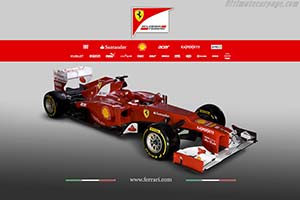
 The F2012 is the fifty eighth car built by Ferrari with the express purpose of taking part in the Formula 1 World Championship. It adopts a well established tradition of being named after its year of manufacture.