Go to Ultimatecarpage.com

Car search: Quick Advanced 
  Ultimatecarpage.com  > Cars by brand  > Italy  > Ferrari
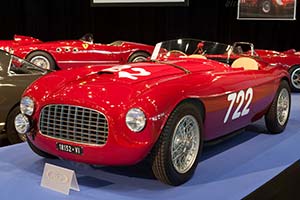
166 Fontana Spyder Corsa
Cars statistics: 5054 cars, 430 makes, 39392 images; Events statistics: 215 reports, 41349 images; Forum statistics: 85,353 members, 41,968 topics; more...


  Ferrari 166 Fontana Spyder Corsa
 

Ferrari 166 Fontana Spyder Corsa Ferrari 166 Fontana Spyder Corsa Ferrari 166 Fontana Spyder Corsa Ferrari 166 Fontana Spyder Corsa Ferrari 166 Fontana Spyder Corsa Ferrari 166 Fontana Spyder Corsa
Click here to save all images    Image credits: Wouter Melissen 

Model history:
Click here to download printer friendly version In the early 1920s a young Enzo Ferrari entered the racing world as a moderately successful driver, it was not until the end of the decade when formed his own racing team, 'Scuderia Ferrari', that he made a lasting mark. By bringing together Italy's finest engineer and driver, Vittorio Jano and Tazio Nuvolari respectively, Ferrari created a winning package that would dominate the sport in the early 1930s. When Alfa Romeo decided to decrease their racing efforts the independent Scuderia Ferrari replaced the official racing department. Initially cars were assembled from parts supplied by Alfa Romeo, but from 1936 completely new Grand Prix racers were designed and constructed.

After being closely involved with the Milanese firm for almost two decades, Ferrari felt it was time to really spread his wings in 1937. Although Scuderia Ferrari was officially independent, the relationships between the two were so intertwined that Enzo had to agree on not making cars under his name for four years to get out of the contracts. While the rest of Europe was now actively involved with the Second World War, Ferrari was busy constructing his first cars. Complying with his agreement he had formed a new company called Auto Avio Construzioni. Introduced in 1941, the '815' was a combination of various Fiat mechanicals and a custom body. Only two cars were built before the War reached Italy.

During the War all production was aimed at military supplies and the various factories were spread out around the country for tactical reasons. Ferrari's workshop was moved from Modena to nearby Maranello and focused on constructing ball bearing grinding machines. Soon after the fighting was over, Enzo continued work on a new racing car, despite the high demand for his machines. He unsuccessfully tried to employ Vittorio Jano to design his new car, but found a very good replacement in Gioachino Colombo. They had already worked together before the War when the Scuderia Ferrari was developing new racing cars for Alfa Romeo with the 158 single seater as their finest product.

Ferrari understood that the demand for the exotic cars he proposed to construct would not be very high in a world preoccupied with reconstruction. He gave Colombo the difficult brief of designing a drivetrain and chassis that was versatile enough to attract a broad audience. In 1946 the engineer drew up a straightforward tubular frame and a 60 degree V12 engine not dissimilar to his last projects at Alfa Romeo. A displacement of 1.5 litre was chosen, which in Naturally Aspirated form could power a sports racer and equipped with a Supercharger met the Grand Prix regulations. As per Enzo's request a five speed gearbox completed the package at a time when four speeds were the norm.

Rejoining Alfa Romeo, Colombo did not stay long enough for the designs to materialize and Ferrari was on the lookout again for a new chief engineer. In the meantime draughtsmen turned the designs into usable drawings and the first engine parts were cast halfway through 1946. Construction of the chassis frames was outsourced to Gilco, who completed two similar frames in September of 1946. A month later Aurelio Lampredi joined the engineering team to help develop the engines, which suffered from various teething problems. In November Enzo Ferrari officially announced a range of three production cars all sharing the 1.5 litre V12 engine. It was referred to as the '125', as a reference to the unitary displacement; a naming policy that was to be used for many decades to come.

It was not until March of 1947 that the first car was ready to drive around on its own power. Two weeks after the testing commenced, Lampredi left to leave the team of young engineers without a leader once more. By May two distinctively different Ferraris were ready to make their competition debut. The first car featured a fully enclosed roadster design, while the second was equipped with a rather ugly cycle fender body. Two accidents for the cycle fender car and a heavily smoking engine in the roadster disguised the potential of the Ferrari 125 at its debut in Piacenza on May 11th. A fortnight later Franco Cortese drove the roadster to the manufacturer's maiden victory in only their second race!

Throughout the season the racing efforts were combined with the continuous development of the two cars. To take on more powerful cars, the V12 engine's bore and stroke were increased to yield a displacement of 1908 cc and the cars were renamed accordingly as 159. A third car was constructed in the summer and equipped with a newly designed cycle fender body. Colombo returned as a consultant and immediately set out to alter the 159 engine with a significant increase in performance as a result. Raymond Sommer scored the company's first major victory in the Turin Grand Prix with the new cycle fender car, equipped with the Colombo modified version of the 159 engine.

While the new cycle fender style of the third car would form the basis of the first 'production' Ferrari, work on the engine was not over yet. Yet again the bore and stroke were increased, but only slightly to 60 mm and 58.8 mm respectively. The resulting 166 engine displaced just under 2 litres, making it still eligible for the popular sports racing class in Italy. Equipped with this engine, the Turin winner received serial number 002C was renamed 166 Spyder Corsa and sold late in December of 1947. In 1948 another seven cars were constructed from existing and new parts along the lines of '002C' before a second generation of all new racing and street cars was introduced.

Enzo Ferrari could not have picked a worse time to start as a car manufacturer, but due to his determination and excellent management skills he succeeded where many others had failed in even the most ideal of circumstances. Little over two years after the very first Ferrari had turned a wheel in anger, Luigi Chinetti and Lord Selsdon drove a 166 MM to victory in the gruelling 24 Hours of Le Mans race. The design Colombo had hastily drawn up in 1946 would continue to form the basis of much of Ferrari's racing and commercial success up into the 1960s, accounting for a vast majority of the manufacturer's class and overall victories at Le Mans.

It is not entirely clear what happened to the first two cars completed, but it is commonly believed both were rebuilt at the factory; 01C became 010I and 02C became 020I. The third car completed 002C still exists, but is fitted with a later engine and has been re-bodied several times. It has recently been restored to its original, Turin Grand Prix winning guise. With its engine dating back to 1946 and considering it still features its original chassis and body, Ferrari historians commonly refer to chassis 004C car as the oldest complete Ferrari in existence.


Chassis: 012I
Chassis 012I Completed in the spring of 1948, chassis 012I was one of the Spyder Corsas and the ninth Ferrari built. It was raced extensively by the Scuderia Ferrari with considerable success on road courses and hill climbs. At the end of the year the car was sold to Giovanni Bracco, who campaigned it in 1949, scoring victories in several hill climbs. Vittorio Marzotto was the next owner, and like most Ferraris owned by the Sicilian family, he had chassis 012I re-bodied by Fontana. The small coach-builder fitted the Ferrari chassis with a Touring-inspired 'Barchetta' body.

Giannino Marzotto entered the newly clothed car in the Targa Florio, where he retired to save the life of a friend and fellow competitor, as well as in the Mille Miglia where he placed ninth overall and sixth in class. Fontana was called in again at the end of the year and modified the body with a fastback hard-top roof. It is believed that the car was raced as late as 1955 before it was stored in a garage in Rome. The 166 Spyder Corsa resurfaced in the early 1970s and since then has past through various hands. During the 1990s, it was acquired by an American, who had it meticulously restored by Phil Reilly & Co. The work was finally completed in January of 2012. Fitted with a 166 F2 engine, chassis 012I was soon after offered by RM Auctions in their Monaco sale, where it changed hands for just over EUR 1 million.

Article by Wouter Melissen, last updated on June 08, 2012

Add your comments on the Ferrari 166 Fontana Spyder Corsa


General specifications
Country of origin Italy
Chassis number 012I
Numbers built 8
Produced in 1948
Body design Fontana

Past Sales

Engine
Configuration 60º V12
Location Front, longitudinally mounted
Construction light alloy block and head
Displacement 1.995 liter / 121.7 cu in
Bore / Stroke 60.0 mm (2.4 in) / 58.8 mm (2.3 in)
Compression 7.5:1
Valvetrain 2 valves / cylinder, SOHC
Fuel feed 3 Weber Carburettors
Aspiration Naturally Aspirated
Power 110 bhp / 82 KW @ 6000 rpm
BHP/Liter 55 bhp / liter

Drivetrain
Body aluminium panels
Chassis steel tubular frame
Front suspension double wishbones, transverse semi-elliptic leaf spring, friction dampers
Rear suspension live axle, semi-elliptic leaf springs, Houdaille friction dampers
Brakes drums, all-round
Gearbox 5 speed Manual
Drive Rear wheel drive

Dimensions
Weight 800 kilo / 1763.7 lbs
Length / Width / Height 3835 mm (151 in) / 1549 mm (61 in) / 1010 mm (39.8 in)
Wheelbase / Track (fr/r) 2420 mm (95.3 in) / 1270 mm (50 in) / 1200 mm (47.2 in)

Performance figures
Power to weight 0.14 bhp / kg

Resources
Related cars
Related articles
Useful links