Go to Ultimatecarpage.com

Car search: Quick Advanced 
  Ultimatecarpage.com  > Cars by brand  > Italy  > Alfa Romeo
6C 2500 S Ghia Cabriolet
Cars statistics: 5055 cars, 431 makes, 39426 images; Events statistics: 215 reports, 41349 images; Forum statistics: 85,363 members, 41,972 topics; more...


  Alfa Romeo 6C 2500 S Ghia Cabriolet
 

Alfa Romeo 6C 2500 S Ghia Cabriolet Alfa Romeo 6C 2500 S Ghia Cabriolet Alfa Romeo 6C 2500 S Ghia Cabriolet Alfa Romeo 6C 2500 S Ghia Cabriolet Alfa Romeo 6C 2500 S Ghia Cabriolet Alfa Romeo 6C 2500 S Ghia Cabriolet
Click here to save all images    Image credits: Wouter Melissen 

Model history:
Click here to download printer friendly version Introduced in 1939, the Alfa Romeo 6C 2500 was the result of over a decade of gradual development of the '6C'. Starting in 1927 with the 6C 1500, the six cylinder engined machines had served as Alfa Romeo's main production model but also scored numerous competition successes. The 6C 2500 would remain in Alfa's line-up until 1952 and is to this day regarded as one of the company's finest cars.

The main distinguishing feature compared to the outgoing 6C 2300 was the enlarged engine. This twin overhead camshaft straight six, originally designed by the legendary Vittorio Jano, grew in size from 2309 cc to 2443 cc courtesy of a slightly larger bore. It was available equipped with either one or three Weber carburettors. The triple was used for the top of the range 6C 2500 SS model, which also featured a high-compression head. In that specification, the engine produced a quoted 110 bhp.

Mated to a four-speed gearbox, the new engine was mounted in the existing steel ladder frame chassis. As before the suspension was fully independent, using twin trailing arms at the front and swing axles at the rear. Stopping power was provided by sizeable, hydraulically actuated drum brakes. The rolling chassis was available in three lengths; 3250 mm on the 'Turismo', 3000 mm on the 'Sport' and 2700 mm on the 'Super Sport'. A choice of companies offered coach-work for the 6C 2500.

In addition to the production road car, Alfa Romeo also developed a competition version for long distance events like the Mille Miglia and the 24 Hours of Le Mans. It featured an even higher compression and larger fuel tank and was known internally as the Tipo 256 for its displacement and number of cylinders. Although not victorious in the big races, the eight cars built scored several wins, most notably in the 1939 Tobrouk-Tripoli road rally. Sadly none have survived in their original condition.

6C 2500s kept rolling off the line well into the War but production eventually ceased in 1942. Alfa Romeo managed to safely store all the tools and moulds, so by 1946 the factory was already up and running again. There were no resources for major developments and the only difference was the adoption of lower compression heads to cope with the poor quality of the fuel available. From 1947 a column mounted gear-lever was fitted. In those early post-War years the 6C 2500 was the most expensive car available.

A majority of the 6C 2500s produced were clothed by Touring of Milan. The designs of their bodies evolved much faster than Alfa Romeo's chassis, making it very easy to distinguish the pre and post-War machines. The most famous is no doubt the two-door coupe that won the 1949 Concorso d'Eleganza Villa d'Este and was subsequently known as the Villa d'Este Coupe. Another body of note was the 'Freccia d'Oro' introduced in 1947. This large two-door coupe was welded to the chassis and was a precursor to the unitary chassis that would soon become the norm.

As early as 1948, Alfa Romeo developed a three litre replacement but this was eventually discarded for economic reasons; there was a much bigger market for a more affordable four-cylinder model. So when the final 6C 2500 rolled off the line in 1952, it truly was the end of an era. Accordingly, the 6C 2500 remains as the last of the great Alfa Romeos that dominated on road and track during the 1930s and 1940s.


Chassis: 915358
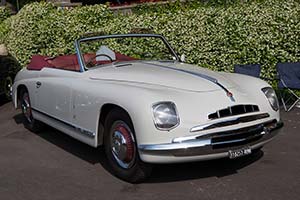
Chassis 915358 This is one of four 6C 2500 clothed by Ghia with a cabriolet body penned by Mario Felice Boano. The design stands out because of its smooth lines and the covered headlights. Of the four examples built, only two are believed to have survived. In recent years it has been completely restored by Quality Cars in Italy. Still in immaculate condition, it is seen here at the 2012 Concorso d'Eleganza Villa d'Este where it received the best in class award.

Article by Wouter Melissen, last updated on October 23, 2012

Add your comments on the Alfa Romeo 6C 2500 S Ghia Cabriolet

 Ghia Alfa........  
oldthudman
10-24-2012
Wow that is so ugly...........I'm almost ashamed to say it a Ghia........

Ghia usually designed and built lovely cars......
     

General specifications
Country of origin Italy
Chassis number 915358
Numbers built 4
Produced in 1947
Body design Felice Boano for Ghia

Engine
Configuration Straight 6
Location Front, longitudinally mounted
Construction cast-iron block, light alloy head
Displacement 2.443 liter / 149.1 cu in
Bore / Stroke 72.0 mm (2.8 in) / 100.0 mm (3.9 in)
Compression 7.5:1
Valvetrain 2 valves / cylinder, DOHC
Fuel feed Weber Carburettor
Aspiration Naturally Aspirated
Power 95 bhp / 71 KW @ 4600 rpm
BHP/Liter 39 bhp / liter

Drivetrain
Chassis steel tubular frame
Front suspension twin trailing arms, coil springs, hydraulic shock absorbers
Rear suspension swing axles, radius arms, longitudinal torsion bars, twin tubular shock absorbers
Steering worm-and-wheel
Brakes hydraulic drums, all-round
Gearbox 4 speed Manual
Drive Rear wheel drive

Dimensions
Weight 1550 kilo / 3417.2 lbs
Length / Width / Height 5200 mm (204.7 in) / 1800 mm (70.9 in) / 1500 mm (59.1 in)
Wheelbase / Track (fr/r) 3000 mm (118.1 in) / 1450 mm (57.1 in) / 1470 mm (57.9 in)

Performance figures
Power to weight 0.06 bhp / kg
Top Speed 155 km/h (96 mph)

Resources
Suggested reading
  • Alfa Romeo Tutte le Vetture Dal 1910, by Luigi Fusi
Related articles
Useful links