
 Ultimatecarpage.com
> Cars by brand
> Great Britain
> Napier-Railton
Ultimatecarpage.com
> Cars by brand
> Great Britain
> Napier-Railton
 Racing cars
> Pre 1950 GP Special Racing cars
> Pre 1950 GP Special
|
| Napier-Railton Special |
| Article | Image gallery (30) | Specifications | User Comments (3) |
|
|
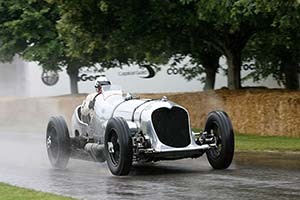
Page 1 of 1  Born into a rich family of fur brokers, John Rhodes Cobb had a keen interest in motor racing. In the 1920s he raced a wide variety of machines on the Brooklands track, usually with absolutely massive engines. Among them was a 10 litre Fiat, a 10.5 litre Delage V12 and Parry Thomas' infamous 'Babs' Special, which used a 27 litre airplane engine. The Brooklands circuit consisted of two sections of which the 2 3/4 mile Outer Circuit with its banked turns was the most interesting. Cobb broke the record on the very bumpy track in 1930 with the Delage and averaged close to 130 mph. Born into a rich family of fur brokers, John Rhodes Cobb had a keen interest in motor racing. In the 1920s he raced a wide variety of machines on the Brooklands track, usually with absolutely massive engines. Among them was a 10 litre Fiat, a 10.5 litre Delage V12 and Parry Thomas' infamous 'Babs' Special, which used a 27 litre airplane engine. The Brooklands circuit consisted of two sections of which the 2 3/4 mile Outer Circuit with its banked turns was the most interesting. Cobb broke the record on the very bumpy track in 1930 with the Delage and averaged close to 130 mph.By the early 1930s, the Delage, originally constructed in 1923, was showing its age and was frequently beaten by Tim Birkin's supercharged Bentley single seater special. Cobb commissioned local preparation experts Thomson & Taylor to purpose build him a racing car. The company's chief engineer was Reid A. Railton, who had previously assisted Parry Thomas and also helped design the chassis of a variety of other machines including the ground-breaing Low Chassis Invicta with its underslung suspension. He was assigned with developing the new racing car around a defunct aircraft engine from the Great War. There is no replacement for displacement was a well known principle even back then, so a 24 litre Napier engine was sourced for Cobb's new racer. Despite its massive displacement, the Napier Lion was relatively compact thanks to its three banks of four cylinders, W12 construction. The factory quoted 502 bhp at around 2200 rpm for the engine, but Cobb had his W12 modified to produce somewhere in the vicinity of 600 bhp. One can only imagine the amount of torque available. All this power was fed to the rear wheels through a purpose build three-speed Moss gearbox. Having to cope with the masssive and powerful engine, as well as with the bumpy Brooklands circuit, Railton drew up an incredibly sturdy ladder frame. Suspension was by underslung live axles on both ends and the rear suspension featured twin semi-elliptic leaf springs. The front suspension had single semi-elliptics, but did use twin friction dampers. The 'Napier-Railton' was clothed in a bare aluminium single seater body, built by Gurney Nutting. The completed machine was huge and weighed in at nearly two tons; fortunately size and weight did not really matter on a track like Brooklands. At the first tests, the tires proved to be absolutely inadequate, but Dunlop sorted the situation out in time for Cobb to debute the machine at Brooklands in August of 1933. He started off the Napier-Railton's racing career in great form by taking a win abd breaking a record first time out. It was a sign of things to come in the following years, which not only saw Cobb win numerous races at Brooklands, but also break several dozen (world-)records at Brooklands, Montlhery and on the Bonneville Sand Flats. With the Napier-Railton Cobb set the ultimate Brooklands lap-record of 143.44 mph, which stands to this day. After racing the Napier-Railton for several years, Cobb turned his attention to the Land Speed Record. Not surprisingly he had Reid Railton build him a new machine, this time featuring two engines. With it he broke the 350 mph barrier in 1938 and later raised the bar to 394 mph. Like Malcolm Campbell, he then went on a chase for the World Water Speed Record, sadly with tragic consequences; he fatally crashed on Loch Ness in 1952. He will be best remembered for his years behind the wheel of the Napier-Railton, with which he won many races and broke 47 world records. After Cobb's death, the car was bought by Sir Geoffrey Quilter, who adopted it to test parachutes. He fitted the car with disc brakes and a huge rig on the tail for the parachute mechanism. In the early 1960s the car was sold to a prominent historic racer. In 1963 he finished second in a contemporary Formula Libre race around Silverstone. In the 1970s, the car was fully restored, although the rear disc brakes were retained. After being in private ownership until the late 1990s, the Brooklands society managed to buy the Napier-Railton and it is now proudly displayed in the Brooklands museum. Quite possibly the most important surviving British pre-War racing car, the Napier-Railton Special took centre again in 2007 when the 100th anniversary of Brooklands was celebrated. It was featured in a variety of magazines and shown at several events. Among them was the Goodwood Festival of Speed, where it was driven up the hill on Sunday by actor/comedian Rowan Atkinson. Page 1 of 1 |
| Article | Image gallery (30) | Specifications | User Comments (3) |
| All Cars - Contact us - Privacy Statement - Top | © 1998 - 2026 Ultimatecarpage.com |