Go to Ultimatecarpage.com

Car search: Quick Advanced 
 groupc Ultimatecarpage.com  > Cars by brand  > Switzerland  > Sauber Mercedes
Racing cars  > Group C / IMSA GTP
     C11
Cars statistics: 5052 cars, 430 makes, 39334 images; Events statistics: 215 reports, 41349 images; Forum statistics: 85,345 members, 41,962 topics; more...


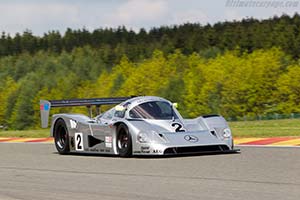
  Sauber Mercedes C11
 

Sauber Mercedes C11 Sauber Mercedes C11 Sauber Mercedes C11 Sauber Mercedes C11 Sauber Mercedes C11 Sauber Mercedes C11
Click here to save all images    Image credits: Wouter Melissen 

Model history:
Click here to download printer friendly version One of the first specialist manufacturers to build a Group C racer was Peter Sauber. This Swiss engineer and motor racing enthusiast previously constructed mainly small-engined sports-prototypes, so Group C was quite a step forward. He had teamed up with engine specialist Heini Mader and together they created the Cosworth engined Sauber C6 in 1982. The car looked very purposeful, but the badly vibrating V8 engine proved to be a reliability nightmare. In the following seasons, the Swiss team had a little more success with the BMW engined C7, but they could not match the Works developed Porsches and Lancias. The C7's biggest achievement was a ninth at Le Mans in 1983; preventing a complete Porsche top-ten.

Perhaps with the intention of securing factory backing, Peter Sauber asked Mercedes-Benz if he could use their brand new windtunnel to test his latest racing car. The Germans were clearly impressed and shortly after the wind tunnel test an exclusive engine deal was signed between Sauber and Mercedes. This effectively meant the return of Mercedes-Benz to sportscar racing for the first time since their withdrawal after the tragic 1955 Le Mans. The priority was to develop a race winning engine first before drawing too much attention and in the first few years of the cooperation, Mercedes-Benz was listed as an engine supplier only.

Sauber was particularly interested in the recently introduced, all-alloy five litre V8 engine, known internally as the M117. Mader was commissioned to turn this street engine into a full Group C powerplant by adding two KKK Turbochargers. With Group C fuel limitations in mind, the engine was not only developed for outright performance, but also to get sufficient mileage. In qualifying trim the engine easily produced 700 - 800 bhp, but in racing spec 650 bhp was the more sensible output. The newly developed twin-Turbo V8 was mated to a familiar Hewland five speed gearbox.

For the first Sauber Mercedes, the C8, Peter Sauber used the C7's aluminium monocoque as a basis. The Mercedes engine was mounted in a steel subframe directly behind the driver's compartment. All the other running gear was very conventional with independent suspension and vented discs all-round. Subject of the windtunnel test, the ground-effects body was indeed very efficient, although not very stable. At Le Mans in 1985 the sole Sauber Mercedes C8 entered recorded the second highest top speed, but also flipped on the Hunaudieres in practice. Although the car landed on its wheels, it was damaged too much to start the race.

The Sauber team returned the following year with two new C8 chassis, liveried in the dark blue Kouros colours. Both cars managed to start the race, but retired with engine and gearbox problems before night fell. Tweaks to the aerodynamics had made the cars more stable on the straights, but they weren't quite as fast as in 1985. One of the C8s was sold to privateer Noel del Bello, while Sauber and Mercedes were busy working on a replacement for the 1987 season. The C8 was raced twice more at Le Mans by the Frenchman, but again with little success.

Logically dubbed the C9, the 1987 Sauber racer was again a development of its predecessor. The rear suspension and the body were brand new, while the engine was a further Mader development. The Saubers made a better impression at Le Mans in 1987, qualifying seventh and eight. In the opening stages of the race, Johnny Dumfries was running as high as fourth before retiring with a gearbox problem after only 37 laps. The second car faired not much better, eventually succumbing to its second drivetrain related problems at around midnight.

Surprisingly Mercedes-Benz was not deterred and dramatically upped their involvement in 1988 to full factory backing. This paid off immediately as a Sauber Mercedes C9 was driven to victory in the Jerez 800 km, one lap clear of the dominant Jaguars. That year's Le Mans was an even bigger disappointment than the previous editions with both C9s forced to be withdrawn before the start. The combination of higher speeds and higher downforce had increased the loads on the tires too much, causing the rear tires to burst on one of the C9s at very high speed during qualifying. Starting the race was considered too dangerous.

For 1989 Mercedes-Benz provided a completely new development of the alloy V8 engine, known as the M119. The biggest change was a full four valve head with double overhead camshafts. This bumped the power to 720 bhp and 810 Nm in race spec. The new quad-cam V8 engine was fitted to the proven C9 chassis. The Germans' involvement in the Sauber program was visibly increased as the cars were now painted silver; a clear drawback to the successful Silver Arrows of years past.

For the fifth Sauber Mercedes attempt, the team again fielded two cars. All of the four difficult previous editions were quickly forgotten as the two cars were placed first and second on the grid. After a trouble free race, the two cars crossed the line in the opposite order, clinching a convincing one-two victory. The winning C9 was driven by Jochen Mass, Manuel Reuter and Stanley Dickens. The team kept the Le Mans winning form for that season's World Championship and with seven wins out of eight races, they were crowned World Champions at the end of the season.

Encouraged by the good results, Sauber developed a brand new car for 1990. The aluminium monocoque was replaced by a more modern and rigid carbon fibre one. The C10 name was skipped because it was difficult to pronounce in German, so the new car was dubbed C11. Much of the running gear, including the M119 engine, was carried over from the C9. Surprisingly the Swiss/German team did not return to Le Mans and instead focused on defending the World Championship. They did so with visible ease, with the last race of the season being won by Jochen Mass and a young Michael Schumacher.

For the 1991 season Sauber developed the flat-12 engined C291, in accordance with the new F1 inspired 3.5 litre Group C regulations. Nevertheless, the C11 was brought back from retirement for Le Mans, but the flawless race of 1989 proved to be the rare exception as all three 'Silver Arrows' fielded retired with mechanical issues. At the end of the season, both Sauber and Mercedes-Benz withdrew from sportscar racing, to focus on Formula 1.


Chassis: 89.C11.00
Chassis 89.C11.00 Built late in 1989, this C11 was the original prototype. Although never raced in period, it was used extensively in testing. The car was retained by Peter Sauber until the current owner acquired it a few years ago. The car has since been restored to full running order and has been raced extensively in the historic Group C championship. At recent outings at Spa and Paul Ricard, the car showcased its stunning performance during qualifying, setting lap times that would have put the car at the sharp end of the grid for the contemporary Le Mans Series events held at the same tracks.

Chassis: 90.C11.01
Chassis 90.C11.01 This was the first C11 built for the 1990 World Endurance Championship, for which it was used throughout the season. Although it debuted as the #1 car at Suzuka, it was raced as the #2 for the remainder of the season. It was raced to second at Monza by Karl Wendlinger and Jochen Mass and the Austrian/German pairing later in the year won the Spa round after starting second. Retired from active duty at the end of the year, chassis 90.C11.01 has since been acquired by a German collector and historic racer. He is seen here at the 2011 Spa Classic where he faced a sister car in the hotly contested Group C race.

Chassis: 90.C11.04
Chassis 90.C11.04 Chassis 04 was first seen in the fall of 1990 when it practiced but did not race at the Donnington round of the World Championship. An electric problem in the warm-up prevented it from taking part in the race. Jochen Mass and Karl Wendlinger drove it to a ninth at the subsequent Montreal race. Chassis 04 then served as a spare or T-Car for several events until it was put back on track for the 1991 24 Hours of Le Mans. Fifteen hours into the race the engine failed, causing a premature exit. Today this C11 is still owned by the factory and has been maintained very well. Mass was reunited with his old car at the Goodwood Festival of Speed in 2007.

Chassis: 90.C11.05
Chassis 90.C11.05 The final C11 built, chassis 05 was only raced once in 1990, at the Mexico City round of the championship. It was disqualified for 'overfueling'. In 1991, it was called into service more often. Although it did not win outright, it took class wins at the Suzuka, Monza and Silverstone rounds of the championship. At Le Mans it was piloted by Karl Wendlinger, Michael Schumacher and Fritz Kreutzpointer to a fifth overall. After its retirement, it became one of only very few Mercedes-Benz prototype racing cars ever sold to a privateer. Its new American owner campaigned the car quite extensively until 2004. In 2007 the current owner acquired chassis 05 and had it fully restored by Lanzante in England. Back to full running order it is seen here at the Modena Trackdays in 2009.

Article by Wouter Melissen, last updated on October 17, 2011

Add your comments on the Sauber Mercedes C11


General specifications
Country of origin Switzerland
Chassis number 89.C11.00 / 90.C11.01 / 90.C11.04 / 90.C11.05
Numbers built 6
Produced in 1990
Predecessor

Major wins
1990 480 km Monza (Jean-Louis Schlesser / Mauro Baldi in 90.C11.02)
1990 480 km Spa (Jochen Mass / Karl Wendlinger in 90.C11.01)
1990 480 km Dijon (Jean-Louis Schlesser / Mauro Baldi in 90.C11.03)
1990 Nurburgring 480 km (Jean-Louis Schlesser / Mauro Baldi in 90.C11.03)
1990 480 km Donington (Jean-Louis Schlesser / Mauro Baldi in 90.C11.03)
1990 480 km Montreal (Jean-Louis Schlesser / Mauro Baldi in 90.C11.03)
1990 480 km Mexico (Jochen Mass / Michael Schumacher in 90.C11.02)

Engine
Configuration Mercedes-Benz M119 HL 90º V8
Location Mid, longitudinally mounted
Weight 212 kilo / 467.4 lbs
Construction light alloy block and head
Displacement 4.973 liter / 303.5 cu in
Bore / Stroke 96.5 mm (3.8 in) / 85.0 mm (3.3 in)
Compression 8.5:1
Valvetrain 4 valves / cylinder, DOHC
Fuel feed Bosch Motronic MP 1.8 Fuel Injection
Aspiration Twin KKK Turbos
Power 730 bhp / 545 KW @ 7000 rpm
Torque 820 Nm / 605 ft lbs @ 3500 rpm
BHP/Liter 147 bhp / liter

Drivetrain
Chassis carbon fibre monocoque
Suspension (fr/r) double wishbones, push-rod operated coil springs over shock absorbers, torsion bar stabilizer
Steering rack-and-pinion
Brakes internally ventilated discs, all-round
Gearbox 5 speed Manual
Drive Rear wheel drive

Dimensions
Weight 905 kilo / 1995.2 lbs
Length / Width / Height 4800 mm (189 in) / 2000 mm (78.7 in) / 1030 mm (40.6 in)
Wheelbase / Track (fr/r) 2770 mm (109.1 in) / 1620 mm (63.8 in) / 1560 mm (61.4 in)

Performance figures
Power to weight 0.81 bhp / kg
Top Speed 400 km/h (249 mph)

Resources
Related articles
Useful links