Go to Ultimatecarpage.com

Car search: Quick Advanced 
 f1 Ultimatecarpage.com  > Cars by brand  > Great Britain  > Brabham
Racing cars  > Formula 1
     BT49C Cosworth
Cars statistics: 5054 cars, 430 makes, 39392 images; Events statistics: 215 reports, 41349 images; Forum statistics: 85,353 members, 41,968 topics; more...


  Brabham BT49C Cosworth
 

Brabham BT49C Cosworth Brabham BT49C Cosworth Brabham BT49C Cosworth Brabham BT49C Cosworth Brabham BT49C Cosworth Brabham BT49C Cosworth
Click here to save all images    Image credits: Wouter Melissen 

Model history:
Click here to download printer friendly version Hastily put together during the second half of the 1979 season by combining the existing BT48 chassis with Cosworth's venerable DFV V8, the BT49 would end up being one of Brabham's most successful Formula 1 cars. There were two primary reasons for the mid-season engine change; Alfa Romeo's new V12 performed very inconsistently and the arrival of the Italian manufacturer's own works team had left team supremo Bernie Ecclestone with a nagging suspicion that Brabham was no longer a top priority.

Ironically, the discarded Alfa Romeo V12 had been hastily created after a specific request from Brabham designer Gordon Murray. It had replaced the Italian company's flat 12 engine, which while very low was also wide and as such interfered with Murray's plan to create a full 'ground effect' car in order to keep track of pioneer Lotus. Relying on downforce generated by tunnels underneath the side pods, ground effect called for the narrowest possible engine and drivetrain. The big advantage was that with ground effect, the downforce was generated without the drag created by conventional wings.

Shared between the BT48 and BT49 was the extremely compact monocoque chassis. The bottom half was constructed from the conventional sheet aluminium, while the top featured carbon fibre composite panels. This was a first for a racing car and added much needed strength to the chassis, which thanks to the ground effect aerodynamics was subjected to much higher loads. Inboard springs and dampers, actuated by pull-rods, were used on both ends to ensure the air could flow as uninterrupted as possible through the ground effect tunnels.

So complete was Murray's confidence in the ground effect aerodynamics that the BT48 was originally fitted with neither a front or rear wing. This proved far from ideal and wings were soon fitted, although they served mainly to trim the car's balance. When possible the car did run without a front wing to keep drag to a minimum. Another advantage of replacing the rueful Alfa Romeo V12 with the Cosworth V8 was the smaller fuel tank required. This, in addition to the lower weight of the engine itself, made the new BT49 the lightest of all the top teams' cars.

Ready for the penultimate round of the championship in Canada, the BT49's debut was overshadowed by Brabham's lead driver Niki Lauda's sudden retirement from the sport just two days earlier. His team-mate, Nelson Piquet, was unaffected and placed the new car fourth on the grid only to retire from the race with a gearbox failure. The full potential of the car was revealed a week later when Piquet qualified the BT49 on pole but sadly his gearbox proved troublesome again during the race. Brabham were clearly on the right path and now had plenty of time to perfect the BT49 for the 1980 season.

Much time and resources was spent on incorporating a new, transverse gearbox built by Weismann in the United States. It was so compact that the rear springs could be mounted behind the gearbox, cleaning up the airflow even further. Unfortunately, it was very unreliable and eventually halfway through the season, it was set aside altogether. With the conventional Hewland gearbox fitted and in Piquet's hands, the BT49 was one of the top runners. The young Brazilian won three races and finished on the podium another three times, which saw him end the year second in the standings.

Subtle rule changes, which included a ban on the sliding skirts used to seal off the ground effect tunnel and a 6 cm minimum ground clearance, prompted Murray to further develop the car into the BT49C for the 1981 season. The talented South African conceived a sophisticated hydro-pneumatic damper system, which was able to lift the car to the mandatory 6 cm in the pits but also allowed the car to run as close to the ground as possible to generate maximum downforce. To compete with the increasingly competitive turbo-engined cars, more carbon fibre was used to further lower the weight.

Even in its third year, the Brabham BT49 was not bullet-proof. In 'C-specification', it nevertheless allowed Piquet to dice all season long with the Williams drivers, including defending World Champion Alan Jones. He won three races again but this time, it was enough to win the world championship, be it by a single point. Meanwhile Brabham had struck a deal with BMW to supply the team with a turbo engine. So despite fighting for the championship, Piquet also had to spend time testing the new engine, which was considerably more powerful but also ruefully unreliable.

With the turbo engine's bugs not fully ironed, Brabham was forced to roll out the BT49 for yet another season. It was lightened again and equipped with water-cooled brakes. This was a clever trick applied by several of the teams still running naturally aspirated engines. Considered a coolant, the reservoir could be filled up before the car was checked to see if it complied with the weight limit. Needless to say, the 50-litre reservoir was emptied in the opening laps, allowing the cars to run under weight for the majority of the race. The system was successfully protested and Piquet was disqualified after winning round two of the championship in Brazil.

For 1982, Piquet finally received a worthy team mate in the form of Ricardo Patrese. The young Italian would go on to score the BT49D's only victory at Monaco. His final outing with the car came at the Canadian Grand Prix where he finished second behind Piquet in the BMW-engined BT50. Having served the team so well for the better part of three seasons, the BT49 could now finally be retired from active duty. In that period, the 18 examples built were driven to 7 Grand Prix victoris, earning Piquet his first driver's championship along the way. He would repeat that feat in 1983 with the BMW-engined BT52.

When Gordon Murray left the team a few years later, Bernie Ecclestone offered him the very rare opportunity to select his favourite Brabham as a parting gift. He picked the final BT49 built. In recent years, Ecclestone has made two of his BT49s available to be raced in the Historic Formula 1 Championship. Campaigned by Kumschick Racing for drivers Christian Glaesel and Joaquin Folch-Rusinol, they have been as successfully as the elegant machines had been in period.


Chassis: BT49C/10
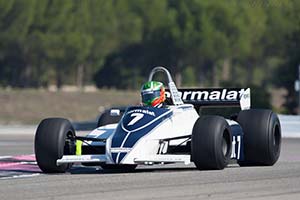
Chassis BT49C/10 The first of five all-new BT49Cs built for the 1981 season, this chassis was only used once. Nelson Piquet finished second in the South African Grand Prix, which did not count for the World Championship. Still owned by Bernie Ecclestone, it has been prepared for racing in recent years by Kumschick Racing. In 2011, Nelson Piquet was reunited with the car during the Brazilian Grand Prix to celebrate the 30th anniversary of his World Championship. A year later Spaniard Joaquin Folch-Rusinol used the car very effectively on his way to win the FIA Historic Formula 1 Championship.

Article by Wouter Melissen, last updated on November 16, 2012

Add your comments on the Brabham BT49C Cosworth


General specifications
Country of origin Great Britain
Chassis number BT49C/10
Numbers built 5
Produced in 1981
Successor
Body design Gordon Murray for Brabham

Major wins
1981 Argentine Grand Prix (Nelson Piquet in BT49C/11)
1981 San Marino Grand Prix (Nelson Piquet in BT49C/9)
1981 German Grand Prix (Nelson Piquet in BT49C/14)

Engine
Configuration Ford Cosworth DFV 90º V8
Location Mid, longitudinally mounted
Weight 147 kilo / 324.1 lbs
Construction magnesium alloy block and head
Displacement 2.993 liter / 182.6 cu in
Bore / Stroke 85.7 mm (3.4 in) / 64.8 mm (2.6 in)
Compression 11.5:1
Valvetrain 4 valves / cylinder, DOHC
Fuel feed Lucas Fuel Injection
Lubrication Dry sump
Aspiration Naturally Aspirated
Power 490 bhp / 366 KW @ 10750 rpm
Torque 353 Nm / 260 ft lbs @ 9000 rpm
BHP/Liter 164 bhp / liter

Drivetrain
Chassis aluminium and carbon fibre monocoque with fully stressed engine
Suspension (fr/r) double wishbones, pull-rod actuated coil springs and dampers, anti-roll bar
Steering rack-and-pinion
Brakes ventilated discs, all-round
Gearbox Hewland FGA 400 5 speed Manual
Drive Rear wheel drive

Dimensions
Weight 580 kilo / 1278.7 lbs
Wheelbase / Track (fr/r) 2718 mm (107 in) / 1702 mm (67 in) / 1588 mm (62.5 in)

Performance figures
Power to weight 0.84 bhp / kg

Resources
Related articles
Useful links