Go to Ultimatecarpage.com

Car search: Quick Advanced 
 gt Ultimatecarpage.com  > Cars by brand  > Italy  > Ferrari
Racing cars  > GT Cars
     F40 LM
Cars statistics: 5052 cars, 430 makes, 39334 images; Events statistics: 215 reports, 41349 images; Forum statistics: 85,344 members, 41,962 topics; more...


  Ferrari F40 LM
 

Ferrari F40 LM Ferrari F40 LM Ferrari F40 LM Ferrari F40 LM Ferrari F40 LM Ferrari F40 LM
Click here to save all images    Image credits: Wouter Melissen 

Model history:
Click here to download printer friendly version After almost a decade of relatively poor results in Formula 1, Ferrari decided to put all their efforts on retaining their edge in the pinnacle of motorsport from 1974 onwards. Although this led to the much desired victories and championships, it also was the end of the line for Ferrari's highly successful prototype and GT racers that had reigned surpreme in the 1950s and 1960s. For the manufacturer's many privateers this meant they had to either retire from racing or switch to another manufacturer. For these enthusiasts Michelotto, a small motorsport firm from Padova, Italy, provided the answer. With some back-door support from the factory, they converted two generations of Ferrari's GT road cars in full blown racers.

Initially these Michelotto racers proved very competitive, but the ill-fated 512 BB LM revealed that Ferrari's high-end road cars were no longer suitable for track use. There were too many compromises made for comfort and safety reasons, which did not show on the road, but very much so on the track. By the turn of the decade Ferrari had won four constructor's and three driver's World Championships and was set to continue the successes in the 1980s with a newly developed Turbocharged V6 engine. Tempted by the popularity of the Group B rally class, work was started by the factory on a potential contender. Visually similar to the 308 GTB road car, the 288 GTO that was first shown in 1984 was quite a different beast.

To homologate the aptly named 288 GTO for racing at least 200 examples were required to be produced. Underlining Ferrari's popularity and the GTO's appeal, all production cars were sold even before production started. The 288 GTO offered Michelotto a far better base for a competition car and work was started to develop the mid-engined supercar into a racing car. The first of these 'Evolution' models was ready in 1985 and featured a rounder, more aerodynamic body. Under the restyled panels an even more powerful version of the twin-Turbocharged V8 was fitted. Sadly, Group B racing was abandoned shortly after for being too dangerous. Six Evolutions were eventually constructed, but they never turned a wheel in anger.

To celebrate the manufacturer's 40th anniversary, Ferrari launched the 'F40' in 1987. Both visually and technically the F40 was a clear development of the GTO Evoluzione. The V8 engine was increased in size slightly and developed 478 bhp in stock form, but a performance package boosting power to over 700 bhp was also available. With the GTO it shared the spartan construction, resulting in an impressive kerb weight of 1100 kg; 350 kg lighter than the closest competition, the Porsche 959. With an already impressive power to weight ratio, there was little surprise when Michelotto was again commissioned to turn Ferrari's latest offering into a racer, this time for the track.

Michelotto's work resulted in the F40 LM, which first took to track for testing late in 1988. Interestingly much of the speculation before the F40's launch suggested that it would be called 'Le Mans', which now proved to be partly right. The differences between the road and racing cars were subtle with the carbon fibre splitter, rear diffusers and adjustable rear wing as the most obvious. Furthermore the pop-up headlights were replaced by two big perspex covered units and additional NACA-ducts hinted at an increased cooling capacity. A new engine management system and increased compression saw the power increased to at least 720 bhp, but for qualifying the boost could be increased to yield in excess of 900 bhp. The interior was stripped even further and the dashboard was replaced by a state of the art digital setup.

One of Ferrari's most loyal privateers, Ferrari France, was the first to field a F40 LM. A year after testing started, Jean Alesi debuted the LM in the Laguna Seca round of the IMSA GT championship. He finished a promising third in a highly competitive field and being forced to run with engine intake restrictors. In the following season Ferrari France campaigned one or two of their LMs in a number of rounds, adding an additional four podium finishes to their tally, but unfortunately no victory. At the end of the season, Ferrari France abandoned the F40 LM campaign. Although Michelotto built 19 examples of the F40 LM between 1989 and 1994, only three chassis were ever campaigned in anger.

This was not the end of the F40's international competition history, far from it. Two years after the production of the road car had ceased, the competition cars were given a new lease of life thanks to the BPR Championship for GT cars first held in 1994. Michelotto was called in once more to create an even more potent version of the F40. Dubbed the F40 GTE, it featured a 3.5 litre and later 3.6 litre version of the F40's Turbo-charged V8. Running with intake restrictors the revised engine produced around 660 bhp and bucket-loads of torque. In the following seasons a variety of modifications were carried through, which included a six speed sequential gearbox and carbon ceramic brake discs for the 1996 season.

One of the F40 LM's was bought from its collector owner and joined the GTEs in the BPR Championship and at Le Mans to run in the GT1 class. The F40s proved highly competitive in the shorter sprint races of the BPR championship, but reliability issues plagued them in the legendary 24 Hours race. Between 1994 and 1996 the F40 LM and GTEs scored numerous victories against more modern competition like McLaren's F1 GTR. At Le Mans in 1995 the brought back from retirement F40 LM impressively finished. Although it was ranked only sixth in class and twelfth overall, it was the first Ferrari to complete all 24 Hours in many years. At the end of 1996, the F40 finally became outdated when the competition introduced purpose built 'GT racers'.


Chassis: 74045
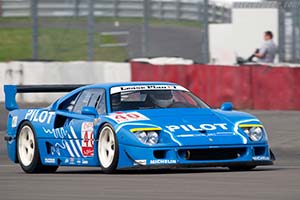
Chassis 74045 Originally used for one of the F40 prototypes, chassis 74045 was rebuilt into a F40 LM by Michelotto in 1992. It was acquired by Michel Ferté in 1994, who campaigned the car for two seasons in striking French blue racing colours with Pilot sponsoring. Together with Olivier Thévenin and Carlos Palau, Ferté finished 12th at Le Mans in 1995. A month later Ferté and Thévenin scored a victory in the BPR race at Anderstorp. For 1996 chassis 74045 was upgraded to GTE specifications with a wider rear wing. The best result that year was a third at the team's home race in Nogaro. Since its contemporary racing career, it changed hands several times and in 2008 it was acquired by the current, German owner. The most successful of F40 LMs is seen here in the hands of the current owner during the Modena Trackdays.

Chassis: 88522
Chassis 88522 Like many of the F40 LMs, chassis 88522 was sold immediately to a private collector; in this case cartoonist Albert Uderzo of Asterix fame. He used the car several times in private track sessions before he sold it in 1993. One of the later owners had Jacky Ickx drive it on the Nürburgring Grand Prix track in 1998. The multiple Le Mans winner clocked a time considerably faster than the contemporary Formula 1 racers also present. It is seen here at the Bonhams' Gstaad Ferrari Auction in 2005, making its second appearance at the exclusive sale after it was offered in 1998. A Far East collector jumped on the rare opportunity to obtain one of the F40 LMs and coughed up CHF 844,665 or $654,615 USD to take ownership of s/n 88522.

Article by Wouter Melissen, last updated on November 16, 2009

Add your comments on the Ferrari F40 LM


General specifications
Country of origin Italy
Chassis number 74045 / 88522
Numbers built 19
Produced from 1989 - 1994
Body design Pininfarina

Major wins
1995 Anderstorp 4 Hours (Michel Ferté / Olivier Thevenin)

Engine
Configuration F120B 90º V8
Location Mid, longitudinally mounted
Construction light alloy block and head
Displacement 2.936 liter / 179.2 cu in
Bore / Stroke 82.0 mm (3.2 in) / 69.5 mm (2.7 in)
Compression 8.0:1
Valvetrain 4 valves / cylinder, DOHC
Fuel feed Weber-Marelli Fuel Injection
Aspiration Two IHI Turbos with two Behr intercoolers
Power 720 bhp / 537 KW @ 7500 rpm
Torque 706 Nm / 521 ft lbs
BHP/Liter 245 bhp / liter

Drivetrain
Chassis kevlar body on steel spaceframe, integrated with composite materials
Suspension (fr/r) unequal A arms, coaxial springs, Koni hydraulic shock absorbers, anti roll bar
Steering rack-and-pinion
Brakes ventilated discs, all-round
Gearbox 5 speed Manual
Drive Rear wheel drive

Dimensions
Weight 1050 kilo / 2314.9 lbs
Length / Width / Height 4535 mm (178.5 in) / 1980 mm (78 in) / 1150 mm (45.3 in)
Wheelbase / Track (fr/r) 2450 mm (96.5 in) / 1580 mm (62.2 in) / 1570 mm (61.8 in)

Performance figures
Power to weight 0.69 bhp / kg
Top Speed 367 km/h (228 mph)
0-60 mph 3.1 s

Resources
Related articles
Useful links