Page 1 of 1 When the Formula 1 changed to three litre engines in 1966 many believed it would favour Ferrari with their vast experience with V12 engines of that displacement. Surprisingly they struggled and so did the other top runners of the previous seasons BRM and Lotus. This gave the edge to Brabham, who fielded a relatively simple spaceframe car powered by the 'underpowered' Repco V8 engine. Nevertheless Jack Brabham took the title in 1966 and Dennis Hulme repeated that feat in 1967. By then the other teams and particularly the engine manufacturers had caught up and in 1968 the Repco engine proved to be the weak link. A switch to Cosworth power for 1969 brought the team right back to the front of the grid, despite fielding what was basically an evolution of a four year old car.
There was no room for further evolution as rule changes left the existing Brabham designs obsolete at the end of the year. The now mandatory enclosed fuel cells required a sheet aluminium chassis, although Brabham, like Ferrari, did not develop a full monocoque car. Designer Ron Tauranac did not move away from the familiar spaceframe just yet by using a tubular structure as basis for the 'semi-monocoque' of the new BT33. Brabham again opted for Cosworth power and the chassis was designed for the V8 engine to be used fully stressed. The body followed familiar Brabham lines with an easily recognisable nose, which housed the radiator and was flanked by two small wings.
Triple World Champion Jack Brabham was not surprisingly the chief driver, while Rolf Stommelen piloted the second Brabham. The first Grand Prix of the decade at Kyalami South Africa must have felt like a fresh start with many brand new cars. Brabham clearly had done their homework best over the winter as Jack Brabham converted a front row starting position into victory. It looked like 1966 all over again, but the glory was short lived as driver errors and mechanical failure struck the team throughout the season. What should have been a great farewell for 'Old Jack' ended in bitter disappointment. Probably most telling of the situation was Sir Jack's desperate attempt to win the Monaco Grand Prix, which saw him miss his braking point, handing the win to Jochen Rindt. The win in South Africa remained the team's only victory. Jack finished fifth in the driver's table and Brabham fourth in the constructor's.
Over the winter Jack Brabham sold his share of the team to Tauranac and left for Australia. This left Brabham without its name giver and more importantly without a number 1 driver. Tauranac found a worthy replacement in two-time World Champion Graham Hill. The management changes did take most of his attention and the BT33 had to be rolled out for a second season with only slight aerodynamic tweaks. The cars failed to impress and Brabham slipped to ninth and last in the constructor's standings. Specifically for Hill, Tauranac developed the unconventional BT34 with twin nose mounted radiators, but it only proved successful in a minor event, giving Hill his final F1 win. At the end of the 1971 season Tauranac also took a break and the end for Brabham seemed nye. The three BT33s were campaigned by privateers in various series for several years. Eventually Tauranac sold the team to Bernie Ecclestone, who managed to bring Brabham to the foreground once again.
Today the 1970 season is considered a missed opportunity for Jack Brabham and the BT33. A case of the famous could have or possibly should have been. The three cars constructed in 1970 have all survived and are still campaigned regularly in events like the Monterey Historic Races and the Monaco Historic Grand Prix. Page 1 of 1

 Ultimatecarpage.com
> Cars by brand
> Great Britain
> Brabham
Ultimatecarpage.com
> Cars by brand
> Great Britain
> Brabham
 Racing cars
> Formula 1
Racing cars
> Formula 1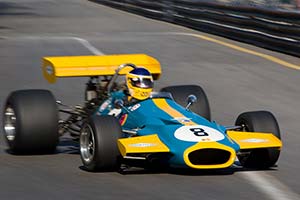
 When the Formula 1 changed to three litre engines in 1966 many believed it would favour Ferrari with their vast experience with V12 engines of that displacement. Surprisingly they struggled and so did the other top runners of the previous seasons BRM and Lotus. This gave the edge to Brabham, who fielded a relatively simple spaceframe car powered by the 'underpowered' Repco V8 engine. Nevertheless Jack Brabham took the title in 1966 and Dennis Hulme repeated that feat in 1967. By then the other teams and particularly the engine manufacturers had caught up and in 1968 the Repco engine proved to be the weak link. A switch to Cosworth power for 1969 brought the team right back to the front of the grid, despite fielding what was basically an evolution of a four year old car.