
| f1 |
 Ultimatecarpage.com
> Cars by brand
> Great Britain
> Tyrrell
Ultimatecarpage.com
> Cars by brand
> Great Britain
> Tyrrell
 Racing cars
> Formula 1 P34 Cosworth Racing cars
> Formula 1 P34 Cosworth
|
| Tyrrell P34 Cosworth |
| Article | Image gallery (82) | Chassis (6) | Specifications | User Comments (1) |
|
|
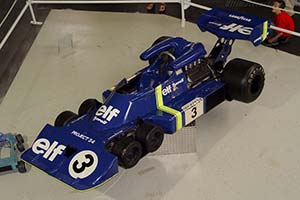
Page 1 of 1  With the dominant Cosworth DFV engine and Hewland gearbox readily available to all, Formula 1 was more competitive than ever before during the 1970s. This placed extra emphasis on chassis designers and aerodynamicists to give teams that extra edge over the others running the same drivetrain. The result was an unprecedented number of out-of-the-box solutions, many of which also proved successful. One of the most unusual of these was the Tyrrell P34 launched at the Heathrow Hilton on September 22nd, 1975. Created by Derek Gardner, it was the first Formula 1 car with six wheels; four at the front and two at the back. With the dominant Cosworth DFV engine and Hewland gearbox readily available to all, Formula 1 was more competitive than ever before during the 1970s. This placed extra emphasis on chassis designers and aerodynamicists to give teams that extra edge over the others running the same drivetrain. The result was an unprecedented number of out-of-the-box solutions, many of which also proved successful. One of the most unusual of these was the Tyrrell P34 launched at the Heathrow Hilton on September 22nd, 1975. Created by Derek Gardner, it was the first Formula 1 car with six wheels; four at the front and two at the back.There were several reasons why Gardner believed four wheels at the front were better than two. The main problem of the conventional layout was that exposed, spinning tyres create a lift. To counter that large wings were needed, which in turn added drag. The trend was to fit smaller front wheels to lower the lift without the drag penalty but that also meant a smaller contact patch on the track. By using four very small wheels, Gardner managed to lower the front-end lift without adding drag or giving up mechanical grip. When Ken Tyrrell first learned of the idea, he was baffled but he quickly came to grips with Gardner's solution and gave the go-ahead to build a six-wheeled car. The first order of business was to convince Goodyear to build bespoke tyres for the new intended 10-inch wheels. Once that was sorted, Gardner went to work in complete secrecy. The front-end laid down had a conventional steering rack that operated the forward set of wheels. The second row of front wheels was connected to the wheel ahead. All four wheels were fitted with tiny disc brakes. The revolutionary front-end was grafted onto an existing Tyrrell 007 tub and the prototype was completed with an even earlier rear-end. Once completed, this car was shown to a baffled audience at the Heathrow Hilton. Claiming it was just an experimental machine and uncertain of its viability, Gardner and Tyrrell simply named the car P34, after its project number. Constructing the car turned out to be the easy part as testing revealed a great deal of problems. Needless to say many of these concerned the front tyres. One of the issues was the rapid wear of the tyres because they had to spin much faster than the bigger, conventional front tyres. Dissipating the heat from the tiny brakes also proved troublesome. Both drivers also struggled to adapt to the car but especially Patrick Depailler quickly began to appreciate the P34. Gardner accommodated the drivers by cutting 'port-holes' in the sides of the cock-pit, so they could see the front tyres, which helped them place the car and monitor their wear better. Although not all bugs were ironed out, Ken Tyrrell commissioned the construction of new P34s for Depailler and Jody Scheckter to race in 1976. Production delays meant that the first P34 was not ready until the fourth race of the season. Not surprisingly it was entrusted to Depailler, who immediately impressed by setting the third fastest time in qualifying. Scheckter on the other hand could do not better than fourteenth in the earlier 007. Depailler was running strong in the race until over-heating brakes caused him to crash out. Scheckter received 'his' P34 ahead of the next race, which he ended in a promising fourth. The rapid progression paid off soon after at the Swedish Grand Prix. Scheckter and Depailler dominated the race, finishing first and second. Although no more races were won, Depailler and Scheckter ended the season third and fourth and Tyrrell was third in the standings. After the remarkably successful debut season, the P34 looked set to fight for the championship in 1977. Over the winter Gardner tweaked the aerodynamics in the wind-tunnel and moved the oil-coolers to the nose. Never quite at ease with the car, Scheckter left to join the Wolf team. His replacement was the Swede Ronnie Peterson. Tyrrell also attracted sponsorship money from the First National Bank, resulting in a change of livery. The pre-season optimism quickly disappeared as both drivers struggled to keep up with the competition in the P34. The problems were the result of Goodyear's refusal to develop the front tyres any further. They supplied the entire field that year and understandably focused on the conventional front and rear tyres. Gardner made some last-minute changes but it was all in vain and he left Tyrrell before the season was out. Maurice Philippe was hired, initially to mate the Tyrrell chassis to Renault's V6 turbo engine, but soon tasked with designing a brand new Tyrrell for 1978. It came as no surprise that that Tyrrell had four wheels again. Known as the 008 it helped Tyrrell return to its winning ways. Both March and Williams tested cars with four rear wheels but before they could be raced, six-wheelers were banned. As a result, Scheckter's win remains as the only victory for a six-wheeled Formula 1 car. With a superior top-speed and a razor-sharp turn-in, the P34 was briefly the fastest F1 car in the world. While many of the Tyrrell P34 contemporaries were dusted off and raced in historic events, the six-wheeler sat idly by for obvious reasons. This problem was eventually addressed in the late 1990s, when Martin Stretton, on behalf of one of the P34's owners, convinced Avon to produce suitable 10-inch front tyres. Stretton quickly vindicated the program by scoring numerous victories in 'his' P34, including wins at Monaco and the Thoroughbred Grand Prix car championship outright. Since then several other P34s have also emerged from retirement. Page 1 of 1 |
| Article | Image gallery (82) | Chassis (6) | Specifications | User Comments (1) |
| All Cars - Contact us - Privacy Statement - Top | © 1998 - 2026 Ultimatecarpage.com |