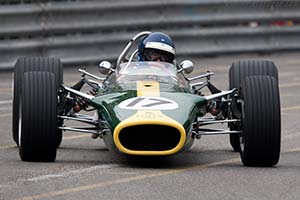
Model history: More than any time before or since, Grand Prix racing was revolutionized in the 1960s. There was little resemblance between the front-engined Ferrari 246 Dino that won the 1960 Monza Grand Prix and the winged and sponsored Formula 1 cars used in 1969. Colin Chapman's Lotus was frequently at the source of these revolutions. A major catalyst for the rapid development was the switch to a displacement limit of 1.5 litres for the 1961. With less power available, there was much more emphasis on the chassis and suspension design. Chapman took a major step forward in 1962 with the Lotus 25, which used a monocoque chassis instead of the conventional spaceframe used in the past. It was lighter and more rigid.
After just five years the regulations were changed once more with the displacement hiked to three litres. This left many of the independent teams like Lotus and Cooper without an engine. Both BRM and Coventry Climax figured they could cut a few corners by turning their 1.5 litre V8s into 3-litre sixteen cylinder engines. Only the BRM 'H16' became a reality and it found its way in the back of the Lotus 43 built for the 1966 season. The unusual engine was heavy, but rigid enough to take the bulk of the suspension loads, so it was bolted directly to the monocoque chassis. Jim Clark managed to score one victory, but at every other occasion the highly unreliable engine expired.
Not surprisingly Chapman was on the look out for a new engine for 1967, but he struggled to find one. He then contacted his old friends Mike Costin and Keith Duckworth, the founders of the Cosworth engine tuning company. They were most definitely interested, but they did not have the resources to produce an engine to Formula 1 specifications. Having just won the Indy 500 with Ford, Chapman used his influence to convince one of the company's executives to fund the operation; a lengthy relationship between Ford and Cosworth was born. Using a Ford four cylinder as a base, the Cosworth team first developed a 16-valve 1600 cc FVA engine for Formula 2. It would form the basis for the three litre V8 readied for the 1967 season.
Dubbed the DFV (Double Four Valve), the new engine was completely cast from aluminium in the Cosworth factory. As it name suggests, it used dual overhead camshafts and four valves per cylinder. Using a Lucas supplied Fuel Injection system, the compact engine was good for a very competitive 400 bhp at 9000 rpm. Like the BRM H16, the new Cosworth DFV was exceptionally rigid and Chapman used this to the fullest when he designed the Lotus 49 F1 car. The racer used an aluminium monocoque chassis that stretched no further than the bulkhead behind the driver. The V8 was bolted directly onto this chassis and took all of the rear suspension load, wich was a much lighter and cleaner solution than using a rear subframe.
The car itself was an evolution of the 43 with the monocoque chassis housing three fuel cells. The front suspension was carried by a steel subframe and consisted of a lower wishbone and a top lever arm that was bolted onto an internally mounted coil spring over shock absorber unit. At the rear there was a lower inverted wishbone, a top link and two radius arms on each corner. The internally vented disc brakes were provided by Girling. Specifically for the fat Firestone tires, Lotus developed somewhat unusual lightweight dish wheels. The package was completed by a ZF five speed gearbox, which also helped to carry the suspension load.
Unfortunately, the Cosworth engined Lotus 49 was not ready in time for the start of the 1967 season and only made its first appearance in June of that year at Zandvoort. It was a stellar debut with Graham Hill clinching the pole position and Jim Clark the fastest lap and victory. The Scotsman would score another three Championsip wins that season, but it was not enough to get ahead of Denny Hulme in the final standings. The Lotus 49 was lighter and more powerful than its competition, but it was not overly reliable and especially Hill suffered many retirements. Underlining the performance advantage, the Team Lotus took eleven consecutive pole positions in GP races.
Even though the Cosworth engine had now become available for other teams, 1968 was expected to be a Lotus year. Clark got off to a good start by winning the season opening round at Kyalami, before being tragically killed in a F2 Lotus at Hockenheim in April. Deeply saddened, Chapman knew he had to move forward and at the second race of the season he changed the outlook of the sport once more again. The sole Lotus 49 entered was the first F1 car to be livered in the colours of the sponsor. In this case the red, white and gold of the Gold Leaf cigarette company. Finally Hill was not hampered by technical difficulties and took a convincing win just weeks after Clark's tragic death.
Chapman had even more up his sleeve and at the very next race introduced the Lotus 49B. It used a slightly longer wheelbase and a new Hewland gearbox, but more importantly it was equipped with wings. It was the start of a season that would see a wide variety of aerodynamic aids being tried with the suspension mounted high wings as the most extreme examples. Hill would score a debut win with the 49B at Monaco, but then had to wait until the final round for another win. It was sufficient for the driver's title for Hill and the constructor's title for Lotus. The Cosworth engine had won all but one race that season and it would go on to dominate F1 for many years to come. Its availability also made getting into F1 a lot easier than it was before or is today.
Further developed, the Lotus 49 would be raced for another season and a half. For 1969 Graham Hill was joined by Jochen Rindt, but neither was a force as the Cosworth powered Matras and Brabhams had a clear advantage. Hill managed to score one win, at his much beloved Monaco track and Rindt won the USA Grand Prix. Lotus finished the season in a distant third. Waiting for the new and again ground-breaking Lotus 72 to be ready, the 49 was used for a few races in 1970 with a final victory for Rindt at Monaco as the best result. The Lotus 49 has found its way into the history books as one of the most influential F1 designs, having served to introduce the Cosworth engine, sponsorship liveries and wings to Grand Prix racing. Lined up next to the 1960 Ferrari 246 Dino, it is hard to imagine that the two were produced less than a decade apart.
Chassis: R2
Jim Clark drove chassis R2 to the victorious debut of the Lotus 49 and the Cosworth DFV engine during the 1967 Dutch Grand Prix at Zandvoort. Later in the year he scored two further Grands Prix victories in this car. It was subsequently fitted with a 2.5 litre version of the engine for the lucrative Tasman Cup Series. Clark won four of the eight rounds he competed in. In 1968 it was updated to 49B specifications and loaned to privateer entrant Rob Walker, who campaigned it for Jo Siffert and Jackie Oliver. The best result was a third place at the Oulton Gold Cup for the latter.
It was long believed that R2 was scrapped at the end of the 1968 season. It was not until the 1990s, when author Michael Oliver went about charting the individual histories of the cars for his book on the Lotus 49, that chassis R2 was rediscovered. It had actually been used by Lotus for the 49B that had been sold to American privateer Pete Lovely in 1969 as a new car with the chassis number R11. In this guise, it was raced by Lovely with limited success until 1971 in contemporary events. He later sold the car before buying it back for historic racing. At the time of the discovery of the car's origins Lovely was the owner of the car.
Some time later it was sold to another American historic racer, before it was acquired by the current, American owner in 2009. He sent the car to Classic Team Lotus to have it restored to its original configuration. All of the '49B' upgrades were removed from the tub and the Hewland gearbox was replaced by a correct ZF 5DS-12. The extensive work was completed in time for the 2010 Monaco Historic Grand Prix where it was driven by the current owner, while wearing a copy of Jim Clark's helmet. The car is set to be one of the stars of the upcoming Goodwood Festival of Speed where 60 years of Formula 1 will be celebrated.
Chassis: R3
Graham Hill used chassis R3 for the second half of 1967 and for the 1968 season opener at Kyalami. Two second place finishes were Hill's best results in R3. Lotus sold the car to South African John Love, who campaigned the car with a lot of success in local events for several years. The car was last raced in contemporary events in 1970. It was eventually acquired by the Beaulieu / National Motor Museum where it has been on display for many years in its original livery. Chassis R3 is the only Lotus 49 that has not been upgraded to B-specification and as such remains as the most original example in existence. It is seen here at a rare outing during the 2008 Goodwood Festival of Speed.
Chassis: R4
Chassis R4 was the fourth Lotus 49 produced, which was prepared for the 1968 opening Grand Prix at Kyalami, South Africa for Jim Clark. He used it to score his final Formula 1 victory. The car was subsequently sold to Rob Walker, who readied it for the Race of Champions at Brands Hatch for Jo Siffert. Sadly the car was destroyed in a garage fire after Siffert crashed the car in practice. In 1998 the car was reconstructed by Hall and Fowler for the current owner.
It was raced at Goodwood in 1999 by Jackie Oliver, who unfortunately had contact with Jack Brabham, who was racing one of his old cars. The car was rebuilt again and campaigned extensively in the FORCE series for historic Formula 1 cars. It is seen here at 2007 Goodwood Revival where the 40th anniversary of the Cosworth DFV engine was celebrated and later in the year at the Essen Motorshow.
I was an awestruck 14 year-old when I stood outside the old Kendall Tech center (paddock) in October of 1967. Both Lotus 49s were backed out of the garage. The only thing separating us fans from them was a 40 inch high wire fence. The mechanics actually had the exhaust pipes of the cars extending through the fence. Due to youthful exuberance I wormed my way to the front and managed to position myself and stand against the fence directly between the pipes of Clark's 49.
I stood there absolutley glued to the spot as Chapman spoke with Clark, Hill and Duckworth and the mechanics brought the engine to life and manually "blipped" the throttle using the linkage on top of the engine.
The noise was deafening but unlike the wiser adults around me I chose not to stick my fingers in my ears to better fully absorb the moment. Alas no camera in my hand by I know someone must have photos of that day in my life. Wish I had one, but these images certainly bring back the moment.