Page 1 of 1 After a number difficult years, the Chevrolet Corvette slowly but steadily grew in popularity throughout the 1950s. In 1960 the production reached the planned 10,000 units for the first time. Ten years after the first Corvette was released, a completely new Corvette replaced it. Today these are referred to as the C1 and C2 Corvettes, although the C1 Corvette changed slightly in design and specification every year. One of the side effects of these changes was an increase size and weight, which was partly cured when the C2 Corvette saw the light in 1963.
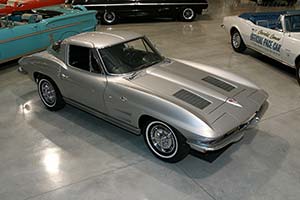
Although the overall design of the C2 was completely new, the rear end design introduced on the C1 in 1961 was carried over. One of the most striking novelties on the new Corvette were the reverse rotational flip up headlights, which would remain a Corvette feature until the C6 was introduced in 2004. Another important change was the introduction of the Coupe bodystyle, which for 1963 only featured a unique split rear window. This was replaced by a regular window after customers complained about poor visibility.
Technically the C2 followed the same principles as the C1 with a steel ladder chassis and a fiberglass body, but both were completely redesigned. Handling was much improved by replacing the live rear axle with a double wishbone and transverse leaf spring setup. The engines were carried over from 1962 and all displaced 327ci and produced 250 to 360 bhp. In the C2's last year of production, 1967, the engines had grown in size to 427ci and in power to a factory claimed 430 bhp.
For 1963 Chevrolet also changed the optional package codes, which now consisted of one or two letters combined with two or one numbers. From then onwards the specific models were often referred to by their optional package code, some of which have become legendary among automotive enthusiasts, like Z06 and L88, both of which referred to performance enhancing options.
A new body design was adopted for 1968, but the basic chassis remained unchanged for almost twenty years. Around 22,000 units of the C2 Corvette were produced annually in those five years. Today the C2 or 1963-1967 Corvette is among the most desirable of all Corvettes built in the last 50+ years.
Featured is a 1963 'Split Window' Corvette, equipped with the L75 300 bhp version of the 327 V8. It is pictured here at General Motors' Heritage Center. Page 1 of 1

 Ultimatecarpage.com
> Cars by brand
> United States
> Chevrolet
Ultimatecarpage.com
> Cars by brand
> United States
> Chevrolet
 Corvette C2 Sting Ray Coupe 'Split Window'
 After a number difficult years, the Chevrolet Corvette slowly but steadily grew in popularity throughout the 1950s. In 1960 the production reached the planned 10,000 units for the first time. Ten years after the first Corvette was released, a completely new Corvette replaced it. Today these are referred to as the C1 and C2 Corvettes, although the C1 Corvette changed slightly in design and specification every year. One of the side effects of these changes was an increase size and weight, which was partly cured when the C2 Corvette saw the light in 1963.