Page 1 of 1 British sports car manufacturer Elva bounced back from financial issues during the early 1960s to create some of the greatest small-displacement competition cars of the decade. Company founder Frank G. Nicholls sold the production of the Courier road car to Trojan in 1961, which allowed him to focus on creating the first mid-engined Elva sports racers. This resulted in the relatively modest Mk 6, followed by the hugely successful Mk 7, and ultimately the Mk 8 of 1965.
The Mk 7 was such an accomplished racer that even Porsche used an eight-cylinder engined example one for the European Hill Climb Championship and sanctioned a series of Elva Porsches using the four-cylinder Carrera engine. It was a very light car but most of that little weight was concentrated over the rear axle, which made it relatively difficult to drive. That prompted designer Keith Marsden to make changes to the suspension geometry, widen the track and lengthen the wheelbase to create the Mk 8.
As before, the latest Elva was built around a steel spaceframe that used the aluminium floor as a stressed panel. At the front, the coil springs and shock absorbers were now moved in-board and actuated by rockers from the top wishbones. At the rear, the Mk 8 had a multi-link layout with reversed lower wishbones, top links and twin trailing arms. Although designed to accommodate a variety of engines, the two-litre Nerus-tuned BMW M10 proved to be the engine of choice for most customers. It was mated a Hewland five-speed gearbox. The Mk 8 was clothed in fibreglass bodywork that was similar to that of its predecessor.
A sign of things to come for Elva, development of the Mk 8 prototype was entrusted to the McLaren team and its driver Chris Amon. The young Kiwi did not have the best of luck with the new Elva as he suffered a slew of retirements before finally finishing third at Crystal Palace behind a pair of Brabhams BT8s. Elva eventually sold 12 examples of the Mk 8 and then a further nine of the Mk 8S, which represented a very subtle evolution. Crucially, it could run V8 engines and one sported a BRM V8, while another was equipped with a 3.5-litre Buick engine.
Ultimately, the Elva Mk VIII was not quite as successful as its predecessor and this was perhaps the result of priorities shifting towards the production of McLaren's M1 sports car. Elva had been contracted to construct the cars destined for customers, which were known as McLaren-Elvas to distinguish them from the works cars built at the McLaren factory. As such the Mk 8 and Mk 8S remain as the very last cars designed and built in-house by Elva. Page 1 of 1

 Ultimatecarpage.com
> Cars by brand
> Great Britain
> Elva
Ultimatecarpage.com
> Cars by brand
> Great Britain
> Elva
 Racing cars
> Other Sportscars
Racing cars
> Other Sportscars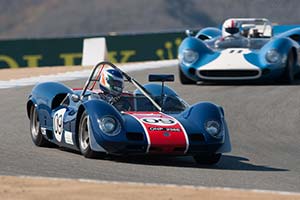
 British sports car manufacturer Elva bounced back from financial issues during the early 1960s to create some of the greatest small-displacement competition cars of the decade. Company founder Frank G. Nicholls sold the production of the Courier road car to Trojan in 1961, which allowed him to focus on creating the first mid-engined Elva sports racers. This resulted in the relatively modest Mk 6, followed by the hugely successful Mk 7, and ultimately the Mk 8 of 1965.