
 Ultimatecarpage.com
> Cars by brand
> Italy
> Pagani
Ultimatecarpage.com
> Cars by brand
> Italy
> Pagani
 Utopia Roadster Utopia Roadster
|
| Pagani Utopia Roadster |
| Article | Image gallery (35) | Specifications |
|
|
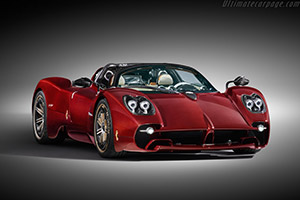
Page 1 of 2 Next >>  Two years ago, Pagani Automobili unveiled the Utopia, a car whose very name embodies the philosophy of a relentless pursuit towards perfection, an unattainable ideal that nonetheless inspires creators to aspire to excellence. Project C10, Utopia’s code name, came into being with the dual nature of Roadster and Coupé already written in its destiny, following the enthusiasm generated by previous models. However, unlike the roadster versions of the Zonda and Huayra – which were designed after their respective closed versions – here the development of the two variants took place jointly. Two years ago, Pagani Automobili unveiled the Utopia, a car whose very name embodies the philosophy of a relentless pursuit towards perfection, an unattainable ideal that nonetheless inspires creators to aspire to excellence. Project C10, Utopia’s code name, came into being with the dual nature of Roadster and Coupé already written in its destiny, following the enthusiasm generated by previous models. However, unlike the roadster versions of the Zonda and Huayra – which were designed after their respective closed versions – here the development of the two variants took place jointly.What better way to solve the enthusiasts’ old dilemma? Gran Turismo aficionados have always debated as to which is the purer expression: a closed or open cabin. Both traditions boast a rich pedigree and supporters of the two contrasting options are often irreconcilable. The only way for Pagani to help resolve this quandary was to offer both versions, leaving fans free to choose between them. Invariably, those who favor performance opt for coupés, since they tend to be lighter and more agile. But the criterion does not apply here, as the Utopia Roadster is just as light, dynamic, and high-performance as its closed sister. The styling of the two versions is an expression of continuity, being the work of the same team of designers and engineers; a team united by common visions, working under the guidance of Horacio Pagani in the Modenese Atelier. The doors have the same elegant butterfly kinematics, a fascinating and sophisticated mechanism. When one wishes to travel under the open sky, the hard-top can be placed on a stand, transforming it into a piece of design to be looked at and admired. In addition to this, there is a soft-top, which can be stored in a suitcase in place of the vanity case that is usually located centrally behind the two seats. The same car can therefore convert into three different versions, each to be preferred depending on the season, the mood, the desire to feel enclosed and protected or in contact with the open air, and the wind gently caressing the face. On board the Utopia Roadster, the floor mats have a specific texture reminiscent of an outboard boat, and the key has been redesigned, recalling the profile of the open version. Even with the hard-top in place, the light-filled interior differs significantly compared to the Coupé, thanks to the presence of a single large roof window. Removing the hard-top brings the driver and passenger closer to nature, such that they experience the surrounding landscape in a unique way, perceiving smells and subtle changes in air temperature as the road winds up and downhill. As for the upholstery in the Utopia Roadster, the almost endless choice of colors and materials becomes even more important, since the car’s interior is constantly exposed to the gaze of onlookers. It is from this cabin that you see the world, and it is in this cabin that the world sees you. The style of an object is distinguished partly by the accessories that complement it, and the luggage items are one of the features that further embellish every Pagani Hypercar. For the Utopia, two matching suitcases are made with leather-covered carbon inner shells, adorned with the emblematic Pagani ellipse. These can be stowed in two special compartments situated next to the engine. They are true gems of high-quality workmanship, where meticulous care has been devoted to every detail: from the selection of the leathers, which can either be coordinated with the car’s con?guration or create a contrast to it, down to the smallest details such as the hinges, the small leather straps that muffle their noise and the feet pads incorporating the iconic four exhaust symbol. The range of accessories is further enriched by two matching garment bags, which in the Utopia are neatly positioned behind the headrests. Horacio Pagani is a pioneer of advanced composite materials; for almost forty years he has been experimenting with the most innovative solutions for his products. The first creation of the Pagani Atelier, the Zonda, was one of the first road cars to use a monocoque in carbon fiber, a material at the time mainly reserved for the aerospace industry, Formula 1, and Sport Prototype endurance cars. Today, thanks to continual investment in research, Pagani Automobili has developed know-how that has culminated in the Utopia Roadster. Current advances go well beyond the use of carbon fiber alone; in fact, there are over forty formulas of composite materials within the same Hypercar. These include Carbo-Titanium HP62-G2 and Carbo-Triax HP62. Technological sophistication has enabled the Utopia Roadster to maintain the same lightness as the Coupé, weighing in at only 1,280 kg (2,822 lb) [dry weight], an incredible figure for a large Hypercar fitted with a V12 engine. This result was achieved thanks to a monocoque chassis entirely redesigned to optimize rigidity and resistance, without resorting to the heavy reinforcements usually required when a car roof is eliminated. Key objectives in the design of the Utopia were to achieve a low coefficient of aerodynamic resistance and significant aerodynamic downforce without resorting to protruding appendages. With this in mind, Pagani’s engineers conducted a meticulous study of air flows in the wind tunnel. Air is carefully guided and controlled through the wheel passages, channeled around the teardrop roof and along the sinuous sides. It flows around the wing mirrors, over the bonnet, and down to the elliptical trailing edge, where two movable flaps, visible and yet harmoniously incorporated into the design, help to further improve aerodynamic efficiency by adapting to different driving conditions. The internal air flows for cooling and intake have also been perfected down to the last detail, making an essential contribution to the car’s performance and stability. From the very outset, Pagani Automobili has maintained its loyalty to the V12 engine and to its collaboration with Mercedes-AMG, initiated thanks to Juan Manuel Fangio, world champion with the German manufacturer and supporter of Horacio Pagani’s pragmatic vision. This continuity has not stood in the way of progress: the team worked intensively on the version of the Pagani V12 destined for the Utopia. It is an authentic marvel of mechanics, light and compact, built in close collaboration with AMG engineers, who are in charge of its exclusive production for the Italian Hypercar. Each engine is entirely assembled by a single craftsman, a true mechanical artist. The power output of 864 horsepower (635 kW), comparable to that of many racing engines, does not do full justice to the incredible versatility of this mechanical system: capable of turning smoothly at low revs and delivering explosive acceleration when the driver wants to experience the full power of the Pagani engine. Turbo response is immediate, thanks partly to the prodigious torque of 1,100 Nm delivered extraordinarily. No heavy batteries, no hybrid system, just the wonderful roar of a V12 engine. In collaboration with the British specialist firm Xtrac, Pagani has designed a transmission capable of handling the torque of the twin-turbo V12, while guaranteeing smooth and agreeable functioning in all conditions. Extremely compact and positioned transversely behind the engine, the seven-speed manual gearbox is connected to a light and adjustable triple-disc clutch. The cutting-edge technology employed in the fabrication of materials for the Utopia Roadster is not just about carbon: even the metal parts are incredibly sophisticated. The eight suspension triangles, forged in aircraft-grade aluminum alloy, are designed to guarantee both strength and lightness. The recent rebirth of Modena Design, a historic Pagani-owned company, today allows total control over every aspect of the production of components in aluminum, titanium, and special metals, from design to engineering, to manufacture with the most advanced equipment currently available, which also involves using the noble technique of milling from solid metal. The Utopia Roadster boasts extraordinary agility and exceptional road holding during cornering, guaranteeing an unrivaled driving sensation in all conditions. The active suspension, combined with the electronic differential and dynamic control system, eliminates any tendency to understeer, while the electronic traction control ensures flawless movement despite the enormous power supply available. The Utopia Roadster delivers astonishing performance while remaining persistently intuitive. True to Pagani’s philosophy, the driver never has to struggle with the car; it is always an exhilarating, obedient, and reassuring ally. Pirelli, an essential partner of Pagani Automobili from the prototyping and simulation phase with the aid of the most advanced AI technology, is supplying the Utopia Roadster with exclusive tires equipped with advanced sensor technology on the inside of the tread that become points of interaction between the car and the road surface. Thanks to the , the tire’s sensors will send information to the vehicle’s stability control systems, including ABS, ESP, and traction control, to ensure maximum performance and the highest level of safety based on driving conditions. The Pirelli P ZERO™ Corsa and P ZERO™ Winter (standard) and the P ZERO™ Trofeo RS (optional), are fitments developed specifically for the Pagani Utopia, in size 21” at the front and 22” at the rear. Inspired by the visionary genius of Leonardo da Vinci, who saw the union of Art and Science as the highest expression of human creativity, work at Pagani Automobili is tirelessly geared to ensure that design, engineering, and product manufacture are developed in an integrated process, meticulous attention being paid to every aspect of form and function. Ergonomics is studied down to the smallest detail: every control is positioned exactly where you would expect it to be, is designed to be operated comfortably, and is fashioned with taste and attention to its mechanical beauty. Even a simple switch, carefully designed in its form, its lighting, and the precision of its actuation, is as pleasant to look at as it is efficient to use. Every single element contributes to an overall sense of visual and tactile satisfaction, enhancing every gesture and making a drive in the Utopia Roadster a unique and inimitable experience. The Utopia’s seven-speed manual gearbox is a marvel of ultra-modern design, yet retains traditional mechanics and is operated by a classical gear lever with a titanium grille. An object of sophisticated workmanship that is as enchanting to the eye as it is enjoyable to the touch. Each and every part of the clearly visible mechanism is finished with the greatest care and attention, the polished knob itself providing an ideal grip. For those who prefer lightning-fast changes, there is the AMT automated gearbox controlled via paddle shifters mounted on the steering wheel. Software strategies have further improved speed and comfort so that the driver feels as comfortable on the road as he does on the racetrack. Pagani Automobili has always been dedicated to the pursuit of timeless design, celebrating the elegance of manual control as the purest expression of mechanical art. From the time of its earliest creations, it has embraced the enduring appeal of analog technology, enhancing the beauty and functionality of knobs, dial hands, buttons, and levers. The development of sophisticated components, such as a manual gearbox capable of meeting the high expectations of Pagani’s customers, today represents an even more formidable technological challenge than in the past. The steering wheel is the very symbol of a car; that of the Utopia is a symbol of Pagani’s savoir-faire. No one had ever designed a steering wheel quite like this. In appearance it looks almost ordinary: one immediately notices, however, the excellent grip of the thick rim, finished with leather pads. But it is in the detail that its uniqueness is revealed: a closer look shows that the rim, spokes, and hub are a single piece of lightweight metal. Starting from a 43-kilo (94,80 lb) block, a five-axis milling machine works continuously for 28 hours to achieve this extraordinary object weighing only 1.6 kg (3.53 lb), the discarded waste being reused as recycled material for other industries. An expert craftsman hand-finishes, personally polishes, and carefully inspects each steering wheel. The result is an extraordinary feat of aesthetics and engineering. Page 1 of 2 Next >> |
| Article | Image gallery (35) | Specifications |
| All Cars - Contact us - Privacy Statement - Top | © 1998 - 2026 Ultimatecarpage.com |