
 Ultimatecarpage.com
> Cars by brand
> France
> Renault
Ultimatecarpage.com
> Cars by brand
> France
> Renault
 R5 Turbo 3E R5 Turbo 3E
|
| Renault R5 Turbo 3E |
| Article | Image gallery (28) | Specifications |
|
|
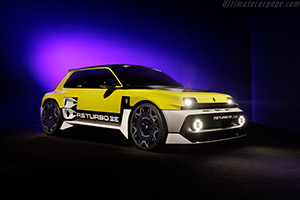
Page 1 of 2 Next >>  “A beast of a car built for rallying, drift and track performance, adapted for the road.” These few words sum up the brief for the development and engineering of Renault 5 Turbo 3E. Renault’s most powerful and most advanced road car ever, this spectacular electric model embodies the spirit of the Renault brand and its passion for sport and competitive essence. “A beast of a car built for rallying, drift and track performance, adapted for the road.” These few words sum up the brief for the development and engineering of Renault 5 Turbo 3E. Renault’s most powerful and most advanced road car ever, this spectacular electric model embodies the spirit of the Renault brand and its passion for sport and competitive essence.Renault 5 Turbo 3E reboots the iconic heritage of the Renault 5 Turbo and Turbo 2 of the 1980, two speed demons that made their mark on their times, by their already exuberant character and innovative spirit, and with their impressive rallying performance. They were the first French models to feature a turbocharged petrol engine, a technology that Renault had just successfully introduced in Formula 1 and are now highly sought-after as collector cars. But Renault 5 Turbo 3E is also more than that. More than just a restomod of an iconic model, modernised, innovative, electric, and even more exuberant and powerful than its predecessors, it asserts its identity as the first in a new class of vehicle: mini-supercars. Just like bigger vehicles, it boasts impressive technical specifications (540 hp, 0-100 km/h in under 3.5 seconds, carbon superstructure, etc.), while offering a high level of customisation to meet all requirements. What's more, it has a minimum length/width ratio of 2.01, putting it in the same league as a supercar, but in a compact hot hatch format. Built on a custom platform tailored to its ambitions and performance, Renault 5 Turbo 3E is the mini-supercar taking up a position alongside Renault 5 E-Tech electric (the city car) and Alpine A290 (the sporty city car) Renault Group thus applying the formula already seen in the 1980s with the Renault 5, Renault 5 Alpine and Renault 5 Turbo: the bold image and strong credentials of Renault combined with the competitive spirit and expertise of Alpine. At the same time, other complementary forces are emerging, such as Ampere for software and electronic architecture, and Mobilize for bidirectional charging (V2L and V2G), along with a range of services to make electric driving easier: Mobilize Smart Charge, Mobilize Charge Pass and the Plug & Charge function. Some partners also have provided their expertise and know-how for key components such as the in-wheel motors and carbon fibre superstructure. As such, Renault 5 Turbo 3E takes full advantage of Renault Group's transformation, driven by the Renaulution plan. On the outside, Renault 5 Turbo 3E is designed to look like a supercar: exuberant – as witnessed by the prominent bumper and rear wing extensions – while never turning aside from the quest for sportiness, agility and optimised aerodynamics. On an electric vehicle, aerodynamics plays a key role in vehicle efficiency, alongside weight. The design of Renault 5 Turbo 3E is naturally inspired by the original Renault 5 Turbo and Turbo 2. A few features and characteristics are recognisable from the recent Renault 5 E-Tech electric, such as the rear lights and wing mirrors, but the main idea behind the project was to revive the iconic heritage of these two 1980s models, using cutting-edge technologies to showcase its modern credentials and optimise performance. This is the concept of retro-futuristic design already applied to the Renault 5 and Renault 4, rebooted as the Renault 5 E-Tech electric and Renault 4 E-Tech electric. To revive the genetic base of the original Renault 5 Turbo and Turbo 2, Renault 5 Turbo 3E is built on a new platform with specifically developed rear-wheel drive architecture. Compared with Renault 5 E-Tech electric (3.92m long and 2.54m of wheelbase), the windscreen has been moved back and the wheelbase extended (2.57m) to achieve truly spectacular dimensions (4.08m long, 2.03m wide, 1.38m tall) that showcase the sophisticated lines. The windscreen pillar, for example, appears to melt towards the front wheels. With these dimensions, Renault 5 Turbo 3E has the length of a city car for the width of a supercar. With its combined performance, it has created the category of ‘mini-supercars’. At the front, Renault 5 Turbo 3E maintains the same layout as its predecessors: square headlights – now with LED technology – fusing with the edge of the bonnet, a slim strip with three central sections and two additional square lights, originally long-range lights now replaced by LED daytime running lights. The aerodynamic splitter running around the front bumper and the large air outlet on the bonnet help to optimise downforce for a perfect balance between front and rear. To maximise air flow efficiency, the intakes on the sides of the bumper channel the air ahead of the wheels, while the side scoops on the rear wings channel the flow under the lights, behind the vehicle. We are referring here to the higher side air scoops. The lower side scoops cool the brakes. The left-hand scoop also conceals the charging hatch.On the side, a specific surround runs around the windscreen pillars and the cabin roofline, fusing into the rear spoiler in a nod to the original Renault 5 Turbo and Turbo 2. An aerodynamic splitter crosses the body between the two rear lights. Underneath the bumper is a diffuser whose efficiency is maximised by the design of the bumper, extending outwards on either side. Strictly a 2-door, 2-seater vehicle, Renault 5 Turbo 3E conceals 20-inch wheels, each fitted with an electric motor, under its wing extensions. All the power electronics are located in between, while the battery is housed under the floor. This architecture frees up plenty of boot space for luggage - a unique proposition for such a sporty vehicle - while lowering the centre of gravity. Page 1 of 2 Next >> |
| Article | Image gallery (28) | Specifications |
| All Cars - Contact us - Privacy Statement - Top | © 1998 - 2026 Ultimatecarpage.com |