
 Ultimatecarpage.com
> Cars by brand
> Germany
> Capricorn
Ultimatecarpage.com
> Cars by brand
> Germany
> Capricorn
 01 Zagato Coupe 01 Zagato Coupe
|
| Capricorn 01 Zagato Coupe |
| Article | Image gallery (9) | Specifications |
|
|
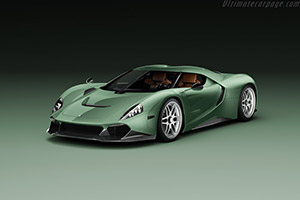
Page 1 of 2 Next >>  capricorn GROUP (capricorn), the German-based industry leader in automotive and motorsport lightweight technology, has today unveiled the first limited-edition hypercar to carry the company’s name. Featuring a body designed by Zagato, the capricorn 01 Zagato is a mid-engined, rear-wheel-drive, manual transmission hypercar, engineered and handbuilt by capricorn in Germany to deliver a pure, immersive, analog driving experience. capricorn GROUP (capricorn), the German-based industry leader in automotive and motorsport lightweight technology, has today unveiled the first limited-edition hypercar to carry the company’s name. Featuring a body designed by Zagato, the capricorn 01 Zagato is a mid-engined, rear-wheel-drive, manual transmission hypercar, engineered and handbuilt by capricorn in Germany to deliver a pure, immersive, analog driving experience.The capricorn 01 Zagato prioritizes true lightweight technology and purity of driving over simply excessive horsepower. A 5.2-liter supercharged V8 engine producing more than 900 PS (subject to final homologation results) and 1,000 Nm of torque. Featuring a full LMP1-type carbon fiber structure and carbon fiber body, the capricorn 01 Zagato weighs less than 1,200 kg, ensuring an excellent power-toweight ratio, exceptional agility, and a 0-100km/h acceleration time of less than 3.0 seconds. The capricorn 01 Zagato also represents the culmination of a belief shared by capricorn Founder and CEO Robertino Wild and Zagato President Andrea Michele Zagato as to what a true driver’s car should stand for. The two men enjoy a longstanding business relationship and a deep personal friendship, giving the project a special character and providing a strong foundation to combine German engineering discipline with Italian design flair. Production of the capricorn 01 Zagato will be strictly limited to a run of just 19 coupes as a tribute to Zagato’s founding year, 19th April 1919. This number holds particular significance for the design house and serves as a nod to its history of creating highly sought-after, ultra-limited, collectible hypercars. The entire series will be offered exclusively through prominent premium and luxury automotive retailer Louyet Group. With a heritage dating back to 1933, capricorn is a global leader in five key technologies with focus on lightweight: composites, forging, machining, casting, and additive manufacturing. The company has proven its competency at the highest level of world motorsport, supplying bespoke components for Formula 1, LMP1, World Endurance Championship (WEC), World Rally Championship (WRC) teams, and others. For decades, capricorn has helped deliver success for its partners in global motorsport and in the luxury high-performance automotive OEM sector. While the majority of the company’s work is confidential, projects in the public domain include collaborations with Lotus and Caterham in Formula 1, with Peugeot Sport in Le Mans, and significant involvement in Porsche’s LMP1 program. The company also has a highly successful history with Volkswagen Motorsport in the WRC and with Peugeot Sport on the Dakar Rally. “The capricorn 01 Zagato represents the culmination of everything we have learnt from decades of pioneering ultra-lightweight materials, technologies and construction techniques,” explains capricorn CEO Robertino Wild. “This car is a showcase of capricorn’s comprehensive capabilities. It demonstrates precisely what capricorn can do when it combines all of its different technologies and skills to engineer, develop, and build an entire car. “The project elevates capricorn to the next level, positioning the group as a manufacturer that can produce a pre-series car or assemble an entire series for an OEM, or indeed any customer. It proves that capricorn is capable of managing complex projects to OEM standards, and it also establishes capricorn as a high-end automotive manufacturer in its own right.” Until now, capricorn may be a name that many automotive enthusiasts may have heard of, though they will certainly be very familiar with the company’s work, Zagato, however, is a name that speaks for itself. The company’s president, Andrea Michele Zagato, is the grandson of the visionary designer and coachbuilder, Ugo Zagato, who founded the company in 1919. “Over the past century, we have had the honor of partnering with many iconic car brands such as Alfa Romeo, Aston Martin, Ferrari, Lamborghini, Lancia, Maserati, Porsche, and more than forty others to design highly exclusive and elegant collectible limited-edition vehicles,” explains Zagato President, Andrea Michele Zagato. “Until now, though, Zagato has never designed a hypercar. I am delighted that the first hypercar ever to feature a Zagato-designed body has been created in partnership with my dear friend Robertino Wild, and his highly experienced technical team at capricorn. And I am also proud that by combining Italian design flair with German engineering discipline and holding steadfast to the vision that Robertino and I share on what a true driver’s car should be – we have brought a unique and highly collectible proposition to the market.” “While it looks like nothing else on the road today, the capricorn 01 Zagato is not a car from a sci-fi movie or a game; it is a car that can take its place in the history of the automobile with confidence. Naturally, it reflects capricorn’s lightweight engineering values and Zagato’s proud design heritage. Still, more than that, it reflects the vision and the personalities of the two men who created it, Robertino Wild and Andrea Michele Zagato,” reveals Norihiko Harada, Chief Designer, Zagato. “From the start, it was critical that Zagato’s first hypercar should stun people with an aura of modernity and an intensely avant-garde nature. Andrea was very clear on that and Robertino was always pushing me to go further and further. This was fantastic as it gave my team and me complete freedom, which is not always the case with designing a car for a client. “Above all, though, the design of the capricorn 01 Zagato had to stand the test of time – the test of decades, not years. I am confident that it can today sit alongside beautiful cars from other eras, a 1930s Bugatti or a 1960s Aston Martin, for example, and look perfectly at home in any collection. And it should still look as good in 40- or 50-years’ time: I believe that we have achieved precisely that.” Yet another stunning visual dimension is provided by the gullwing doors. To minimize weight, the side mirrors are mounted on the front fenders, rather than on the doors. No consideration was given to using cameras as they would have detracted from the purity of the car’s timeless character. From the very first stages of the design process, Zagato worked in parallel with capricorn and several external partners, who supplied comprehensive Computational Fluid Dynamics (CFD) analysis data to ensure that technical performance was fully embedded with the emotional, timeless design. In many ways, these precise technical requirements helped Zagato shape the car’s visual character, as Harada reveals: “The capricorn 01 Zagato has a lot of air intake and air outlets, which characterize the vehicle’s overall aesthetic, while providing aerodynamic and cooling functionality. The most striking is the large air intake at the rear, behind the driver’s door, where the surface of the door is used to channel air to the intake. A pin-sharp design line runs over the front fender and along the door before seeming to ‘disappear’ into the air intake, and then suddenly ‘reappearing’ on the external surface of the car again to sweep over the rear fender.” The capricorn 01 Zagato does not need to rely upon a visually ostentatious aerodynamic package with large wings to generate downforce. Instead of using large wings, it generates significant, and crucially, consistent levels of downforce passively through internal airflow management and the design of the underfloor, including the front and rear diffusers. Additionally, a subtle rear airfoil is semlessly integrated into the design, working in conjunction with the diffuser. “As with our approach to horsepower, the aim was to create a car with usable levels of downforce that an ordinary driver could access and utilize,” explains Wild. “Our target was to achieve a constant and predictable downforce distribution for stability, not an ultra-high-downforce number with a narrow operating window that would make the hypercar nervous and challenging to drive. This is a car that can also be enjoyed by regular, skilled drivers, not just racing drivers. Page 1 of 2 Next >> |
| Article | Image gallery (9) | Specifications |
| All Cars - Contact us - Privacy Statement - Top | © 1998 - 2026 Ultimatecarpage.com |