
| Home | Cars | Racing | Events | Features | Forums | About |
| Pre-War Single Seaters and Grand Prix cars |
| Indy Cars |
| Formula 2 Cars |
| F5000 Cars |
| Post-War Single Seaters |
| Can-Am (1966 - 1974) |
| Group C and IMSA GTP (1982 - 1993) |
| LMP Cars (1994 - present) |
| GT Cars |
| One Make |
| Other Sports Cars |
| 2026 |
| 2025 |
| 2024 |
| 2023 |
| 2022 |
| 2021 |
| 2020 |
| 2019 |
| 2018 |
| 2017 |
| 2016 |
| 2015 |
| 2014 |
| 2013 |
| 2012 |
| 2011 |
| 2010 |
| 2009 |
| 2008 |
| 2007 |
| 2006 |
| 2005 |
| 2004 |
 Ultimatecarpage.com
> Cars by brand
> Germany
> Audi
> RSQ
Ultimatecarpage.com
> Cars by brand
> Germany
> Audi
> RSQ
 Comments Comments
|
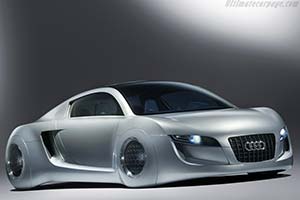
| Audi RSQ |
| Article | Image gallery (12) | User Comments (1) |
|
|
Add your comments on the Audi RSQ
| mag lev spheres |
| NormanGH 10-8-2004 |
This car could be built for real now. It runs on mag lev spheres. It is less complex than existing cars. This means all systems are replaced by electronics. For example the brakes, no mechanical contact, its all done with electronic switching of the magnets. Steering, the spheres are controlled by switching of the magnets lines that lie at right angles to each other. To see all the basic detail visit the UK Patent Office�s web site and look up the reference no GB2371033B author Hannaford. Because it is so simple there will be no stopping its eventual production for real. What we have to day is no different to what we had 100 years ago. Wait till the Japanese wake up to this idea, they just love anything that is mag lev. I wonder who will get it off the ground first, where are the Americans, let�s see some muscle, that should stir things up a bit. |
| Article | Image gallery (12) | User Comments (1) |
| All Cars - Contact us - Privacy Statement - Top | © 1998 - 2026 Ultimatecarpage.com |