<< Prev Page 2 of 2 For the opening (non-Championship) races of the season Lotus and the team's main driver Jim Clark used the new Lotus 24 together with the customer teams. It proved to be a competitive car, but not an instant winner, which for obvious reasons did not bother Chapman too much. At the first of the World Championship in Zandvoort, Lotus wheeled out the ace they had kept up their sleeves for a good few months. Jim Clark immediately was the quickest man in the field, which made the 9th place finish due to technical difficulties somewhat disappointing. In the remaining eight races that season Clark racked up three victories, but he was beaten in Championship by Graham Hill, who scored three wins. Now almost a year old, the Lotus 25 was technically still well ahead of the rest of the field in 1963. A better reliability record saw Clark win seven out of the ten races that season, easily winning Lotus' first Driver's and Constructor's titles.
Throughout the 1963 season minor modifications were made to the '25', most noticeable was the installation of a newer version of the Climax engine that had low exhausts instead of the high 'pipes' of the first version. To stay one ahead of the competition, work was started on a successor for the 1964 season. Visibly similar to its predecessor, this Lotus 33 featured so many subtle changes that very few parts were interchangeable. The suspension was completely new to take even more advantage of the monocoque's rigidity and the ever grippier rubber. The 33 also used the latest generation Climax V8, which featured a flat pane crank and mechanical Fuel Injection. To accommodate for this slightly longer engine, the '33' also had a longer wheelbase.
Lotus' competition arrived at the first Grand Prix of 1964 considerably stronger and in larger numbers than before. Jim Clark and the Lotus were still one of the fastest combinations on the grid with five pole positions in the ten races that seasons. Sadly, he managed to convert that speed in only three victories and was beaten in the championship by the more consistent Graham Hill and World Champion John Surtees. For the last season of the 1.5 litre regulations, Coventry Climax introduced a new four valve version of the FWMV engine that brought the Lotus right back into it. Armed with the more powerful engine and fully developed 33 chassis, Jim Clark continued where he left off in 1963 by winning six of the ten rounds in 1965. In the following years 33s equipped with larger engines were used in the Tasman series and even Formula 1, with a lot and very little success respectively. Colin Chapman would go on to win races and championships with innovative designs, starting off with the real Lotus 33 replacement; the Lotus 49, which was the first Formula 1 car with a fully stressed engine. << Prev Page 2 of 2

 Ultimatecarpage.com
> Cars by brand
> Great Britain
> Lotus
Ultimatecarpage.com
> Cars by brand
> Great Britain
> Lotus
 Racing cars
> Formula 1
Racing cars
> Formula 1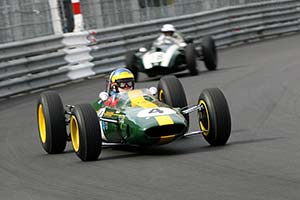
 For the opening (non-Championship) races of the season Lotus and the team's main driver Jim Clark used the new Lotus 24 together with the customer teams. It proved to be a competitive car, but not an instant winner, which for obvious reasons did not bother Chapman too much. At the first of the World Championship in Zandvoort, Lotus wheeled out the ace they had kept up their sleeves for a good few months. Jim Clark immediately was the quickest man in the field, which made the 9th place finish due to technical difficulties somewhat disappointing. In the remaining eight races that season Clark racked up three victories, but he was beaten in Championship by Graham Hill, who scored three wins. Now almost a year old, the Lotus 25 was technically still well ahead of the rest of the field in 1963. A better reliability record saw Clark win seven out of the ten races that season, easily winning Lotus' first Driver's and Constructor's titles.