<< Prev Page 3 of 3 Even though the Cosworth engine had now become available for other teams, 1968 was expected to be a Lotus year. Clark got off to a good start by winning the season opening round at Kyalami, before being tragically killed in a F2 Lotus at Hockenheim in April. Deeply saddened, Chapman knew he had to move forward and at the second race of the season he changed the outlook of the sport once more again. The sole Lotus 49 entered was the first F1 car to be livered in the colours of the sponsor. In this case the red, white and gold of the Gold Leaf cigarette company. Finally Hill was not hampered by technical difficulties and took a convincing win just weeks after Clark's tragic death.
Chapman had even more up his sleeve and at the very next race introduced the Lotus 49B. It used a slightly longer wheelbase and a new Hewland gearbox, but more importantly it was equipped with wings. It was the start of a season that would see a wide variety of aerodynamic aids being tried with the suspension mounted high wings as the most extreme examples. Hill would score a debut win with the 49B at Monaco, but then had to wait until the final round for another win. It was sufficient for the driver's title for Hill and the constructor's title for Lotus. The Cosworth engine had won all but one race that season and it would go on to dominate F1 for many years to come. Its availability also made getting into F1 a lot easier than it was before or is today.
Further developed, the Lotus 49 would be raced for another season and a half. For 1969 Graham Hill was joined by Jochen Rindt, but neither was a force as the Cosworth powered Matras and Brabhams had a clear advantage. Hill managed to score one win, at his much beloved Monaco track and Rindt won the USA Grand Prix. Lotus finished the season in a distant third. Waiting for the new and again ground-breaking Lotus 72 to be ready, the 49 was used for a few races in 1970 with a final victory for Rindt at Monaco as the best result. The Lotus 49 has found its way into the history books as one of the most influential F1 designs, having served to introduce the Cosworth engine, sponsorship liveries and wings to Grand Prix racing. Lined up next to the 1960 Ferrari 246 Dino, it is hard to imagine that the two were produced less than a decade apart. << Prev Page 3 of 3

 Ultimatecarpage.com
> Cars by brand
> Great Britain
> Lotus
Ultimatecarpage.com
> Cars by brand
> Great Britain
> Lotus
 Racing cars
> Formula 1
Racing cars
> Formula 1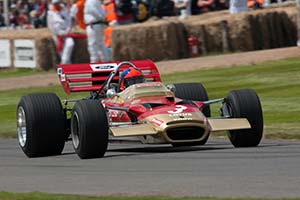
 Even though the Cosworth engine had now become available for other teams, 1968 was expected to be a Lotus year. Clark got off to a good start by winning the season opening round at Kyalami, before being tragically killed in a F2 Lotus at Hockenheim in April. Deeply saddened, Chapman knew he had to move forward and at the second race of the season he changed the outlook of the sport once more again. The sole Lotus 49 entered was the first F1 car to be livered in the colours of the sponsor. In this case the red, white and gold of the Gold Leaf cigarette company. Finally Hill was not hampered by technical difficulties and took a convincing win just weeks after Clark's tragic death.