<< Prev Page 2 of 2 With just four days to go until the second deadline would expire, Rene Dreyfuss arrived at Montlhéry with the new Delahaye 145. It would not be a surprise if the barely finished, unpainted and above all very ugly racer was received very skeptically by the gathered crowd. Once it got going the skepticism turned into admiration as Dreyfus started to get well up to speed and at the end of the day was just fast enough to beat the record and claim the prize money. The gamble had paid off and Delahaye was one million Francs and a brand new Grand Prix racer richer. In fact the car was designed in such a way that it would also be eligible for Le Mans, so the ploy to get France back on the international racing map had really worked. To celebrate this major achievement the Delahaye was painted blue with a red and white banner running down each side of the car from the radiator cap. Now that there was some more time for details, the body was slightly revised and especially in sports trim with its large swooping fenders the 145 did not look too bad. Along the same lines four more examples of the V12 racers were constructed.
Thanks to its head-start, the Delahaye 145 was the only car ready in time for the 1938 season. Dreyfus profited from the problems the other teams had coming to grips with the engine displacement limitations by winning the Pau and Cork Grand Prix. Once the three litre supercharged Mercedes-Benz was ready there was little the French could do; it was almost twice as powerful. There was more success though for Delahaye that season when a six cylinder 135 took the marque's first overall win at Le Mans. The 145s were fielded there and other endurance races like the Mille Miglia as well, but the V12 engine proved too fragile. A fully single seater version of the V12, dubbed the 155, was constructed as a last, but unfruitful attempt to regain competitiveness. War fell over Europe and the racing cars were disassembled and carefully hidden. When the hostilities were over at least three 145s were re-assembled, fitted with new bodies and detuned engines, and sold as road cars. Delahaye's racing days were over. << Prev Page 2 of 2

 Ultimatecarpage.com
> Cars by brand
> France
> Delahaye
Ultimatecarpage.com
> Cars by brand
> France
> Delahaye
 Racing cars
> Other Sportscars
Racing cars
> Other Sportscars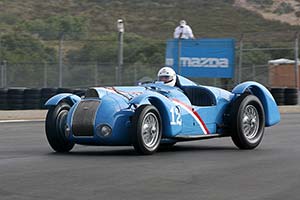
 With just four days to go until the second deadline would expire, Rene Dreyfuss arrived at Montlhéry with the new Delahaye 145. It would not be a surprise if the barely finished, unpainted and above all very ugly racer was received very skeptically by the gathered crowd. Once it got going the skepticism turned into admiration as Dreyfus started to get well up to speed and at the end of the day was just fast enough to beat the record and claim the prize money. The gamble had paid off and Delahaye was one million Francs and a brand new Grand Prix racer richer. In fact the car was designed in such a way that it would also be eligible for Le Mans, so the ploy to get France back on the international racing map had really worked. To celebrate this major achievement the Delahaye was painted blue with a red and white banner running down each side of the car from the radiator cap. Now that there was some more time for details, the body was slightly revised and especially in sports trim with its large swooping fenders the 145 did not look too bad. Along the same lines four more examples of the V12 racers were constructed.