<< Prev Page 3 of 3 Throughout the production run, the engine dimensions stayed the same. An increase of 55 bhp was achieved by adding a Supercharger. Only a handful of supercharged Model Js were constructed and they are today commonly known as the Model SJ, a name never used by Duesenberg themselves. A final evolution was the addition of ram-horn intakes on the last supercharged models. Fitted in two short wheelbase chassis, this engine reportedly produced up to 400 bhp, a stunning figure even today. Two of these 'super-Duesenbergs' were constructed and are reffered to as ssJs, again a designation never used by the factory.
Production ceased in 1937 because of the depression and for a number of specific reasons. The Model J's development grounded to a halt in 1932, when Fred Duesenberg died from the results of a car crash. By 1937 the chassis and gearbox were ancient compared to the competition and a thorough redesign was needed to bring Duesenberg back on top once more. The Cord company had lost interest in Duesenberg, which from a business perspective never lived up to the expectations. E.L. Cord had left the company and with him went the enthusiasm required to keep a brand like Duesenberg alive.
Today the Model J is considered to be one of the most legendary cars ever constructed. The combination of state-of-the-art racing inspired engineering, the era's finest coach-building and the cars' many famous owners have all contributed to that legend. One of the most told stories about the Model J underlined the engine's incredible power; the Model J could smoothly accelerate from 10 mph to 89 mph in second gear. The ssJ's top-speed is estimated to be close to 160 mph, faster than any other pre-War road car. << Prev Page 3 of 3

 Ultimatecarpage.com
> Cars by brand
> United States
> Duesenberg
Ultimatecarpage.com
> Cars by brand
> United States
> Duesenberg
 SJ Weymann 'Fishtail' Speedster
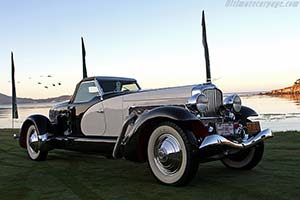
 Throughout the production run, the engine dimensions stayed the same. An increase of 55 bhp was achieved by adding a Supercharger. Only a handful of supercharged Model Js were constructed and they are today commonly known as the Model SJ, a name never used by Duesenberg themselves. A final evolution was the addition of ram-horn intakes on the last supercharged models. Fitted in two short wheelbase chassis, this engine reportedly produced up to 400 bhp, a stunning figure even today. Two of these 'super-Duesenbergs' were constructed and are reffered to as ssJs, again a designation never used by the factory.