<< Prev Page 2 of 2 With the chassis and running gear considerably closer to the ground, the Type 57 S also required a lower version of the original cast-iron straight eight. This was achieved by fitting a competition derived dry-sump oil system. The twin-cam head and engine block were left largely untouched. What did change was the compression ratio, which helped raise the power of the 3.3 litre engine from 135 to 170 bhp. Shortly after the first Atlantic was produced, Bugatti introduced an optional Roots-type supercharger. This added a further 40 bhp to the engine's output. Only one of the four Atlantics were originally fitted with the Type 57 SC engine but all surviving cars were upgraded soon after.
All three Atlantics that were sold to customers survived the War largely undamaged. The same could not be said for the Aerolithe and the factory show car, which was the only one fitted from new with a supercharged engine. The Aerolithe was most likely cannibalised for parts for production cars in the late 1930s. The missing Atlantic was on a list of cars that were due to be hidden away from the Germans in Bordeaux but it has never surfaced again. In 1955 one of the remaining three Atlantics was involved in a horrific collision with a train, leaving just two complete cars. The crashed car was, however, rebuilt in the early 1970s and more thoroughly in 2010.
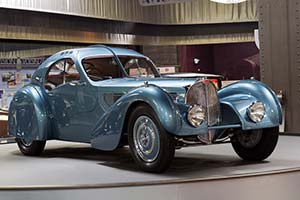
Today the Atlantic is generally considered Bugatti's ultimate creation, which, by default, makes it one of the finest cars ever constructed. The futuristic lines with its beautiful details also make it a true icon. During the last decades the two original cars have been in long-term ownership and only the death of one of the owners resulted in one coming to the market. It sold in the spring of 2010 for well over $30 million; the highest known price ever paid for a car. Both of the complete survivors have won the prestigious 'Best of Show' award at the Pebble Beach Concours d'Elegance, further underlining their significance. << Prev Page 2 of 2

 Ultimatecarpage.com
> Cars by brand
> France
> Bugatti
Ultimatecarpage.com
> Cars by brand
> France
> Bugatti
 Type 57 SC Atlantic Coupe
 With the chassis and running gear considerably closer to the ground, the Type 57 S also required a lower version of the original cast-iron straight eight. This was achieved by fitting a competition derived dry-sump oil system. The twin-cam head and engine block were left largely untouched. What did change was the compression ratio, which helped raise the power of the 3.3 litre engine from 135 to 170 bhp. Shortly after the first Atlantic was produced, Bugatti introduced an optional Roots-type supercharger. This added a further 40 bhp to the engine's output. Only one of the four Atlantics were originally fitted with the Type 57 SC engine but all surviving cars were upgraded soon after.