<< Prev Page 3 of 3 For the 1982 season the rules were drastically changed with the arrival of the 'Group C' class, which replaced all existing prototype classes. One of the biggest changes was the introduction of 'ground effect' aerodynamics, which rendered the existing machines virtually obsolete. This was the cue for Rondeau to start the development of the all new M482. Unfortunately the project suffered from setbacks and delays, which meant the car was not ready for the 24 Hours of Le Mans. As a stop-gap, Rondeau produced the M382, which combined the existing chassis with the in-board suspension developed for the M482. The car also featured a slightly longer tail without the typical rear wheel covers of the M378/9 series. The M382 was also the first new Rondeau made available to customers. In fact the first two chassis were sold to customers in the United States and were raced in the Daytona 24 Hours; the very first time a Rondeau was used away from Le Mans.
Rondeau also broke with tradition by entering the full World Championship. This was immediately awarded with a debut victory for the M382 at the Monza 1000 km. The winning car was powered by the latest DFL engine, now displacing just under 4 litre. At the next round, the Silverstone 1000 km, Porsche debuted the all new 956 Group C car complete with a sophisticated 'ground effect' aero-package. On raw speed the Porsche was superior but the Rondeau team had a very steady run throughout the season and amassed enough points to be in contention for the World Championship. The French manufacturer eventually lost out after Porsche convinced the FIA to add the points scored by a privately entered Porsche at the Nurburgring 1000 km to their tally. Uncharacteristically, the team's worst performance came at Le Mans, where only a privately entered M379 and M382 reached the finish.
In 1983 all attention was on the new M482 with substantial support of Ford. The small team unfortunately failed to get to grips with the complicated 'ground effect' aerodynamics. With the arrival of more major manufacturers, Rondeau's fortunes withered. By the end of the season, the company was in receivership. The sad end of the story was Jean Rondeau's fatal crash at a railway crossing in 1985. The cars he built outlived him and were raced until the late 1980s. During the brief lull of manufacturer involvement, Le Mans lay up for grasps for small 'garagists' and Jean Rondeau convincingly made the most of it. The Rondeau remains as the last privately developed car to win the big race. Jean Rondeau's exploits have inspired the likes of Yves Courage and Henri Pescarolo to also pursue a Le Mans victory with locally developed machinery. << Prev Page 3 of 3

 Ultimatecarpage.com
> Cars by brand
> France
> Rondeau
Ultimatecarpage.com
> Cars by brand
> France
> Rondeau
 Racing cars
> Other Sportscars
Racing cars
> Other Sportscars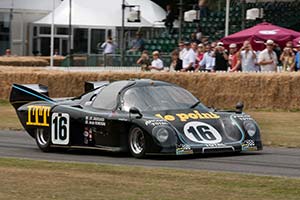
 For the 1982 season the rules were drastically changed with the arrival of the 'Group C' class, which replaced all existing prototype classes. One of the biggest changes was the introduction of 'ground effect' aerodynamics, which rendered the existing machines virtually obsolete. This was the cue for Rondeau to start the development of the all new M482. Unfortunately the project suffered from setbacks and delays, which meant the car was not ready for the 24 Hours of Le Mans. As a stop-gap, Rondeau produced the M382, which combined the existing chassis with the in-board suspension developed for the M482. The car also featured a slightly longer tail without the typical rear wheel covers of the M378/9 series. The M382 was also the first new Rondeau made available to customers. In fact the first two chassis were sold to customers in the United States and were raced in the Daytona 24 Hours; the very first time a Rondeau was used away from Le Mans.