<< Prev Page 2 of 3 Next >> The 'M 93654' engine was fed by a single Mercedes up-draft carburettor. The first competition engine to rev over 3,000 rpm, the 'four' produced its peak power of 106 bhp at 3,100 rpm. This was quite an achievement considering no other Mercedes/Daimler engine built up to that point could safely rev over 1,500 rpm. A separately mounted four-speed gearbox was used. This was connected to the rear wheels not through the chains previously used but by a propellor shaft for weight saving reasons.
The chassis of the new Grand Prix racer followed convention with a cross-braced, pressed-steel frame suspended by semi-elliptic leaf springs and solid axles. One of the things carried over from the 1913 experimental cars was the V-shaped radiator and tightly wrapped aluminium body complete with belly pan. To reduce drag even further, even the front axles were 'streamlined'. Unlike most of the rivals the Mercedes '18/100' only featured brakes on the rear axle and an additional transmission brake.
Touted as the most important race yet, the entrants of the French Grand Prix not only represented the respective manufacturers but also their countries of origin. Considering the political tension that was quickly building around Europe, the nationalistic feelings reached boiling points. Mercedes entered five cars and in addition to three Peugeots further high level entries were fielded by Fiat, Opel and Sunbeam. Among the Mercedes drivers was the company's test pilot Christian Lautenschlager, who had surprisingly won the 1908 Grand Prix for Mercedes. << Prev Page 2 of 3 Next >>

 Ultimatecarpage.com
> Cars by brand
> Germany
> Mercedes
Ultimatecarpage.com
> Cars by brand
> Germany
> Mercedes
 Racing cars
> Pre 1950 GP
Racing cars
> Pre 1950 GP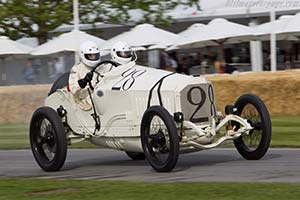
 The 'M 93654' engine was fed by a single Mercedes up-draft carburettor. The first competition engine to rev over 3,000 rpm, the 'four' produced its peak power of 106 bhp at 3,100 rpm. This was quite an achievement considering no other Mercedes/Daimler engine built up to that point could safely rev over 1,500 rpm. A separately mounted four-speed gearbox was used. This was connected to the rear wheels not through the chains previously used but by a propellor shaft for weight saving reasons.