<< Prev Page 2 of 2 When taking a closer look at the racer itself, it is actually surprising that the FIA inspectors only found the car to be underweight. Although based on the 275 GTB, it was built as a racing car from the ground up. The chassis was constructed from smaller diameter, round tubes, which lowered the weight while maintaining the rigidity. The double wishbone suspension and gearbox mounted in unit with the differential (transaxle) were carried over from the road. Power came from a specifically tuned version of the road car's 3.3 litre V12. Using competition components and six Weber carburettors, it was very close to the specification of the 250 LM engine and produced around 300 bhp.
It is believed that Ferrari originally readied four chassis, presumably one for each major privateer teams. Due to the homologation issues production was delayed and once completed, no two were exactly the same. They shared the 275 GTB centre section, while the front design combined cues of the 275 GTB and the earlier 250 GTO. The tail also revealed the racer's origins but featured a more pronounced cut-off, 'Kamm' design. Dramatic gills were cut in the side panels both fore and aft of the cockpit to dissipate heat. While similar in design to the road car, the new racer was actually notably smaller and has often been described as a 7/8 scale model of the 275 GTB.
Of the four cars built, only one was eventually raced. Perhaps in reference to the homologation problems, Ferrari simply referred to the car as a 275 GTB. Today the model is commonly referred to as the 275 GTB Competizione Speciale to distinguish it from later racing derivatives. As a prototype, Ferrari fielded the car in the Targa Florio and the Nürburgring 1000 km, where it proved blisteringly quick compared to the 'other' GT cars. Once homologated, it was sold to Ecurie Francorchamps, who fielded it in the 24 Hours of Le Mans. In the hands Willy Mairesse and Jean Blaton, it finished a very impressive third overall (behind two 250 LMs) and first in the GT class.
The Le Mans class-winning car was subsequently fielded by the North American Racing Team (NART) in the fall of 1965. It won the Nassau Tourist Trophy outright and in the Nassau Governer's Trophy, it scored another class victory. Sadly, this was the end of the racing career of this formidable machine. With the World Championship switching to sports cars for 1966, Ferrari had lost the incentive to develop a replacement. The Italian manufacturer did build another two series of much more mildly modified 275 GTBs but the four cars readied for 1965 can be considered the last of an illustrious line. Effectively a '65 GTO', the Competizione Speciale was only allowed to shine briefly but still remains as one of the great Ferrari GT racers. << Prev Page 2 of 2

 Ultimatecarpage.com
> Cars by brand
> Italy
> Ferrari
Ultimatecarpage.com
> Cars by brand
> Italy
> Ferrari
 Racing cars
> GT Cars
Racing cars
> GT Cars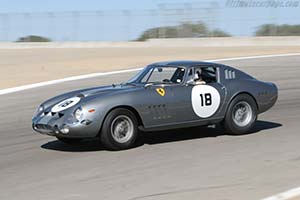
 When taking a closer look at the racer itself, it is actually surprising that the FIA inspectors only found the car to be underweight. Although based on the 275 GTB, it was built as a racing car from the ground up. The chassis was constructed from smaller diameter, round tubes, which lowered the weight while maintaining the rigidity. The double wishbone suspension and gearbox mounted in unit with the differential (transaxle) were carried over from the road. Power came from a specifically tuned version of the road car's 3.3 litre V12. Using competition components and six Weber carburettors, it was very close to the specification of the 250 LM engine and produced around 300 bhp.