
 Ultimatecarpage.com
> Cars by brand
> United States
> Chevrolet
Ultimatecarpage.com
> Cars by brand
> United States
> Chevrolet
 Camaro Z/28 Camaro Z/28
|
| Chevrolet Camaro Z/28 |
| Article | Image gallery (20) | Specifications | User Comments (1) | Video (1) |
|
|
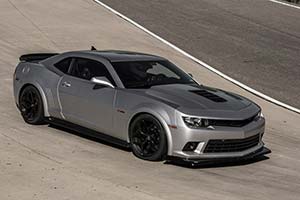
<< Prev Page 3 of 3  The singular focus of the Camaro Z/28 is most evident in the chassis, where the most has been made of every component for track use, from the ultra-high performance tires to race-proven dampers. The singular focus of the Camaro Z/28 is most evident in the chassis, where the most has been made of every component for track use, from the ultra-high performance tires to race-proven dampers."We used the very best components in the industry to deliver uncompromised performance, lap after lap," said Mark Stielow, Camaro Z/28 engineering manager. "We made nearly 200 changes to improve the track performance, which cumulatively make the Z/28 capable of 1.05 g in cornering. For perspective, with all other things, equal increasing maximum grip from 1 to 1.05 g can cut up to four seconds per lap." The Camaro Z/28 is the one of the first production cars fitted with race-proven, spool-valve dampers. Compared to a conventional damper that offers only two-way tuning for bump and rebound, a spool-valve damper allows four-way adjustment to precisely tune both bump and rebound settings for high-speed and low-speed wheel motions. The wider tuning range allowed engineers to dramatically increase the damper stiffness on the Camaro Z/28 without a significant change in ride quality. Additional chassis changes include stiffer string rates and suspension bushings for improved cornering response. The Camaro Z/28 features 19-inch diameter wheels and tires, which reduce unsprung weight by 42 pounds (19 kilograms) per car compared to the 20-inch wheels standard on Camaro ss and ZL1. In addition, the smaller diameter wheels lower the center of gravity by 33 millimeters, further improving handling. At all four corners, the lightweight, forged aluminum wheels are wrapped in massive 305/30ZR19 tires. This is the first production application of ultra-high performance Pirelli PZero Trofeo R tires, and believed to be the widest front tire on any production car. To fully exploit the grip of the Pirelli tires, the Camaro Z/28 also features Brembo Carbon Ceramic Matrix rotors and fixed, monoblock calipers. The large 394 x 36 mm front rotors are paired with six-piston calipers, while the 390 x 32 mm rear rotors are paired four-piston calipers. Compared to similar-size, two-piece steel rotors, the lightweight carbon discs save 28 pounds (12.5 kilograms) per car. The combination of tire grip and braking power enable the Camaro Z/28 to achieve up to 1.5 g in deceleration. With standard front brake cooling ducts, the Z/28 is also capable of continuous track use unmatched brake feel, lap after lap. "What makes the Z/28 so addictive is it inspires confidence through every section on the track," said Stielow. "The incredible, balanced performance helps you carry much more speed through every corner: the brakes are so good you can adjust your braking points later and later; the grip and suspension damping allows you to carry more speed through the apex; and then the limited slip allows you to make the most of the LS7 as you power out of the corner." To optimize the track performance of the Camaro Z/28, the engineering team subjected it to an intensive lightweighting program, saving 100 pounds (45 kilograms) compared to the naturally aspirated Camaro ss and 300 pounds (136 kilograms) to the supercharged Camaro ZL1. "We looked at every subsystem for opportunities to save weight," said Oppenheiser. "Our goal was to get rid of everything that didn't make the car faster, and keep only what was required by law. For example, we wanted to eliminate the audio system completely, but we had to keep a single speaker for the seat-belt chime to meet safety requirements." Other examples of weight savings include:
<< Prev Page 3 of 3 |
| Article | Image gallery (20) | Specifications | User Comments (1) | Video (1) |
| All Cars - Contact us - Privacy Statement - Top | © 1998 - 2026 Ultimatecarpage.com |