<< Prev Page 2 of 2 Dubbed the 330 TRI/LM, the 'experimental' Ferrari made its public debut at the official test day in the hands of Mike Parkes. Still fitted with only three Webers, it was easily the quickest the car, beating its nearest rival by almost four seconds. That closest competitor was a GTO fitted with a similar four litre engine. Built specifically for the 24 Hours, the 330 TRI/LM was only used in a test at Monza in the two months between the test day and the race. Lined up to drive the car in the race were 1961 winners Phil Hill and Olivier Gendebien. Their closest rivals were a variety of other Ferraris, the Tipo 151 Maseratis entered by Briggs Cunningham and the sole Aston Martin DP212. The big Ferrari proved to be the quickest car again, topping all time sheets. Reliability was the biggest worry for Hill and Gendebien with the clutch being the weak link. It would start to slip at peak power, so the two experienced drivers had to 'short shift' the car throughout the race. In the end the 330 TRI/LM did not succumb but all of its rivals did, enabling the Testa Rossa to record its fourth victory in the classic endurance race. The second placed 250 GTO was a full five laps down.
Ineligible for any further races Ferrari intended to compete in, the unique 330 TRI/LM was sold to American importer Luigi Chinetti immediately after Le Mans. It had been acquired for the two Rodriguez brothers, who used it to win a 'big banger' race at Bridgehampton and to finish second in the Mosport Grand Grand Prix. Masten Gregory subsequently piloted chassis 0808 to a fourth place finish during the popular Nassau Speed Week at the end of the year. In March of 1963, Chinetti entrusted the four-litre Ferrari to Pedro Rodriguez and reigning Formula 1 World Champion Graham Hill for the Sebring 12 Hours. They finished third behind two of the latest mid-engined Ferraris. Fittingly, its next and final outing came at the 24 Hours of Le Mans where Pedro Rodriguez was joined by Roger Penske. The powerful machine faired remarkably well against the mid-engined works Ferraris until Penske had a big accident in the high-speed section between the Mulsanne and Indianapolis corners. The crash brought an end to the car's contemporary racing career.
With the 330 TRI/LM, Ferrari made the most of the ACO's desire to have potent sports cars star in the 24 Hours of Le Mans. It has gone into history as the last Testa Rossa built, the last Testa Rossa to win Le Mans and most importantly the last front-engined car to win Le Mans outright. In 1982 Road & Track 'Salon' feature, Phil Hill described the car as 'almost pleasant to drive' thanks to the advanced aerodynamics and despite the ferociously powerful engine. << Prev Page 2 of 2

 Ultimatecarpage.com
> Cars by brand
> Italy
> Ferrari
Ultimatecarpage.com
> Cars by brand
> Italy
> Ferrari
 Racing cars
> Other Sportscars
Racing cars
> Other Sportscars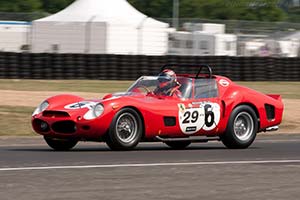
 Dubbed the 330 TRI/LM, the 'experimental' Ferrari made its public debut at the official test day in the hands of Mike Parkes. Still fitted with only three Webers, it was easily the quickest the car, beating its nearest rival by almost four seconds. That closest competitor was a GTO fitted with a similar four litre engine. Built specifically for the 24 Hours, the 330 TRI/LM was only used in a test at Monza in the two months between the test day and the race. Lined up to drive the car in the race were 1961 winners Phil Hill and Olivier Gendebien. Their closest rivals were a variety of other Ferraris, the Tipo 151 Maseratis entered by Briggs Cunningham and the sole Aston Martin DP212. The big Ferrari proved to be the quickest car again, topping all time sheets. Reliability was the biggest worry for Hill and Gendebien with the clutch being the weak link. It would start to slip at peak power, so the two experienced drivers had to 'short shift' the car throughout the race. In the end the 330 TRI/LM did not succumb but all of its rivals did, enabling the Testa Rossa to record its fourth victory in the classic endurance race. The second placed 250 GTO was a full five laps down.