
 Ultimatecarpage.com
> Cars by brand
> Germany
> Audi
Ultimatecarpage.com
> Cars by brand
> Germany
> Audi
 TTS Roadster TTS Roadster
|
| Audi TTS Roadster |
| Article | Image gallery (12) | Specifications |
|
|
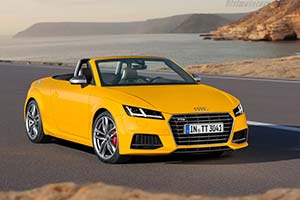
<< Prev Page 2 of 3 Next >>  The body of the TT Roadster and the TTS Roadster represents a new evolution of the Audi Space Frame (ASF) based on the modular transverse matrix (MQB). Ultra-high-strength components made from hot-shaped steel reinforce the front section and the passenger compartment floor. The passenger compartment and all outer skin and attachment parts are made of the classic semi-finished aluminum products cast node, extruded profile and sheet metal. The body of the TT Roadster and the TTS Roadster represents a new evolution of the Audi Space Frame (ASF) based on the modular transverse matrix (MQB). Ultra-high-strength components made from hot-shaped steel reinforce the front section and the passenger compartment floor. The passenger compartment and all outer skin and attachment parts are made of the classic semi-finished aluminum products cast node, extruded profile and sheet metal.With the 2.0 TFSI and manual transmission, the unladen weight of the TT Roadster (without driver) is only 1,320 kilograms (2,910.1 lb). The Audi engineers have also further improved the crash safety through the intelligent composite concept in the TT Roadster. Compared with the Coupé, the body of the Roadster has been modified in important areas. The aluminum A-pillars each conceal a second steel pillar in their interior, which in turn houses a solid steel tube. Internal steel ribbing ensures the aluminum sills have high-strength properties. V-shaped steel struts reinforce the zones underneath the engine compartment and the luggage compartment, and connect the axle carriers. In the TT Roadster and the TTS Roadster, a solid wall consisting of two box profiles separates the interior from the luggage compartment, and replaces the bottom cross member found on the Coupé. The upper area of this wall houses the steel roll-over bars, whose elegantly rounded form marks another classic design theme. Mounting plates seal the openings in the rear wall, which features through-loading as standard. The new TT Roadster is being launched with two turbocharged four-cylinder engines, a TDI and a TFSI. A powerful TFSI ensures efficient drive in the TTS Roadster. With power outputs between 135 kW (184 hp) and 228 kW (310 hp), they clearly surpass the respective predecessor engines in terms of power, while significantly undercutting them with regard to consumption. Using the modular transverse matrix, all engines are mounted in the same place - their installation location has great advantages with regard to packaging. A start-stop system is included as standard. In combination with the optional driving dynamics system Audi drive select (fitted as standard on the TTS Roadster), the adjustable engine sound makes the sound even more sonorous. Featuring 135 kW (184 hp) and 380 Nm (280.3 lb-ft) of torque, the 2.0 TDI ultra is already a sporty engine. As with all engines in the new TT family, the two-liter diesel engine meets the Euro 6 standard. It averages just 4.3 liters of fuel per 100 kilometers (54.7 US mpg), which equates to CO2 emissions of 114 grams of CO2 emissions per kilometer (183.5 g/mi) - a new best figure in its segment. The 2.0 TFSI produces 169 kW (230 hp) and 370 Nm (272.9 lb-ft) of torque in the TT Roadster; in the TTS Roadster, these figures are as high as 228 kW (310 hp) and 380 Nm (280.3 lb-ft). The top model breaks into the high-performance range, sprinting from 0 to 100 km/h (62.1 mph) in 4.9 seconds on its way to an electronically governed top speed of 250 km/h (155.3 mph). The switchable flaps in the exhaust system underscore the sporty sound. The 2.0 TFSI channels its output to a manual six-speed transmission; the output can optionally be channeled to a six-speed S tronic. The dual-clutch transmission shifts rapidly through the gears without any noticeable break in propulsive power and can be controlled by paddles on the steering wheel if desired. In efficiency mode in the Audi drive select system, the S tronic coasts when the driver takes their foot off the gas. New technology: quattro permanent all-wheel driveThe quattro permanent all-wheel drive has been fully redeveloped; it is optionally available in combination with the 2.0 TFSI engine in the TT Roadster and is fitted as standard on the TTS Roadster. During regular driving, its electrohydraulic multi-plate clutch optimally distributes the drive torque between the front and rear axle depending on driving conditions, road characteristics and driver type. Driving enjoyment and safety are combined at a new level by electronic clutch management. More power is routed to the rear axle during sporty driving, literally propelling the new TT Roadster and the TTS Roadster into corners. Safe, controlled drifts are possible on low-friction surfaces. The third TT generation is the first in which the permanent all-wheel drive is integrated into the dynamic handling system Audi drive select. The driver can use this to toggle the engine characteristics and the operation of the steering support between the comfort, auto, dynamic, efficiency and individual modes. Audi drive select also accesses a series of optional technical modules including the adaptive damper control Audi magnetic ride (fitted as standard on the TTS Roadster) and the six-speed S tronic. A synthetic hydrocarbon oil containing microscopically small magnetic particles circulates within the damper pistons. Each of the front dampers contains 154 milliliters (6.1 in), the rear dampers 185 milliliters (7.3 in) apiece. When a voltage is applied to a coil, a magnetic field is generated in which the alignment of the particles changes so that they are perpendicular to the oil flow, thereby inhibiting its flow through the shock absorber channels. The control unit continuously analyzes the driving properties and the condition of the road. Depending on the setting in Audi drive select, the ride of the new Audi TT Roadster and the TTS Roadster is either relatively comfortable, balanced or decidedly taut. The dynamic mode unveils its full dynamic potential. The targeted bracing of the individual wheels during fast cornering ties the Roadster tightly to the road. It largely suppresses roll and makes steering response even more spontaneous. Audi magnetic ride reduces body pitch during braking. The McPherson principle is used for the front suspension of the new Audi TT Roadster and the TTS Roadster. Aluminum components reduce the weight of the unsprung masses. The steering rack of the standard progressive steering is designed so that the steering ratio becomes increasingly direct when turning. The rear axle, which features four steel links per wheel, can handle the longitudinal and transverse forces separately. Together with the progressive steering, the sophisticated suspension and the taut tuning lead to high-precision dynamic handling. The body is lowered by 10 millimeters (0.4 in) on the TTS Roadster, in conjunction with the S line sports package and with Audi magnetic ride. The TT Roadster 2.0 TFSI and the TT Roadster 2.0 TDI roll on 17-inch lightweight wheels, each of which weighs only 8.7 kilograms (19.2 lb); the tire dimension is 225/50. On the TTS Roadster, the format is 18 inch and the tire size 245/40; the available options range up to 20-inch format. The newly developed tires are noted for their improved performance together with significant optimization of rolling resistance. Brakes that can be precisely metered and convey a taut pedal feel are located behind the large wheels. The vented front discs have a diameter between 312 and 338 millimeters (12.3 - 13.3 in) depending on the engine version. The TTS Roadster features newly developed, particularly lightweight aluminum fixed-caliper brakes on the front axle. Another innovation, the electromechanical parking brake, takes effect at the rear wheels regardless of engine version. The Electronic Stabilization Control (ESC), which can be switched off either partly or completely, perfectly complements the car's sporty handling. Wheel-selective torque control takes effect when cornering: Where necessary, it can distribute the drive torque from the front wheel on the inside of the curve to the front wheel on the outside of the curve (in the case of front-wheel drive). With quattro drive, this is also performed at the rear wheel. The car turns very easily into the curve thanks to the difference in propulsive forces, which is helpful for the driver. This enables more precise and neutral driving around curves, with the TT Roadster realizing a major boost in terms of dynamics and stability. Sports mode facilitates particularly sporty driving, facilitating steering and control when drifting. << Prev Page 2 of 3 Next >> |
| Article | Image gallery (12) | Specifications |
| All Cars - Contact us - Privacy Statement - Top | © 1998 - 2026 Ultimatecarpage.com |