
 Ultimatecarpage.com
> Cars by brand
> Germany
> Audi
Ultimatecarpage.com
> Cars by brand
> Germany
> Audi
 R8 V10 R8 V10
|
| Audi R8 V10 |
| Article | Image gallery (5) | Specifications |
|
|
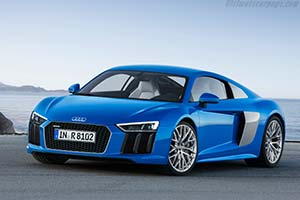
<< Prev Page 3 of 3  A cockpit positioned very far forward, a long, flowing back and a relatively short wheelbase - the exterior design makes the technical concept of the mid-engine, high-performance Audi R8 sports car clear upon first sight. At 4.42 meters long (14.5 ft), 1.24 meters high (4.1 ft) and with a wheelbase measuring 2.65 meters (8.7 ft), its dimensions have only slightly changed in comparison to the previous model. Its width now measures 1.94 meters (6.4 ft) and has thus grown by about four centimeters (1.6 in). The car's proportions convey more of a race car character, with characteristic design ideas from the previous model now more pronounced. A cockpit positioned very far forward, a long, flowing back and a relatively short wheelbase - the exterior design makes the technical concept of the mid-engine, high-performance Audi R8 sports car clear upon first sight. At 4.42 meters long (14.5 ft), 1.24 meters high (4.1 ft) and with a wheelbase measuring 2.65 meters (8.7 ft), its dimensions have only slightly changed in comparison to the previous model. Its width now measures 1.94 meters (6.4 ft) and has thus grown by about four centimeters (1.6 in). The car's proportions convey more of a race car character, with characteristic design ideas from the previous model now more pronounced.The four rings sit proudly on the hood, the Singleframe radiator grille with honeycomb design is wide and flat. Modeled plastic surfaces allow it to merge into the flat headlights - facets of the vehicle which highlight tension, provide an impression of depth and add an air of logic to the design. The grid-type signature of the daytime running lights with vertical elements replicates the structure of the air inlets and emphasizes the width of the car. The entire appearance of the Audi R8 conveys a feeling of lightness and technical precision. LED headlights are standard. Available upon request, Audi can also supply the laser spot which doubles the range of the high beam to 600 meters (1,968.5 ft) as well as the dynamic turn signals at the front. The dynamic turn signals are standard at the rear. The rear lighting signature also combines two vertical elements with a horizontal line. This gives the Audi R8 an even more powerful appearance. As part of the new laser high beams, one laser module per headlight generates a cone of light with twice the range of the all-LED headlamp. Each module comprises four high-power laser diodes. With a diameter of just 300 micrometers, these generate a blue laser beam with a wavelength of 450 nanometers. A phosphor converter transforms it into white light suitable for roadway use with a color temperature of 5,500 Kelvin - ideal conditions for the human eye that enable the driver to recognize contrast more easily and help to prevent fatigue. The laser spot is active from a speed of 60 km/h (37.3 mph) to supplement the LED high beam of the R8 and, thanks to its long range, greatly enhances the driver's field of vision as well as safety. An intelligent camera-based sensor system detects other road users and actively adjusts the light pattern to exclude them. On the sides of the high-performance sports car, characteristically curved contours are drawn over the wheels. The shoulder line, shaped like a powerful muscle, connects the wheels with one another while at the same time dividing the side blade in two to leave an upper and a lower half. This new design solution makes the car appear even longer and more dynamic. At the rear, as well, the lights and the air inlets visually connect to one another. The two tailpipes of the exhaust system have a trapezoidal design and the rear window offers a clear view of the illuminated engine compartment. The R8 is equipped with an electrically extending spoiler, the R8 V10 plus with a fixed wing made from CFRP. Behind the steering wheel of the new Audi R8, the driver feels like a race car driver. All functions are driver-oriented and allow easy operation even when the critical limits are reached - and all without the driver having to take his or her hands off the steering wheel. The newly designed sport seats with integrated headrest provide excellent lateral support. Even more radical seating for a sports car comes in the form of the newly developed R8 bucket seats. These make a clear statement confirming the relationship between lightweight construction and comfort (optional in the V10 and standard in the V10 plus). The start-stop button and the Audi drive select button are located on several satellites on the new multifunction plus steering wheel. The Performance steering wheel in the Audi R8 V10 plus features two more satellites. One button is for performance mode together with a rotary wheel for selecting the dry, wet and snow programs as well as a button for controlling the sports exhaust system. The Audi virtual cockpit is set in a free-standing housing and presents all the information on its 12.3-inch display with elaborately computed, fascinating graphics. The driver can toggle between different display modes and also adjust the digital instrument cluster to his needs in individual mode. In performance mode, the driver is presented with information on the driving programs, acceleration, deceleration and lateral forces as well as power and torque. The Audi virtual cockpit also displays a shift light which informs the driver that the engine speed limit has been reached. The driver operates the Audi virtual cockpit using the multifunction plus steering wheel. The driver's hands remain on the steering wheel and he or she can concentrate on the road. Alternatively, operation can take place via the touch wheel or the buttons in the center console. In the design of the interior too, the taut geometric lines emphasize the aesthetic lightweight construction of the brand. Its characteristic element is the monoposto, a large arc in the area around the driver's seat. The MMI monitor of the previous model is no longer available. Instead, the three central control elements of the air conditioning system have taken its place. The three-dimensional design of the air outlet vents bring to mind the air inlets of a race car. The dashboard appears to float weightlessly. The wide console of the central tunnel accommodates the standard MMI terminal as well as the newly designed flat selector lever of the S tronic transmission. When it comes to upholstery, customers can choose between Alcantara/pearl Nappa leather and fine Nappa leather. Also available are trim elements in clear coated carbon fiber, two leather packages and a new diamond stitching pattern. There are numerous customization possibilities for customers of the new Audi R8 - for both the exterior and the interior. The colors for the body have been newly mixed and can be freely combined with the colors of the side blades - a blade made from glossy carbon is a particular highlight of the range. Ten standard exterior colors are available, for the R8 V10 plus there is an additional matt paint finish available, Camouflage Green. Among the five equipment colors available for the interior, two color ranges can be found, whereby the interior is always characterized by a sporty feel. Additionally, there are numerous options to further customize both the interior and the exterior, for example with headlining in Alcantara with dynamic diamond stitching pattern. The Audi exclusive program makes it possible for you to turn the new R8 into a one-of-a-kind model. In the new Audi R8, the Audi virtual cockpit replaces the analog instruments and the MMI monitor. The driver can switch the all-digital display between two different view modes. These bring either the virtual dial instruments or the large navigation map into focus. The Audi R8 makes use of the latest technology in terms of infotainment. MMI navigation plus is installed as standard; the MMI touch touch wheel is the central control element. In the background, the second generation of the modular infotainment platform sets about its work - just like the Audi virtual cockpit, it integrates a super-fast T30 chip from Audi's cooperation partner, NVIDIA. MMI navigation plus is complemented by the Audi connect module. The passenger can connect a smartphone or tablet via the system's integrated Wi-Fi hotspot. Tailored online services from Audi connect are displayed on the Audi virtual cockpit. The internet connection uses the fast LTE (Long Term Evolution) network. Optional components such as the fine-tuned sound system from Bang & Olufsen with a system performance of 500 watts or the Audi phone box for convenient cell phone integration round off the infotainment program. << Prev Page 3 of 3 |
| Article | Image gallery (5) | Specifications |
| All Cars - Contact us - Privacy Statement - Top | © 1998 - 2026 Ultimatecarpage.com |