<< Prev Page 3 of 3 No Golf has ever had three motors before. But this one does. As described at the beginning, the combustion engine fitted by Volkswagen is a turbocharged 1.6-litre four-cylinder direct-injection engine (TSI) that produces 220 kW / 299 PS of power and a maximum torque of 400 Nm. The electric components consist of the lithium-ion battery and two electric motors. The front electric motor is integrated in the housing of the 6-speed DSG (DQ400E). Both electric motors have a power output of 85 kW. The total available system power is 295 kW / 400 PS. If necessary, the system drive power can be distributed to all four wheels thanks to the rear electric motor and an "electric propshaft". In normal operation the Golf GTE Sport drives just as quietly as the production Golf GTE that is already marketed. In "E-Mode" it is setting off purely electrically. In this case the concept car uses the battery that can be charged externally (but also whilst driving) to cruise without producing any emissions. It can cover up to 50 kilometres on a battery charge. When a defined minimum battery charge is reached, the 1.6 TSI is automatically switched on and the Golf GTE Sport drives in "Hybrid" mode. As soon as the battery reaches a certain charge level again, "E-Mode" can be reactivated at any time via a switch in the overhead console. In "E-Mode", the rear axle electric motor is first and foremost responsible for propulsion. When high demands are made on performance, the front electric motor is also activated to provide support.
As soon as the drive system or the driver deactivates "E-Mode", the Golf GTE Sport becomes a classic full hybrid with regenerative braking charging the battery and automatic utilisation of the right combination of TSI and/or electric motors according to the specific drive situation. When the driver releases the accelerator pedal, and the battery is sufficiently charged, all drive sources are shut off. This is referred to as "coasting". If the driver releases the accelerator pedal or brakes, and the battery is insufficiently charged, the two electric motors operate as generators and charge the lithium-ion battery with the energy recovered from braking. With the dual mode "Battery Hold" or "Battery Charge" the battery's energy content can be deliberately kept constant by the driver ("Hold") or increased ("Charge"). When the 1.6 TSI engine is the sole source of propulsion, the concept car is a pure front-wheel drive car.
The switch on board theGolf GTE Sport that is most important for dynamic performance is located in the overhead console. It bears the letters "GTE". When the driver operates this switch, the character of the Golf GTE Sport's drivetrain changes drastically in an instant because now the full system power of 400 PS is available. The turbocharged 299 PS petrol engine alone delivers immense propulsive power, and at this high level the electric drive components of the Golf GTE Sport assume an additional boost function. The boost effect is so strong that the drive unit would also perform well if used in professional touring car races: the Golf GTE Sport sprints to 50 km/h in 1.8 seconds, reaches 100 km/h in 4.3 seconds, and the maximum speed permitted in Austria, i.e. 130 km/h, in 6.5 seconds. On German motorways, the concept car reaches 200 km/h in 15.9 seconds. In "GTE-Mode" all four wheels of the Golf are driven.
In "GTE-Mode" and as soon as the situation necessitates it, the drive power of the Golf GTE Sport is distributed to both axles. In this case (and if battery charge is low), the front electric motor - which is now being supplied with kinetic energy via the TSI - acts solely as a generator and a source of electricity for its counterpart at the rear axle. Since the energy for driving the rear axle flows by wire and not mechanically here, this is referred to as an "electric propshaft". Because the TSI drives the rear electric motor via the front electric motor, the all-wheel drive system also operates when the battery's charge state is low - an invaluable advantage in terms of driving dynamics. The importance of the implementation of the "electric propshaft" for Volkswagen with regard to series production is demonstrated by the fact that the company has had the German equivalent of this designation protected under copyright law. << Prev Page 3 of 3

 Ultimatecarpage.com
> Cars by brand
> Germany
> Volkswagen
Ultimatecarpage.com
> Cars by brand
> Germany
> Volkswagen
 Golf GTE Sport
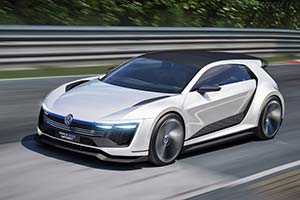
 No Golf has ever had three motors before. But this one does. As described at the beginning, the combustion engine fitted by Volkswagen is a turbocharged 1.6-litre four-cylinder direct-injection engine (TSI) that produces 220 kW / 299 PS of power and a maximum torque of 400 Nm. The electric components consist of the lithium-ion battery and two electric motors. The front electric motor is integrated in the housing of the 6-speed DSG (DQ400E). Both electric motors have a power output of 85 kW. The total available system power is 295 kW / 400 PS. If necessary, the system drive power can be distributed to all four wheels thanks to the rear electric motor and an "electric propshaft". In normal operation the Golf GTE Sport drives just as quietly as the production Golf GTE that is already marketed. In "E-Mode" it is setting off purely electrically. In this case the concept car uses the battery that can be charged externally (but also whilst driving) to cruise without producing any emissions. It can cover up to 50 kilometres on a battery charge. When a defined minimum battery charge is reached, the 1.6 TSI is automatically switched on and the Golf GTE Sport drives in "Hybrid" mode. As soon as the battery reaches a certain charge level again, "E-Mode" can be reactivated at any time via a switch in the overhead console. In "E-Mode", the rear axle electric motor is first and foremost responsible for propulsion. When high demands are made on performance, the front electric motor is also activated to provide support.