
 Ultimatecarpage.com
> Cars by brand
> Italy
> Alfa Romeo
Ultimatecarpage.com
> Cars by brand
> Italy
> Alfa Romeo
 Giulia Quadrifoglio Giulia Quadrifoglio
|
| Alfa Romeo Giulia Quadrifoglio |
| Article | Image gallery (17) | Specifications | User Comments (1) |
|
|
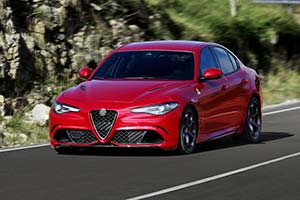
<< Prev Page 2 of 2  State-of-the-art, innovative engines are another characterising element of a genuine Alfa Romeo. For this reason, a unique engine in terms of technology and performance, destined to become the new benchmark of the brand, has been created for the Quadrifoglio version. State-of-the-art, innovative engines are another characterising element of a genuine Alfa Romeo. For this reason, a unique engine in terms of technology and performance, destined to become the new benchmark of the brand, has been created for the Quadrifoglio version.The six-cylinder turbo petrol tuned by engineers with Ferrari background delivers 510 HP and exhilarating performance: for instance, it accelerates from 0 to 100 km/h in only 3.9 seconds. Incidentally, despite the sensational power and torque output, the new engine is surprisingly fuel efficient and implements an electronically controlled cylinder deactivation system. Obviously, as all next-generation petrol and diesel engines, this six-cylinder is made entirely of aluminium to reduce weight particularly on the front axle of the car and make that genuinely Alfa Romeo sound. A peculiarity of the new Giulia is the astute management of weights and materials to obtain a perfect 50/50 distribution across the two axles. This is fundamental to secure the typical Alfa Romeo driving satisfaction and reached by tweaking the layout and arranging the heavier elements in the most central position possible. The suspensions are as essential for optimal ride as weight distribution. In particular, a multilink solution ensuring top performance, driving pleasure and comfort has been chosen for the rear axle. On the front, instead, a new double wishbone suspension with semi-virtual steering axis was developed to optimise the filtering effect and guarantee rapid, accurate steering. This Alfa Romeo exclusive keeps the constant caster trail on corners and can tackle high lateral accelerations as a result of the always perfect footprint.In any situation and at all speeds, driving Alfa Romeo Giulia with the most direct steering ratio available is natural and instinctive. As a further expression of the Alfa Romeo engineering culture, the design, the build and the choice of materials of the chassis and the suspensions is always perfect. As a consequence, it was decided that electronics should only be used to make the driving experience guaranteed by excellent basic mechanicals even more exhilarating. This is demonstrated by the exclusive technical solutions present on the new car, like Torque Vectoring with a double clutch to allow the rear differential to control the torque delivery to each wheel separately. In this manner, power transmission to the road is improved also in low grip conditions. So, the driving is safe and fun without ever having to run up against an invasive stability control system. The Integrated Brake System - an innovative electromechanical system which combines stability control and a traditional servo brake for instantaneous brake response and consequent record-breaking stopping distances in addition to the all-important weight optimisation - is being introduced on the new Alfa Romeo. Together with an excellent Cx, a perfect balance of forces on corners and downforce behaviour, the new model has Active Aero Splitter, a front system which actively manages downforce for higher performance and better grip even at high speed. These state-of-the-art systems are all governed by Chassis Domain Control, the 'brains' of the on-board electronics which assigns the specific task of optimising performance and driving pleasure to each one. The new Alfa Romeo Giulia also features a renewed Alfa DNA which modifies the car's dynamic behaviour according to the driver's selection: Dynamic, Natural, Advanced Efficient (energy efficiency mode implemented for the first time on an Alfa Romeo) and naturally Racing (on high performance versions). The passenger compartment of the new car offers the best in terms of quality, safety, equipment and comfort with a specific, profoundly Alfa Romeo style element: the centrality of the driver. Not by chance, all the main controls are incorporated in the steering wheel as on a Formula 1 car, while the human-machine interface consists of two simple, user-friendly knobs for adjusting the Alfa DNA selector and the infotainment system. To obtain an excellent weight-to-power ratio (remarkably lower than 3kg/hp), Alfa Romeo Giulia combines extraordinary engine performance and the ample use of ultralight materials throughout. For example, carbon fibre was chosen for the propeller shaft, the bonnet and the roof and aluminium was picked for the engine, brakes, suspension (including front domes and front and rear frames), in addition to many other body components, such as the doors and the wings. Furthermore, the rear crossmember is made of aluminium composite and plastic. In order to decrease the total weight, the braking system was tweaked using aluminium elements and carbon ceramic discs and the seats have a carbon fibre structural frame. Despite all this weight optimisation, the car boasts the best torsional rigidity in its class to guarantee quality over time, acoustic comfort and handling even in conditions of extreme stress. << Prev Page 2 of 2 |
| Article | Image gallery (17) | Specifications | User Comments (1) |
| All Cars - Contact us - Privacy Statement - Top | © 1998 - 2026 Ultimatecarpage.com |