<< Prev Page 2 of 2 With high hopes and one extra DBR1 chassis for the works team, Aston Martin entered the 1958 season. With Le Mans being the sole focus, the works team rarely took out their precious cars in the events leading up to the June race. Three weeks prior to the big race, the team used the Nürburgring 1000 km as a warm-up. Like the previous season, the DBR1 excelled at the twisty and long circuit, with Stirling Moss and Jack Brabham taking the flag in first position in DBR1/3. In the mean time, Moss was also quite successful in non-championship races with the DBR2. At Le Mans the car's frailty was shown once again, with none of the works cars finishing, leaving the victory to Ferrari. An old DB3S did claim a credible second place for Aston Martin. Moss and Brooks were victorious in the Tourist Trophy with DBR1/2. These results were enough for Aston Martin to secure a second place in the Constructor's Championship behind Ferrari, but with the little works competition, this was hardly a big achievement. David Brown and his team were not ready to give up and continued work on the DBR1.
Only DBR1/1 was allowed to be campaigned in the season leading up to the 1959 Le Mans race, as Aston Martin was busy designing a completely new car to campaign in the Formula 1 championship. Moss used it to win the DBR1's third consecutive victory at the Nürburgring in one of the finest drives of his career, constantly having to make up for time lost by his team-mate. Aston Martin constructed a fourth work chassis, and a fifth chassis to be competed by long time customer Graham Whitehead. A three car strong works effort was sent out to Le Mans, all three cars equipped with a slightly revised engine with a changed bore and stroke. Moss' DBR1/3 was fitted with a special high compression engine to set a high pace in the opening hours, forcing the competition to speed up and stretch their material. When Moss' DBR1 died, this ingenious tactic had already resulted in two retirements for the four-car strong Ferrari team. After the third Ferrari retired, Roy Salvadori and Carroll Shelby in DBR1/2 finished first, followed by Maurice Trintingant and Paul Frere in DBR1/4. David Brown finally had his victory at Le Mans and Aston Martin was now only trailing Ferrari by two points in the World Championship, which presented a new challenge for the remainder of the season. Shelby, Fairman and Moss piloted DBR1/2 to a victory in the Tourist Trophy and with the help of the fourth place finishing DBR1/4 of Trintingant and Frere, Aston Martin were World Champions!
With the mid-engine revolution taking place, contemporary sports cars and single seaters were quickly rendered obsolete. Not willing or able to make the investments needed to build and design completely new racers, Aston Martin withdrew from racing. With the DB4 GT, Aston Martin did give their customers a means to take on Ferrari in GT-racing, but their success was very limited. Long after the David Brown period, in the 1980s, Aston Martin badged sports cars unsuccessfully tried to take on Le Mans again. John Wyer did win more Le Mans victories with his Gulf GT40s and Mirages, making him one of the most successful managers in Le Mans history. << Prev Page 2 of 2

 Ultimatecarpage.com
> Cars by brand
> Great Britain
> Aston Martin
Ultimatecarpage.com
> Cars by brand
> Great Britain
> Aston Martin
 Racing cars
> Other Sportscars
Racing cars
> Other Sportscars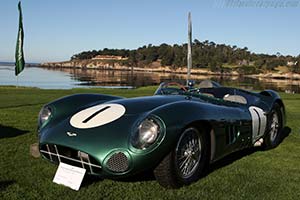
 With high hopes and one extra DBR1 chassis for the works team, Aston Martin entered the 1958 season. With Le Mans being the sole focus, the works team rarely took out their precious cars in the events leading up to the June race. Three weeks prior to the big race, the team used the Nürburgring 1000 km as a warm-up. Like the previous season, the DBR1 excelled at the twisty and long circuit, with Stirling Moss and Jack Brabham taking the flag in first position in DBR1/3. In the mean time, Moss was also quite successful in non-championship races with the DBR2.