<< Prev Page 2 of 2 Tasked to drive the B191 were Brazilians Roberto Moreno and Nelson Piquet. They had a first go in the new Benetton at the San Marino Grand Prix, which was the first European round of the World Championship. By its third outing, the Canadian Grand Prix, the B191 was a winner in the hands of Piquet. The season was dominated by Williams and McLaren, and Piquet's win with the B191 was the only race not won by these two teams in 1991. For the final five races of the season, Moreno was replaced by a young Michael Schumacher, who scored points for the team in the first three of these. Eventually the points amassed by the team's drivers were sufficient for Benetton to place fourth in the Constructors' World Championship.
As had become common practice, Benetton pressed the previous year's car into service for the opening, fly-away races of the season. Much the same happened to the B191, which was run in 'B' specification in the first three rounds of the 1992 World Championship. The updates made over the winter included subtle changes to the suspension layout and aerodynamics. Piquet had retired at the end of 1991 and his empty seat was filled by Martin Brundle. He did not have the best of runs with the B191B as he retired on each of his three outings. Schumacher faired much better and finished in the points three times, including his first two podium finishes of his career in the Mexican and Brazilian Grands Prix.
From the 1992 Spanish Grand Prix, the B191B was superseded by the B192, which was designed by Ross Brawn and Rory Byrne, who had returned from Reynard. Schumacher used the B192 to clinch his first victory and Benetton ended the year third in the standings. The B191 holds the distinction of being the car used by three-time World Champion Nelson Piquet to score his final Grand Prix victory, while it also launched Michael Schumacher's record-setting Formula 1 career. << Prev Page 2 of 2

 Ultimatecarpage.com
> Cars by brand
> Great Britain
> Benetton
Ultimatecarpage.com
> Cars by brand
> Great Britain
> Benetton
 Racing cars
> Formula 1
Racing cars
> Formula 1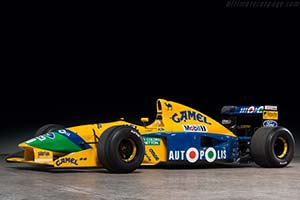
 Tasked to drive the B191 were Brazilians Roberto Moreno and Nelson Piquet. They had a first go in the new Benetton at the San Marino Grand Prix, which was the first European round of the World Championship. By its third outing, the Canadian Grand Prix, the B191 was a winner in the hands of Piquet. The season was dominated by Williams and McLaren, and Piquet's win with the B191 was the only race not won by these two teams in 1991. For the final five races of the season, Moreno was replaced by a young Michael Schumacher, who scored points for the team in the first three of these. Eventually the points amassed by the team's drivers were sufficient for Benetton to place fourth in the Constructors' World Championship.