
 Ultimatecarpage.com
> Cars by brand
> Great Britain
> Aston Martin
Ultimatecarpage.com
> Cars by brand
> Great Britain
> Aston Martin
 Valhalla Valhalla
|
| Aston Martin Valhalla |
| Article | Image gallery (54) | Specifications |
|
|
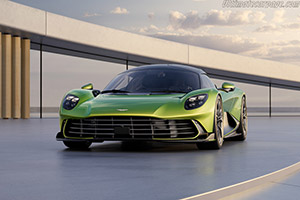
<< Prev Page 2 of 3 Next >>  At Valhalla’s core is a bespoke carbon fibre tub for maximum stiffness with minimum weight penalty, with the lower section weighing only 74.2kg. Designed and engineered by AMPT, which applies their highly specialised F1® expertise and technical capabilities beyond the pinnacle of motorsport, Valhalla’s structure is the product of cutting-edge composite technology. The Carbon Monocoque at the core of Valhalla helps achieve a dry lightweight mass of 1655kg giving a power to weight ratio of 652PS per 1000kg. At Valhalla’s core is a bespoke carbon fibre tub for maximum stiffness with minimum weight penalty, with the lower section weighing only 74.2kg. Designed and engineered by AMPT, which applies their highly specialised F1® expertise and technical capabilities beyond the pinnacle of motorsport, Valhalla’s structure is the product of cutting-edge composite technology. The Carbon Monocoque at the core of Valhalla helps achieve a dry lightweight mass of 1655kg giving a power to weight ratio of 652PS per 1000kg.Valhalla’s carbon structure has been created using proprietary technology developed for Aston Martin. The upper and lower sections of the structure are moulded from carbon fibre using a combination of Resin-Transfer-Moulding process (RTM) and F1® derived autoclave technology. The result is a singular, immensely stiff, strong and light passenger cell which delivers best-in-class dynamic structural attributes and outstanding safety, without compromising driver and passenger ergonomics. Aluminium subframes are attached to the front and rear of the tub. The front-end features Formula One® style push rod front suspension complete with inboard mounted springs and dampers. By moving the dampers inboard, Valhalla benefits from improved airflow within the wheel arch, paired with the purposeful cut outs in the front fender above the wheel lowering the air pressure within the wheel arch and reducing drag. The improvement of airflow out of the wheel arch is directed by the door turning vanes to purposely feed the rear oil coolers with better quality air. From a design and packaging perspective, the inboard damper system has allowed a lower body surface ahead of the A pillar, its efficient packaging allows greater room for the front axle electric motors and front radiator system. The rear is built around a highly effective 5link suspension system. A bespoke evolution of Bilstein’s precise and ultra-reactive DTX adaptive dampers are fitted front and rear. Tuned to deliver an exceptional range of performance across Valhalla’s various dynamic driving modes, Sport and Sport+ offer the refinement and optimum balance of body control, dynamic agility and compliance for road driving, with Race mode introducing much increased support and control to capitalise on Valhalla’s active aerodynamic downforce for maximum performance on track. Valhalla’s braking system has also been honed to truly deliver across those two extremes. Progressive stopping power during road use with ample reserves of outright retardation for on-limit track driving. These characteristics have been achieved through careful tuning of a new Integrated Power Brake system, which allows fine tuning of pedal feel across the full range of deceleration. This ensures precise, instinctive modulation thanks to a firm, confidence-inspiring pedal feel whether making modest braking inputs or demanding maximum stopping power from elevated speeds. Featuring 410mm Carbon Ceramic (CCB) discs on the front axle and 390mm on the rear, Valhalla’s braking system is controlled by sophisticated brake-by-wire technology. Engineered for the rigors of track use and finessed for the nuanced demands of road driving, Valhalla’s brakes are a spectacular blend of power and precision. With a core of ceramic material reinforced with carbon fibre and covered by an additional ceramic friction layer, these CCB brakes yield significant mass reduction over traditional cast iron discs together with superior thermal and durability properties. Gripped by 6-piston front and 4-piston rear ventilated monobloc calipers fed with direct mass airflow from dedicated ducts for uninterrupted cooling, Valhalla has immense reserves of stopping power. The braking system has been engineered specifically for the Valhalla, incorporating Brembo's Carbon Ceramic Brakes (CCB) technology. This system features the largest combined front and rear brake assemblies ever used in any Aston Martin sports car. Extensive simulation and physical development have been conducted to optimize brake cooling performance, including Computational Fluid Dynamics (CFD) analysis, Finite Element Analysis (FEA), and rigorous physical testing across various global circuits and wind tunnel environments. The calipers are custom designed to seamlessly integrate with the cooling system, incorporating vented pistons to enhance airflow and cooling efficiency across both the brake pads and caliper internals. This approach guarantees that temperatures are effectively regulated during high-performance driving conditions. despite this focus on performance, the refinement of the braking system has still been a priority and not a compromise. We have continued to build upon the best-in-class Aston Martin brake pedal DNA, providing good support throughout the pedal sweep, matched with appropriate levels of response to instil confidence, and the ease of modulation through a linear, sporty feeling pedal. All this with the introduction of Integrated Power Brake (IPB), ultimately leads to reduced reaction time and a great level of control. In Race mode Valhalla’s friction braking system is supplemented by the Active Aerodynamics, which adjust front and rear active aerodynamic surfaces to create an Airbrake. Acting like a parachute to significantly add drag during heavy braking, the Airbrake also puts more downforce on the rear of the car. Using aerodynamic downforce to counter the forces of weight transfer improves stability under hard braking. The increased drag also helps reduce stopping distances and improve braking times. Regenerative Braking is a major feature of the Aston Martin Valhalla, increasing the usable range of the electric drivetrain and making otherwise wasted energy usable again by employing the front axle E-machine to convert braking energy and store it in the HV battery. Valhalla utilises two forms of regeneration; CAT B, via the front E-motor where the driver applies the brakes and CAT A where regeneration is done via the rear E-motor as the driver lifts off the throttle. The majority of the regenerative energy conversion is achieved when the driver applies the brakes, with the requested deceleration being actively divided between the front electric motors and the conventional friction brakes. This is possible because the car features an integrated power brake, which is a brake-by-wire system decoupling the driver from the actual brakes and integrated into the IVC system, enabling it to be actively used during full-ABS-braking, a novel application with noticeable benefits when driven on track. A further technical triumph, the regenerative braking is coupled with the Torque Vectoring system, enabling the distribution of wheel individual regenerative torque across the front axle. Valhalla excels on both the Road and Track, focusing on driver engagement, agility and dynamic excellence with a unique combination of active aerodynamics and torque vectoring. Central to Valhalla’s remarkable handling and dynamic behaviour is a sophisticated Torque Vectoring system. Using the two electric motors located on the front axle to independently feed varying amounts of torque to each wheel, Torque Vectoring is used to enhance the agility and stability of the car. Torque Vectoring (E-TV) is an extension of Aston Martin’s advanced and Integrated Vehicle Dynamics Control (IVC) system. First introduced in DB12, the IVC system has been developed even further for Valhalla, seamlessly adding Torque Vectoring, Electric All-Wheel-Drive Distribution (E-AWDD) and regenerative braking work in harmony with the E-diff, Powertrain and the IPB braking system. Valhalla utilises E-TV to adjust the way the vehicle handles and feels, by virtually changing basic parameters of the car. This means, that the control system is permanently calculating a desired behaviour with a model-based approach. By changing those parameters in the desired vehicle model, IVC automatically calculates the amount of Torque Vectoring needed. The calibration of torque vectoring is primarily dependent on the selected level of ESP, as E-TV is integrated into the ESP’s control strategy. In turn, the ESP on Valhalla is part of the Integrated Power Brake (IPB), which is a brake-by-wire system to allow for the seamless integration of regenerative braking. There are three modes available, as follows: The main objective of ESP-On is to make the car as accessible as possible for the driver, with E-TV used to make the limit of the car more approachable. This is achieved by ESP acting early to mitigate over- and understeer before it develops to a level where corrective steering inputs are required. By maintaining stability without the need for sharp ESP intervention drivers of all abilities are enabled to gradually work towards the limit of the car without ever breaching it. ESP-Race increases the feeling of agility and steering response, using Torque Vectoring to attack corners at the limit of maximum lateral performance. The ESP’s intervention threshold is also increased, allowing skilled drivers to drive at and even drift slightly beyond the limits of traction and lateral grip. Though tuned for more extreme driving, ESP-Race still provides less experienced drivers with the background support to confidently explore Valhalla’s elevated capabilities with the reassurance ESP will intervene beyond a certain slip angle. ESP-Off, the full scope of Valhalla’s dynamic capability is unleashed. Developed for the enjoyment of expert drivers in a track environment, ESP-Off allows the limits of traction and lateral acceleration to be freely exceeded, placing the driver in full control. To aid their enjoyment, E-TV is tuned to achieve the highest levels of lateral acceleration and used to adapt the balance of the car, sharpening steering response and intensifying the feeling of agility in low-speed corners and focusing on stability and calmer responses at higher speeds. In addition to E-TV, which distributes torque between both the front axle motors, the advanced IVDC system also distributes torque front to rear across the car via electric All-Wheel-Drive-Distribution (E-AWDD). A model-based and fully integrated approach, E-AWDD harnesses the power of sophisticated predictive software. Taking information from a suite of six-axis inertia measurement sensors, this software builds a real-time picture of road conditions by comparing model-based calculations of how close each tyre is to its limit of lateral and longitudinal grip. Based on this understanding of each individual wheel, the software then seamlessly manages the flow of torque accordingly. Integrate within the IVC system, E-AWDD works hand-in-hand with front-axle Torque Vectoring and the rear-axle E-diff to precisely meter and continually optimise the amount of torque reaching each wheel. The aerodynamic approach to Valhalla starts in a similar way to an F1® car, by using all elements of the body shape to generate downforce and minimise drag. However, Valhalla is not restricted by F1® regulations so it can benefit from fully active aerodynamic systems at both the front and rear of which will generate in excess of 600kg of downforce at 240km/h (149mph). Valhalla employs an integrated system of Active Aerodynamics which combines moveable aerodynamic surfaces with precise management of underbody airflow. This enables Valhalla to adapt front and rear downforce to maximise grip, balance and consistency, or reduce drag depending on the situation and the driving mode selected. This enables drivers to extract the very best from Valhalla’s chassis and tyres, across the full performance range of the car. This powerful system is the key to generating high downforce for maximum cornering capability and braking stability, with the added benefit of DRS to achieve a towering 350 km/h (217mph) top speed. To do this Valhalla uses powerful and near-instantaneous hydraulic actuation to control the active aerodynamics, the rear wing working in conjunction with concealed active front wing to maintain an optimal aero-balance. Behind the front splitter the under-floor surface is concave, creating a low-pressure area that generates downforce. Valhalla’s front wing is a unique piece of engineering that is bespoke to Aston Martin and Valhalla. The movement on the front wing, controls the downforce of the wing itself and the air flow to the underfloor vanes. The front wing also has an integrated cooling bypass to save additional drag at high speed when Valhalla does not need as much cooling. Taking information from Valhalla’s Integrated Vehicle Control (IVC) electronics system, the active rear dual element ‘T’ wing continually adjusts to optimize downforce, reduce drag or minimise braking distance in Race mode. In Sport and Sport+ modes the rear wing remains stowed to preserve Valhalla’s sleek and elegant profile, only deploying when Race mode is activated. Having both front and rear active aerodynamic mechanisms allows Valhalla to have excellent control of the downforce distribution between front and rear axles, this is crucial for stability and vehicle performance. The multi element rear wing lies flat to create the beautiful clean lines of the car, whilst generating a baseline level of downforce with minimal drag. In Race mode the rear wing extends upwards by 255mm, with Valhalla’s electronic systems adjusting the angle of the wing to ensure optimal balance for any given dynamic scenario. When Valhalla is subjected to heavy braking demands the active aerodynamics use the rear wing as an air brake, altering the angle of attack in under 0.5 seconds to increase drag. This is conjunction with the concealed front wing, shifts the aero balance and centre of pressure to maximise braking stability. Valhalla’s meticulously sculpted aerodynamic surfaces are operating at peak performance to generate in excess of 600kg of downforce, enough for high-speed cornering ability and stability under acceleration and braking. From 240km/h (149mph) the downforce is kept at a consistent level and actively managed to remain at that figure all the way to Valhalla’s electronically limited 350km/h (217mph) maximum speed, with the rear wing’s angle of attack gradually trimmed as speed increases to reduce drag while maintaining elevated and consistent dynamic behavior over the widest possible operating window. Maintaining a consistent downforce figure above 240km/h (149mph) gives the driver an assured sense of stability and predictability as they explore the outstanding dynamic potential of the car. << Prev Page 2 of 3 Next >> |
| Article | Image gallery (54) | Specifications |
| All Cars - Contact us - Privacy Statement - Top | © 1998 - 2026 Ultimatecarpage.com |