
 Ultimatecarpage.com
> Cars by brand
> Great Britain
> Lotus
Ultimatecarpage.com
> Cars by brand
> Great Britain
> Lotus
 Evija Evija
|
| Lotus Evija |
| Article | Image gallery (24) | Specifications |
|
|
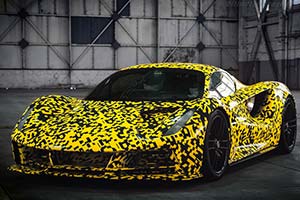
<< Prev Page 3 of 3  The interior of the Lotus Evija is as dramatic as the exterior. Inspired by the technical precision of race car engineering, the dominant characteristic of the cabin is the 'floating wing' dashboard which can be glimpsed from outside through the windscreen. The design also echoes the porosity of the exterior. The interior of the Lotus Evija is as dramatic as the exterior. Inspired by the technical precision of race car engineering, the dominant characteristic of the cabin is the 'floating wing' dashboard which can be glimpsed from outside through the windscreen. The design also echoes the porosity of the exterior."The shape is inspired by the company's prototype racing cars of the late Fifties and early Sixties," explained Russell Carr, Design Director, Lotus Cars. "It has a beauty and an elegance to it, and represents a typically Lotus approach because it performs multiple functions. It houses the instrument panel and air ducts, and is also an integral structural support. It reinforces Colin Chapman's cast-iron rule that no Lotus component goes along for a free ride." Access to the cabin is through the two dihedral doors. Handle-free to preserve the sculpted exterior, they're operated via the key fob. It's the first time Lotus has used such doors, and while they make for a moment of dramatic theatre they also provide maximum space for getting in and out. An exceptional attention to detail - as people would expect from Lotus - is at the heart of the interior. For example, visible carbon fibre surfaces enhance the sense of light weight, while a thin metal band - engraved with the words 'For The Drivers' - runs centrally through the squab of both seats. Once in the car, a switch in the roof console closes the doors. The location aids the minimalist layout of the main control panel and prevents them being activated accidentally. Russell Carr, Design Director, Lotus Cars, explained it's in tribute one of the most iconic Lotus cars, commenting: "Versions of the Lotus Esprit Turbo featured a huge roof console in the late Seventies and early Eighties. It's not something you might expect on a contemporary hypercar but Lotus fans will love the connection." Inside, the cabin strikes the perfect balance between the precise functionality of a track car and the comfort of a road car. The driving position is fully adjustable to accommodate the greatest range of occupants. The elegant carbon fibre shell seats are hand-trimmed with thick Alcantara-finished pads, and feature manual fore / aft adjustment plus electric back operation. The steering column is manually adjustable for both rake and reach. Three-point seatbelts are fitted as standard, with four-point harnesses an option. Built into the bodyshell, close to the occupants' hip point, are two bespoke storage areas. The design of the steering wheel, similar to that found in an LMP or F1 car, further reinforces the Evija's sporting intentions. The outer ring is finished in Alcantara as standard with leather available as an option. Buttons are grouped in an intuitive manner and govern functions including phone use, cruise control and DRS deployment. Mounted centrally at the base of the wheel's hub is the mode controller. There are five modes - Range, City, Tour, Sport and Track - with various of the car's performance features activated or deactivated depending on which is selected. Ahead of the steering wheel is a state-of-the-art digital display, providing the driver with key information such as mode, battery charge and remaining range. It is the car's only screen, putting all necessary information in one place. The screen displays essential functions only, with information appearing as required when the appropriate button is pushed, then fading when no longer needed. Further controls are located on the floating 'ski slope-style' centre console, which features touch-sensitive haptic feedback buttons. Each is integrated in hexagonal recesses to help guide the driver's fingers. As the light plays over the surface it creates an almost organic visual effect. The driver can also interact intuitively with the car's technology via a control wheel. The honeycomb design of the buttons is replicated on indicator stalks and on the surface of the aluminium foot pedals. The Evija's cabin has been deliberately designed so that the occupants feel they are at one with the vehicle. "At the core of the appeal of any Lotus is that the driver is in sync with the car at all times and almost feels as if they are wearing it," said Russell Carr, Design Director, Lotus Cars. "Looking out from behind the wheel, it's a wonderfully emotional moment to be able to see the bodywork outside, both in front and behind you. That's something we hope to enhance in future Lotus models." Climate control and a premium infotainment system are fitted as standard. Customers can seamlessly integrate their smartphones via Apple CarPlay and Android Auto, accessing their own music and navigation. Calibrated to provide the optimum blend of extreme track performance and on-road comfort, the Evija's motorsport-derived suspension features three adaptive spool-valve dampers for each axle. Two are corner dampers with a third to control heave. These are mounted in-board to optimise the aerodynamic performance. They are manufactured by Multimatic, specialists in developing high-performance suspension technology for on-road, off-road and motorsport applications including Formula 1. Magnesium wheels provide optimum lightness and strength, and are sized 20 and 21 inches at the front and rear respectively. They are shod with Pirelli Trofeo R tyres, developed specifically to achieve ultimate performance. To deal with the Evija's extreme performance, the car is equipped with a forged aluminium AP Racing braking system with carbon ceramic discs front and rear. The Lotus Evija is the first production road car in the world to feature laser lights for both main and dipped beams. Produced by Osram, the lighting modules are very compact and will provide an outstanding view of the road or track ahead. The strikingly thin vertical headlamps provide the perfect balance of crystal-like beauty and a highly technical design. Inside the lenses, unique 'wing-like' elements form the daytime running lights and directional indicators. The Evija is the first Lotus to provide drivers with a full suite of digital connected infotainment, which will benefit from over-the-air software updates. A powerful on-board modem enables communication to the cloud, and the driver can interact with that data through a Lotus smartphone app. The app will enable drivers to monitor their Evija from anywhere in the world, for example, to check the battery charge status and driving range. It will also support remote use of air-con, to heat or cool the cabin ahead of the next drive. The Evija's infotainment system includes a chronograph to allow the driver to record their lap times. Connection to the cloud means they can view their performance while at the track and recall previous sessions through the app. Lotus will offer Evija customers an unparalleled level of personalisation, enabling them to specify the car exactly as they wish. This will include the opportunity to select unique paint finishes, interior trims and detailing. Marquetry-style badging will provide further bespoke opportunities. Lotus has developed the ability to inlay metal elements directly into the carbon fibre bodyshell, so that the badge sits completely flush with the bodywork. Currently the Evija carries a partial Union Flag badge on the C-pillar, signifying its status as a British-built hypercar. However, this could be another flag, a family crest or personal logo. "This marquetry-style badging is similar to that associated with traditional cabinet-making, where you inlay different colours of wood," explained Russell Carr, Design Director, Lotus Cars. "On the Evija it's really is up to the customer to choose whatever materials and designs appeal to them." Lotus is also developing a comprehensive programme of bespoke experiential activities for Evija owners. These will include VIP track days and other high-performance motorsport opportunities. The Lotus Evija has been designed and engineered at Lotus' historic home in Hethel, UK, and production will begin in a new dedicated on-site manufacturing facility during 2020. A maximum of 130 examples will be built, guaranteeing exclusivity to match the stunning looks, ground-breaking technology and world-beating performance. They will be sold directly to customers by Lotus, with the global network of 220 retailers in support. Plans to service and maintain the car for each owner are currently in development. The Lotus Evija is priced from £1.7m plus duties and taxes. A £250,000 deposit secures a production slot. Order books are now open through www.lotuscars.com << Prev Page 3 of 3 |
| Article | Image gallery (24) | Specifications |
| All Cars - Contact us - Privacy Statement - Top | © 1998 - 2026 Ultimatecarpage.com |