
 Ultimatecarpage.com
> Cars by brand
> Great Britain
> McLaren
Ultimatecarpage.com
> Cars by brand
> Great Britain
> McLaren
 Elva Elva
|
| McLaren Elva |
| Article | Image gallery (36) | Chassis (3) | Specifications |
|
|
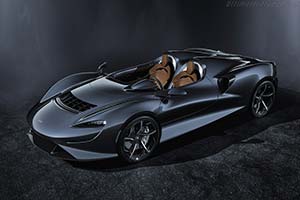
<< Prev Page 2 of 2  "Our mission with the McLaren Elva was to create an open-cockpit, two-seat roadster that delivers the most elemental of driving experiences. Formula 1-inspired shrink-wrapped volumes create a technical sculpture that is as striking as it is remarkable, the exterior flowing into the interior in a stunning example of a new and unique McLaren 'blurred boundaries' design principle that has allowed us to seamlessly bring the outside in, to further enhance driver engagement while remaining true to our philosophy of making no compromises." Rob Melville, Design Director, McLaren Automotive "Our mission with the McLaren Elva was to create an open-cockpit, two-seat roadster that delivers the most elemental of driving experiences. Formula 1-inspired shrink-wrapped volumes create a technical sculpture that is as striking as it is remarkable, the exterior flowing into the interior in a stunning example of a new and unique McLaren 'blurred boundaries' design principle that has allowed us to seamlessly bring the outside in, to further enhance driver engagement while remaining true to our philosophy of making no compromises." Rob Melville, Design Director, McLaren AutomotiveHighlighting the intensity of the driving experience through the direct connection to the elements, there is no clear demarcation between the exterior of the McLaren Elva and the interior. The uppermost sections of the carbon fibre doors simply curve over and flow down into the cabin, the light, stiff and strong composite material providing the perfect properties to form such enticing shapes and forms. Complementing this unique design feature, the buttresses behind the driver and passenger also flow into the cabin behind the seats. While ensuring the driver and passenger remain exposed to the elements, the sculpture of the wraparound upper cabin environment enhances the feeling of security and protection within a cocooned interior. A spar of carbon fibre additionally sweeps down from between the buttresses and runs between the driver and passenger seats to support a central armrest and cradle the engine start button and the controls for Drive, Neutral and Reverse functions. The seats themselves are of a bespoke design, with a new lightweight carbon fibre shell that not only supports the head, shoulder and back area of the occupants, but works seamlessly with the upper shape of the cabin. The lower area of each seat is marginally shorter than a conventional McLaren seat, allowing enough space within the footwells for driver or passenger to stand should they want to in order to enter or leave the vehicle. The seats are available with different upper and lower colours and materials, creating a contrast between the exposed upper section and cocooned lower section. Six-point race harnesses can be selected should the customer wish to use the McLaren Elva on track. Ahead of the driver and passenger, the view forward is unprecedented, with the dashboard seamlessly flowing down into the cabin and around to meet the swooping doors. The shapes are organic and natural - almost pebble-like - with the only interruption to their smooth forms the instrument cluster that stands proud, moving with the steering wheel to optimise visibility of vehicle data for the driver. In a first for McLaren, the controls for the Active Dynamics functions are integrated into the instrument cluster; set either side of the binnacle, the dynamic mode switches are situated close to the gearshift paddles and their operation does not require the driver to remove their hands from the steering wheel. Additional functionality is accessed through the centrally-mounted 8-inch high-resolution touchscreen monitor; a hub for all the vehicle's functions, this brand-new interface features an edgeless-glass screen and a side-mounted control dial. This Central Infotainment Screen has been developed to allow the driver to run multiple applications simultaneously, akin to a smartphone, flicking through them on a vertical carousel. The system shows a range of applications on the screen, including satellite navigation, McLaren Track Telemetry, rear-view camera and climate control. The screen is mounted on a lightweight carbon fibre arm and tilted towards the driver. Stowage space is offered beneath the rear tonneau. Crafted from carbon fibre, the curving single-piece panel is operated manually and secured with soft-close latches. Elegant and lightweight, it further reduces weight at one of the highest points of the McLaren Elva. The compartment under the tonneau has space for helmets and also houses the porthole-like panels that showcase the two visible air filters - a fine example of the McLaren design principle of exposing functional engineering. A portfolio of bespoke interior materials will be available for the new McLaren Elva, allowing customers to personalise their car according to its intended use. Interior leathers in a range of finishes and levels of protection - including an Enhanced Full Aniline leather with a second protective layer to the leather - have been developed to meet the requirements of the open-cockpit car. Additionally, a new technical interior material, Ultrafabric, is another innovation for the car. This breathable synthetic material offers a very different proposition to leather; comprising four layers, the outer two surfaces providing durability and moisture resistance and the inner layers adding a reinforced rayon-fibre base and cushioning, the Ultrafabric helps to 'grip' you in the seat. The McLaren Elva does not have an audio system as standard (in line with the determination to minimise vehicle weight) but customers can specify a bespoke system at no additional cost. Further non-cost options include 5-Spoke Super-Lightweight forged alloy wheels in lieu of the 10-Spoke Ultra-lightweight wheels fitted as standard; track-focused Pirelli P Zero Corsa tyres rather than Pirelli P Zero tyres; and a vehicle lift system. Additional personalisation options available through McLaren Special Operations (MSO), the bespoke division of McLaren, include interior colour choices for the Ultrafabric and leathers; virtually limitless exterior paint colours and almost anything else between a delicate pin-stripe on the wheels and a blended full-body 'contour' or 'velocity' finish that mixes multiple colours across the length of the vehicle. Any selection is individually hand-painted by MSO's highly experienced craftspeople. Alternatively, customers can select a Gloss Visual Carbon Fibre Body, which exposes not only the carbon fibre body panels, but also the perfectly aligned twill of the composite material. This can be further enhanced with a range of colour tints. McLaren Special Operations can also develop a bespoke tint for the exterior or interior carbon fibre. The McLaren Elva can also be personalised with 18ct white gold or platinum badges that feature a TPT inlay. An automotive world-first when introduced on the McLaren Speedtail, thin-ply technology carbon (or TPT for short) is formed from multiple ultra-thin carbon layers just 30 microns in depth. Positioned at a 45-degree angle, when gently milled they expose a stratified, shimmering surface that resembles flowing water. Additionally, MSO offers a 24ct gold engine bay heat shield. The new Ultimate Series McLaren is priced from £1,425,000 including UK VAT, the final specification is determined by customer choice, with infinite possibilities in terms of personalisation by McLaren Special Operations (MSO) to ensure each Elva is unique. "The McLaren Elva is a true Ultimate roadster; it exists purely for the pleasure of driving, to deliver an enthralling and immersive experience born from the ultimate connection between the car, the driver and the elements. The lightest road car we've ever built at McLaren Automotive, the Elva is incredibly agile and ferociously fast, its 815PS twin-turbocharged V8 engine providing breathtaking performance that heightens every sense." Andy Palmer, Vehicle Line Director - Ultimate Series, McLaren Automotive The core of the McLaren Elva is - as with every McLaren road or race car since 1981 - a carbon fibre monocoque. This state-of-the-art 'tub' is incredibly strong and stiff, and its inherent properties mean an open-top roadster does not require any additional strengthening as would be the case with a vehicle built from aluminium or steel. Conversely, despite its rigidity, carbon fibre is also incredibly light, helping to reduce the overall vehicle weight. To that effect carbon fibre has also been used extensively throughout the McLaren Elva. The entire body is carbon, and McLaren has pushed the limits of the material to not only create incredible sculpted forms, but to also reduce weight. The front clamshell, for instance, is just 1.2mm thick and meets all of McLaren's structural integrity targets - yet it forms an astonishing one-piece panel that wraps around the entire nose of the vehicle and provides a clean, uninterrupted vision without any panel joins. Perhaps even more impressive are the body side panels, which are each over three metres long and stretch from the front wheels, past the side intakes, around the rear tonneau cover and all the way until the active rear spoiler. Each door is constructed entirely of carbon fibre and features a single-hinge design, mounting to the vehicle just behind the front clamshell. The doors operate in a Dihedral function, a McLaren trademark. The floor within the McLaren Elva is exposed carbon fibre, once again highlighting the weight saving throughout. Practicality is enhanced with the use of non-slip material at selective points, or bespoke floor mats if preferred. Carbon, too, forms the core of the braking system which is the most advanced ever fitted to a McLaren road car. Each sintered carbon ceramic disc measures 390mm and takes significantly longer to produce than a conventional carbon ceramic disc, but the resultant material is much stronger and has improved thermal conductivity. This allows the front brake discs in particular to be reduced in size, benefitting unsprung mass while still maintaining performance. Cooling requirements are lessened, reducing the brake ducting needed, which further reduces weight and improves aerodynamic efficiency. The braking system was first introduced on the McLaren Senna but is enhanced for the Elva with the addition of titanium caliper pistons which save a total of 1kg across the vehicle. Such braking performance is essential because of the performance delivered by the 815PS, 800Nm 4.0-litre, twin-turbocharged McLaren V8 that powers the Elva. From the same family of engines that powers the McLaren Senna and Senna GTR, it features a flat-plane crankshaft, dry-sump lubrication and lightweight connecting camshafts, rods and pistons that reduce mass in the powertrain. Power is directed to the rear wheels through a seven-speed seamless-shift gearbox, and working in conjunction with a launch control function, the performance is breathtaking: 100km/h from a standstill (0-62mph) is reached in less than three seconds, while the McLaren Elva is quicker than the McLaren Senna to 200km/h (0-124mph) at just 6.7 seconds. The increased power output is achieved through an optimised exhaust system with reduced back pressure and improved LTR performance that reduces charge air temperatures. The exhaust itself is an intricate and lightweight titanium and Inconel system, with two lower exits flanking a twin top-mounted exit. In a first for a McLaren road car, the titanium exhaust finisher is created using 3D printing technology to form the unique shape. The exhaust note of the Elva is clean, crisp and unmistakably powerful, as befits an Ultimate Series McLaren. The power of the McLaren Elva is complemented by a chassis set-up that maximises agility and driver engagement and feedback, enhancing the incredibly immersive and enthralling driving experience. Electro-hydraulic steering provides the purest feedback, as expected of a car when the open-cockpit design positions the driver so close to the elements. State-of-the-art McLaren linked-hydraulic fully active suspension offers a staggering breadth of ability on all road surfaces, with both unique software settings and bespoke springs and damper valving matched to the extremely light overall vehicle weight. Accessed through the Adaptive Dynamics Controls, the Comfort, Sport and Track modes for the Handling and Powertrain change the driving characteristics to suit driver mood or environment. Those wishing to explore the full performance of the Elva can adjust the level of available wheelspin and oversteer with three Electronic Stability Control (ESC) modes or utilise Variable Drift Control (VDC). Unique to McLaren, VDC unlocks new levels of driving freedom and excitement. Track-focused Pirelli P Zero Corsa tyres are available as a non-cost option. << Prev Page 2 of 2 |
| Article | Image gallery (36) | Chassis (3) | Specifications |
| All Cars - Contact us - Privacy Statement - Top | © 1998 - 2026 Ultimatecarpage.com |