
 Ultimatecarpage.com
> Cars by brand
> Spain
> Hispano Suiza
Ultimatecarpage.com
> Cars by brand
> Spain
> Hispano Suiza
 Carmen Boulogne Carmen Boulogne
|
| Hispano Suiza Carmen Boulogne |
| Article | Image gallery (15) | Specifications |
|
|
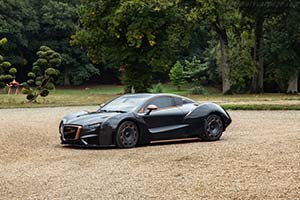
<< Prev Page 2 of 2  The passenger cabin of the Carmen Boulogne is a more contemporary take on Hispano Suiza’s blend of premium quality materials and classic design cues. The Carmen’s refined and luxurious wood trim is replaced by suede or black Alcantara, while chrome trim is changed for anodised metal in a striking Orange Tulipwood colour. The passenger cabin of the Carmen Boulogne is a more contemporary take on Hispano Suiza’s blend of premium quality materials and classic design cues. The Carmen’s refined and luxurious wood trim is replaced by suede or black Alcantara, while chrome trim is changed for anodised metal in a striking Orange Tulipwood colour.Awaiting the occupants inside the car is a combination of the finest leather and Alcantara that is used to trim the heated, 3D / 6 motion power-adjustable carbon fibre composite seats, as well as the door panels and roof lining. All upholstery is hand-trimmed and hand-sewn in-house at Hispano Suiza’s Barcelona assembly facility, helping ensure that the driver and passenger are cosseted within an authentically sumptuous environment. Such is the focus on the ultimate ownership experience, each Carmen Boulogne is almost infinitely customisable via the brand’s ‘Unique Tailormade’ department. Buyers can pick the specific shade of leather, the set-up of the interior mood lighting, and can even specify a custom-perfumed interior, developed with the buyer to ensure the car is aligned perfectly with their preferences. The artisan craftsmanship that is apparent throughout the interior retains a direct lineage to the brand’s history. For example, the dash reflects the characteristics of the Carmen Boulogne’s predecessors, with anodised Orange Tulipwood-coloured metalwork perforated by authentic toggle switchgear for reassuring mechanical tactility. The clockface at the centre of the dash features a Swiss mechanism with design and development by a Spanish watch maker. It echoes the position and status of the timepieces that featured in the brand’s earlier cars. Similarly, the triangular gear selector is a direct reference to the art deco steel triangle that featured on the dash of Hispano Suiza’s in the company’s historic models. While the style is unashamedly retrospective, the technologies employed deliver the best experience possible for occupants. Ambient LED lighting strips are hidden along the door panels and in the footwells to ensure that the interior is a welcoming and inviting space. The steering wheel spokes feature smartphone and multimedia controls, while a highly-intuitive user interface sits at the centre of the driver-focused infotainment console. A high-definition, 10.1-inch touchscreen display allows owners make infotainment selections and configure vehicle settings with ease. The screen is also where video output from the rear parking camera is presented. High-fidelity audio is delivered by six premium speakers and a subwoofer, providing a unique 360-degree audio experience. A dedicated Hispano Suiza mobile app enables owners to remotely set cabin temperature, operate the lights, and set the alarm, as well as monitoring the battery charge status. Achieving enhanced performance, to elevate the Carmen Boulogne to even greater heights, was the primary focus for the Hispano Suiza technical team. Inspired by the brand’s race-winning successes of the 1920s, the engineers set out to boost the Carmen’s exceptional power even further. Building on the Carmen’s substantial credentials, the Carmen Boulogne boasts 820kW (1,114PS) up by 70kW (95PS) on its sibling. With a longer-ratio gearbox, a new silicon carbide transistor, and stiffer suspension, the performance variant has a higher top speed 290km/h (180mph) up by 40km/h (25mph), and boasts a 0-100km/h time of under 2.6 seconds. The Carmen Boulogne is powered by two 410kW permanent-magnet synchronous motors (PMSM), one for each rear wheel. Each motor’s significant torque is controlled through sophisticated torque vectoring systems developed in-house. From 0-6,500rpm, the motors are capable of 1,600Nm maximum torque, enabling the car’s blistering acceleration and seemingly endless pulling power. The high-energy battery pack is T-shaped, running as a central spine of the car and behind the seats. It also serves as a tuned mass damper (TMD), providing stability and reducing structural vibration. The Lithium Ion polymer battery pack boasts an available capacity of 80kWh. High-efficiency mechanical and electric components give a total energy loss from the battery to the ground of less than 10%, maximising vehicle range, which is targeted to exceed 400km. The battery pack – made up of 700 cells – was designed and produced entirely in-house, including a complete temperature control system to ensure the cells can operate optimally. The battery monitoring system ensures stable charge and discharge performance and delivers the required safety strategies. The new model also features >80kW DC Fast Charging capability, requiring just 30 minutes to charge from 30-80% via a CCS2 Fast Charger. It also features CHAdeMO and GB/T charging options. The battery and electric powertrain components are liquid-cooled via three front radiators: one under the hood at the front of the car for battery cooling, and one each side, inboard of the front wheel arches, for cooling powertrain components. The three front air intakes provide airflow to help cool the electric drivetrain system and battery. The location, size and diffuser-style shape of these intakes, together with split planes, distribute the air in the radiator’s core to achieve the optimal balance of drag and high air flow across the radiators. The outlets in the hood that expel air from the front radiator, and those in the front wheel arches that expel air from the side radiators, have been carefully designed and located to minimise drag. Battery heat expulsion is controlled by the front central radiator and condenser. The battery thermal management system uses a passive heat exchanger (radiator) and an active cooling system, which shares its refrigeration cycle with the passenger cabin’s air conditioning. Also, a PTC (Positive Temperature Coefficient) heater warms the battery in cold conditions. The car’s Electronic Control Unit (ECU) software manages all vehicle power and control strategies, continuously interrogating myriad data streams and instruction actuators to control vehicle behaviour. These strategies are all developed and tested in-house by Hispano Suiza software engineers. A complex network feeds a huge amount of data to the ECU at a rate of up to 1,000 samples per second. Data is also fed via the cloud to the Hispano Suiza back office infrastructure to ensure that vehicle status and condition is monitored by Hispano Suiza in real time to ensure ultimate reliability. This 4G functionality also enables eCall emergency services as required. Hispano Suiza’s production partner – QEV Technologies – has extensive experience in developing electric vehicle powertrain technology, specifically for teams participating in FIA Formula E and FIA Electric Production Car Series (EPCS). As such, QEV Technologies brings unprecedented levels of engineering know-how to the Carmen Boulogne’s electric powertrain, contributing to its exceptional performance, efficiency, reliability and safety. The Hispano Suiza Carmen is one of the most carbon fibre intense cars in the world. Carbon fibre composites are employed extensively throughout the vehicle, and account for the vast proportion of vehicle structures. Even in this, the most elementary structure of the Carmen, Hispano Suiza has created a unique work of art: the hand-laid carbon fibre deployed for the monocoque chassis is specifically oriented in a mirrored opposing weave pattern. This results in a forward-facing directional arrow shape down the centre-line of the car from back to front. Uniquely, in the Carmen Boulogne, this detailed and beautiful carbon fibre craftmanship is proudly displayed beneath the car’s clearcoat varnish. Carbon fibre composite is also used for the crash protection structures that absorb and dissipate impact energy to protect the monocoque at the front and rear. Unusually, the rear subframe is also constructed in carbon fibre and is bolted to the primary chassis structure. The monocoque chassis weighs only 195kg and exhibits exceptionally high rigidity to provide a torsional stiffness rating of 50,000Nm/deg. This not only contributes to a stronger and safer passenger cell, but also benefits the car’s dynamic performance. The Carmen’s stiffness-to-mass ratio (256Nm/deg per kg) out-performs any other hypercar: for comparison, the Lamborghini Aventador’s stiffness-to-mass ratio is 237Nm/deg per kg. Through extensive development of the Carmen during the past year, the Boulogne boasts a weight of just 1,630kg, a saving of 60kg versus its sibling. The enhancements have been achieved through a newly optimised suspension (-25kg); a new sub-chassis (-15kg); chassis lay-up optimisation (-15kg); new CNC parts and carbon fibre roof (-6kg). The 11 carbon fibre body panels are also incredibly lightweight, tipping the scales at just 64.5kg – including the front splitter and rear diffuser. Even the seat structures and interior upholstery-support panels are carbon fibre composites. Furthermore, composites are also deployed as electric insulation materials and as part of the car’s NVH management, as a sound and vibration dampening substance. Inspired by the brand’s performance-focused past, the Carmen Boulogne’s blistering straight-line speed is married with driver-focused dynamic capabilities thanks to the highly experienced team. It has developed and integrated a range of advanced chassis systems to achieve the dynamic goals for the car. Not only will the Carmen Boulogne exhibit exceptional handling, but the characteristics and behaviour of the car should be predictable and easy to drive. Carmen Boulogne is a racing-inspired car for the road that embraces and harnesses the most advanced motorsport-inspired technologies and techniques to engage and bring joy to the driver. Double wishbone suspension is fitted at the front and rear, which is paired with adaptive damping control and variable roll stiffness distribution technologies to deliver precise and responsive handling, while retaining a refined and comfortable ride. Notably, the suspension set-up of the Carmen Boulogne has been stiffened slightly to account for the car’s sportier nature. True torque vectoring manages the distribution of the two motors’ torque to each rear wheel, according to driver inputs and levels of grip available. This provides a series of benefits, particularly in dynamic response during the most spirited driving, greater high-speed stability, and improved safety on low-grip surfaces. Additional active safety technologies include anti-lock braking (ABS), traction control (TCS) and electronic stability control (ESP) systems. Meanwhile, the Carmen’s brakes are powerful carbon-ceramic composite units from AP Racing. The 380x34mm front and rear ceramic discs work with the six-piston Radi-CAL calipers to ensure the Carmen Boulogne can shed speed rapidly and consistently. << Prev Page 2 of 2 |
| Article | Image gallery (15) | Specifications |
| All Cars - Contact us - Privacy Statement - Top | © 1998 - 2026 Ultimatecarpage.com |