
 Ultimatecarpage.com
> Cars by brand
> Germany
> BMW
Ultimatecarpage.com
> Cars by brand
> Germany
> BMW
 M3 Competition Touring M3 Competition Touring
|
| BMW M3 Competition Touring |
| Article | Image gallery (26) | Specifications |
|
|
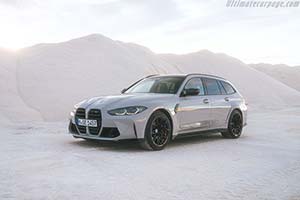
<< Prev Page 2 of 2  The 3.0-litre six-cylinder in-line unit stands out with its urgent power delivery and a healthy appetite for revs. The engine puts maximum torque of 650Nm between 2,750 and 5,500rpm and produces peak output of 510hp when the revs hit 6,250rpm. Its red line is 7,200 rpm. The 3.0-litre six-cylinder in-line unit stands out with its urgent power delivery and a healthy appetite for revs. The engine puts maximum torque of 650Nm between 2,750 and 5,500rpm and produces peak output of 510hp when the revs hit 6,250rpm. Its red line is 7,200 rpm.The straight-six engine powering the BMW M3 Touring also forms the basis for the unit in the new BMW M4 GT3 endurance racing car. Its power output, efficiency and track ability are therefore partly down to numerous components developed on the back of BMW M GmbH’s years of racing experience. These include a rigid crankcase with a sleeve-free, closed-deck construction, a forged lightweight crankshaft and a cylinder head with a core manufactured using 3D printing. Two mono-scroll turbochargers with electronically controlled wastegates supply compressed air to the combustion chambers. An indirect intercooler supplied by a low-temperature circuit increases the effectiveness of the turbocharger. And the direct petrol injection technology operates at pressures of up to 350 bar with exceptional precision and efficiency. VALVETRONIC variable valve timing and Double-VANOS fully variable camshaft timing likewise form part of the M TwinPower Turbo technology. Meanwhile, the M-specific exhaust system with electrically controlled flaps generates a rich soundtrack. The oil supply system has been designed to handle dynamic driving during track use. An additional suction stage allows the map-controlled oil pump to draw lubricant from the smaller chamber, which steps in when extra capacity is needed. The engine’s signature M performance profile, combined with the enhanced traction offered by M xDrive, translates into stunning acceleration times. The BMW M3 Touring takes just 3.6 seconds to power from 0 to 62mph and 12.9 seconds to reach 124mph from rest. The sprint from 50 – 75mph is over in 2.7 seconds (in 4th gear) or 3.5 seconds (in 5th gear). Opting for the M Driver’s Package increases the electronically limited top speed from 155 to 174mph. The eight-speed M Steptronic transmission with Drivelogic fitted as standard is perfectly attuned to the engine’s performance characteristics. A direct connection to the engine and remarkably quick gear shifts lend themselves to a performance-focused driving style, as do engine speed adjustment on downshifts in automatic mode and the ability to change straight to the lowest possible gear in manual mode. The M Steptronic transmission allows both fully automated gear changes and manual shifts using the M-specific selector lever or the standard shift paddles on the steering wheel. Nudging either paddle allows the driver to temporarily switch from automated to manual mode in an instant. It is also possible to execute multiple downshifts to the lowest available gear in manual mode by pulling on the left shift paddle while pressing the accelerator to the floor. M Steptronic does not force upshifts under acceleration in manual mode – even when the engine’s revs hit the limiter. The driver can use the Drivelogic button integrated into the selector lever to alter the transmission’s shift characteristics, with three clearly distinguishable settings in both automated and manual mode. As well as a comfort-oriented setup and a setting for sporty driving, drivers can activate a track-optimised configuration for the shift characteristics. The M xDrive all-wheel-drive system uses an electronically controlled multi-plate clutch in the transfer case to ensure fully variable distribution of the engine’s power between the front and rear wheels. Its rear-wheel bias adds to the M feeling while enhancing both traction and agility. The system features integrated wheel slip control for quick adjustments to power transmission. This intensifies the sense of unruffled poise for which M models are renowned. Teaming up with the all-wheel drive is the Active M Differential that ensures fully variable distribution of the drive torque between the rear wheels. This helps to plant power firmly on the road without losses, especially when the car is being pushed hard or has less grip on one side. The M xDrive system and Active M Differential, with its built-in M-specific traction control, link up with the Dynamic Stability Control (DSC) system to ensure precise interaction. M xDrive also allows the driver to tailor its characteristics to their individual preferences. In the default 4WD setting, the all-wheel-drive system offers maximum traction while maintaining a distinctly rear-biased power split. Activating 4WD Sport mode directs a greater proportion of torque to the rear wheels, enhancing agility. The linear build-up of lateral acceleration forces characteristic of M models now makes it possible to execute controlled drifts. Drivers can also switch off the DSC system altogether and engage 2WD mode. In this setting, drive power is relayed solely to the rear wheels, with traction finely adjusted through ten stages with the standard M Traction Control feature. Torsional rigidity is enhanced by specific strengthening links connecting the strut towers with one another and the nose of the car and bulkhead. Vertical braces bond the stiffening elements of the engine compartment to the front axle subframe, whose supporting base is elevated by a specific connection point in the lower section of the A-pillar. In addition, the front axle subframe is given extra rigidity by a single-piece aluminium shear panel with integrated sill braces. The centre and rear sections of the body incorporate model-specific underfloor bracing elements including a cross-bar, load compartment stiffening measures and a bespoke rear axle subframe with a rigid connection to the body. The M-specific double-joint spring strut front axle takes into account the requirements of the all-wheel-drive system. It features specially adapted axle geometry and an individually tuned steering ratio. The axle kinematics, the camber, castor and kingpin angles, and the lowered roll centre are all designed to maximise lateral dynamic ability while still ensuring well-resolved ride comfort. Aluminium wishbones with ball joints, an aluminium torque arm with newly developed mounting, a forged swivel bearing with bespoke spring strut clamp, and wheel bearings with very high camber stability create an ideal blend of rigidity and lightweight design at the front axle. The five-link rear axle has M-specific wheel carriers and wishbones. The M Servotronic steering delivers accurate turn-in and finely judged communication of steering commands. The driver can also dip into the M Setup menu to call up either of the two steering settings. Comfort mode offers an easy steering feel with precise feedback, while in Sport mode the feel through the wheel rim and the steering force required are dialled up noticeably. The variable ratio that adjusts to changes in steering angle also helps to give the car excellent directional accuracy through corners and superb straight-line poise. When the wheels are sharply turned, the steering rack teeth are positioned more closely together, so smaller steering inputs are required. As a result, the BMW M3 Touring feels particularly nimble when negotiating tight corners. The steering effort required when parking is also reduced by the closer positioning of the rack teeth with large steering angles. And ease of use is further enhanced at low speeds by the increased power assistance provided by Servotronic. Adaptive M suspension is a standard feature of the BMW M3 Touring. Its electronically controlled shock absorbers optimise road contact and maintain traction. The shock absorber control unit uses sensors to keep a constant watch on body movements, the condition of the road and steering adjustments. Electromagnetically controlled valves act in milliseconds to generate the required damping force – infinitely variably and for each wheel. The basic shock absorber characteristics can be adjusted via the M Setup menu. Comfort mode optimises everyday journeys and long trips by smoothing out road imperfections. Switching to Sport brings appreciably stiffer damper responses. Sport Plus mode initiates an additional damper setting that unlocks maximum performance on smooth race circuits. The powerful M Compound braking system fitted as standard on the BMW M3 Touring combines six-piston fixed-calliper brakes for the front wheels with single-piston floating-calliper brakes at the rear. The M Carbon ceramic brakes available as an option offer even stronger braking power, a greater ability to withstand fade, enhanced thermal stability and high resistance to wear. A shared feature of both brake variants is the integrated braking system. This system brings together the brake activation, brake booster and braking control functions within a compact module. The system allows vehicle deceleration to be geared precisely to the driver’s requirements while the M-specific version of the system presents the driver with two pedal feel settings via the Setup menu. The BMW M3 Touring offers the M Traction Control function as standard. This allows the driver to set their desired intervention thresholds for wheel slip when the M xDrive all-wheel-drive system is in 2WD mode. Accessed via the iDrive control/operation system, ten stages of slip are permitted at the rear wheels. On switching from the default ROAD setting to SPORT mode, interventions from the driver assistance systems are suspended, with the exception of inputs from the Collision Warning and the Evasion Assistant. The TRACK mode designed purely for driving on race circuits fully deactivates the assistance systems. SPORT and TRACK modes both reduce the content shown in the information display, while various readouts can also be called up on the left of the information display, including charge pressure and coolant temperature, tyre pressure and tyre temperature or longitudinal and lateral acceleration. The Setup button, part of the M-specific control/operation system, provides direct access to the settings options for the engine, chassis, steering, braking system and M xDrive, enabling the driver to tailor the overall vehicle setup to their individual preferences. Two setup variants can be stored, together with the preferred settings for the engine note, driving stability control, Automatic Start/Stop function and shift characteristics of the eight-speed M Steptronic transmission. The desired configuration can then be activated at any time by pressing one of the two M buttons on the steering wheel. Part of M Drive Professional, the M Drift Analyser helps the driver to sharpen their cornering skills using deliberate oversteer and precise counter-steering, making a note of the duration, distance and angle of the driver’s latest drift. The analysis shown on the control display also includes a score on a scale from one to five stars and a comparison with the driver’s best drift to date. The M Laptimer records track lap times, while a readout in the control display keeps the driver informed of the time margin compared to their fastest recorded lap. The M Driver’s Pack raises the electronically limited top speed of the BMW M3 Touring from 155mph to 174mph. The optional M Pro Pack comprises M Carbon ceramic brakes and the M Driver’s Pack, taking the performance experience to new heights. The BMW M3 Touring is equipped as standard with Park Distance Control with sensors at the front and rear, Cruise Control with brake function, Front Collision Warning with brake intervention, Lane Departure Warning including lane return with steering assistance, the Attentiveness Assistant, and the Speed Limit Info system. Also standard is Driving Assistant which adds lane change warning, rear crossing traffic warning and Rear Collision Prevention functions. Driving Assistant Professional, meanwhile, features Active Cruise Control with Stop&Go function, Automatic Speed Limit Assist, Steering and Lane Control Assistant. << Prev Page 2 of 2 |
| Article | Image gallery (26) | Specifications |
| All Cars - Contact us - Privacy Statement - Top | © 1998 - 2026 Ultimatecarpage.com |