
| sport |
 Ultimatecarpage.com
> Cars by brand
> The Netherlands
> Donkervoort
Ultimatecarpage.com
> Cars by brand
> The Netherlands
> Donkervoort
 Racing cars
> Other Sportscars D8 GTO-JD70 R Racing cars
> Other Sportscars D8 GTO-JD70 R
|
| Donkervoort D8 GTO-JD70 R |
| Article | Image gallery (18) | Specifications |
|
|
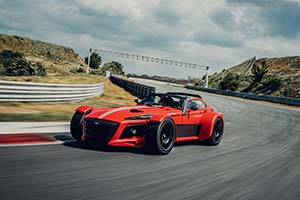
<< Prev Page 2 of 3 Next >>  One of the keys to driver confidence on any racetrack is how the car stops and in the Donkervoort JD70 R’s case, Donkervoort has taken care of that. One of the keys to driver confidence on any racetrack is how the car stops and in the Donkervoort JD70 R’s case, Donkervoort has taken care of that.It’s not just a matter of stopping better than the JD70 on the track, but making the driver feel like it will stop better, every time, so the biggest change is the addition of the Bosch M5 Clubsport anti-lock braking (ABS) system. It’s a system Donkervoort has used before on the track, and it gives the driver 12 steps of adjustment, so there’s always just the right level of feel for each driver, but just the right level of grip for every track condition, too. The ABS delivers a massive advantage in driving consistency because drivers can use it to manufacture far greater agility from the JD70 R when they need to brake and turn at the same time. The rest of the braking system carries over the JD70’s Tarox hardware, but without the need to balance the braking system for both track temperatures and cold-brake stops on the road, the entire system is targeted at the track. It’s far more aggressive than it is on the road-going JD70, using racing brake pads and fluids that are more resistant to sustained heat and bite harder, every time. It retains the brake-bias adjustment knob in the centre of the dashboard, which helps drivers adjust the car’s braking balance for different tyre wear or even different fuel loads. The front end uses wave-pattern 310mm x 24mm discs and six-piston, monobloc calipers, while the rear uses smaller, 285mm x 24mm wave-pattern discs with the optional six-piston calipers. Nankang has repaid Donkervoort’s faith in its tyres for the JD70 by developing a custom set of slick, super grippy and durable race tyres for the JD70 R. They use the same wheel sizes of 235/45 17 fronts and 245/40 18 rears. The Nankang slicks and full wet tyres are offered on Rays, with the front tyres wrapping around 8 x 17” forged alloy wheels, while the rear end uses larger 9 x 18” wheels. The super lightweight carbon-fibre rims are a factory option, as are tyre-warming blankets. With far shorter braking distances, the next step in eking out fast, consistent track laps is the way the car turns, and for that, Donkervoort turned to a technology that hasn’t traditionally been very Donkervoort. The JD70 R uses an ultra lightweight racing electronic power-steering system and a choice of two steering racks, including the ultra-short 2.7:1 ratio. While Donkervoort still offers the JD70 R with a traditional steering setup without power assistance, Denis Donkervoort feels the car is faster and easier to correct with the combination of the shortest available steering rack ratio and the power-steering system. The power-steering system is adjustable, too, to help drivers to hone in on the perfect level of assistance for them in their search for speed through confidence. Like the JD70, the JD70 R is built around a hybrid chassis technology, combining a tubular steel ladder frame with carbon-fibre for added strength and aluminium to reduce weight. The wide-track suspension system uses the JD70’s double-wishbone layout at each corner, with trailing arms at the rear end. Then it changes dramatically. Its four-way adjustable Intrax dampers are 20 percent stiffer, and so are the custom springs. The adjustable anti-roll bars are stiffer, too. Even the bushes are stiffer and the ride height is 20mm lower, all in a search for speed through confidence. << Prev Page 2 of 3 Next >> |
| Article | Image gallery (18) | Specifications |
| All Cars - Contact us - Privacy Statement - Top | © 1998 - 2026 Ultimatecarpage.com |