
 Ultimatecarpage.com
> Cars by brand
> Italy
> Pagani
Ultimatecarpage.com
> Cars by brand
> Italy
> Pagani
 Huayra Tricolore Huayra Tricolore
|
| Pagani Huayra Tricolore |
| Article | Image gallery (8) | Specifications |
|
|
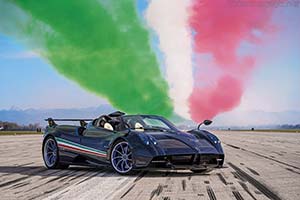
<< Prev Page 2 of 3 Next >>  As in every Pagani project, in which scientific research and attention to detail combine with the aim of producing shapes, surfaces and materials that are highly efficient and at the same time able to captivate the senses, also in this new Hypercar, each component expresses the perfect combination of form and function, Art and Science. As in every Pagani project, in which scientific research and attention to detail combine with the aim of producing shapes, surfaces and materials that are highly efficient and at the same time able to captivate the senses, also in this new Hypercar, each component expresses the perfect combination of form and function, Art and Science.Packed with stylistic and aerodynamic details, the Huayra Tricolore is elegant, extremely efficient from an aerodynamic point of view, and as impetuous as a fighter-jet. A more pronounced front splitter with a completely new aerodynamic profile has been designed to ensure maximum downforce, while the new front bumper with side extractors maximizes the efficiency of the intercooler and ensures adequate heat exchange for the powerful Pagani V12, necessary to achieve maximum performance. Intake efficiency is also guaranteed by the new airscoop, equipped with an innovative air conveying system that allows for an even greater flow of cold air directly to the engine and, in its lines and extension towards the rear wing, evokes the visual language of the aerobatic patrol’s Aermacchi planes. A new, further optimized rear diffuser has been designed to maximize the extraction of air from the underbody. Meanwhile, the new wing, fully integrated with the rear hood with which it forms a single carbon fibre component, allows perfect aerodynamic balance, compensating for the increase in downforce at the front. Careful attention to particulars, even the tiniest details of the Huayra Tricolore design celebrate the technical prowess of the Aermacchi MB-339A P.A.N.: this is the case of the rear wing supports, whose shape recalls the tail fin of the iconic jet and which display the number of the car on the outer side in the unmistakable lettering used to number the patrol aircraft. In the center of the front hood there is a Pitot tube, the instrument that allows each aircraft to measure the macroscopic air speed and, therefore, determine the aerodynamic condition of the aircraft, indicated by the resulting dynamic pressure: this is a reference to the world of aviation and a tribute to the aircraft of the Frecce Tricolori fleet. But the most direct and evident stylistic reference to this symbol of national excellence is provided above all by the external livery, where the tricolour, like an impetuous engulfing flow of air, runs along the side of the car, extending up to the rear light clusters, and matches with the characteristic translucent blue carbon color. From the design of the rims, inspired by the propeller of a turbine, to the anodized aluminium frames of the side air intakes and front headlights, typically inspired by aeronautics and machined from billet, the tribute to the National Aerobatic Patrol is reproduced in every detail of the Huayra Tricolore. The Huayra Tricolore represents a concentration of specifically aeronautical concepts and technologies developed for a car. The long journey of design and development has not only impacted the aesthetics of the car, but it has also involved a meticulous rethinking of all of the car’s technical-engineering equipment, with particular attention to research on lightness, allowing the Huayra Tricolore to achieve its maximum performance. The new chassis made from the latest generation composite materials, such as Carbo-Titanium HP62 G2 and Carbo-Triax HP62, has enabled considerable improvement in mechanical properties, in terms of torsional and flexural rigidity, thus ensuring a better dynamic response of the car during driving and greater safety in critical conditions. The geometry of the suspension assembly is designed to effectively transfer all 840 HP of the Pagani V12 to the ground, reducing dive and roll effects, during braking and cornering respectively. In combination with the electronically-controlled active shock absorbers, interconnected with the active aerodynamics to further enhance the stability of the vehicle, it ensures a perfect dynamic balance, adapting the car’s set-up to driving needs. The Huayra Tricolore is powered by the new Pagani V12, the twin-turbo engine specially developed by Mercedes-AMG, capable of delivering 618 kW (840 HP) at 5900 rpm and 1100 Nm of torque from 2000 to 5600 rpm in its latest version. All the power and exceptional responsiveness of the engine are transferred to the ground by the seven-speed sequential gearbox with electromechanical differential. The entire transmission system is 35% lighter than a dual clutch gearbox, while the transverse structure not only provides significant overall weight savings, but also helps to drastically reduce the effect of polar inertia, limiting the typical tendency to oversteer that normally affects mid-engined cars. The flywheel-clutch unit, consisting of an ultra-light tri-disc clutch, an electronically controlled differential and a racing-derived tripoid coupling system, reduces potential friction losses from the gearbox to the rear wheels. The entire system, which is 4 kilos lighter than previous two-disc units, ensures a significant increase in responsiveness in high-performance gear changes. << Prev Page 2 of 3 Next >> |
| Article | Image gallery (8) | Specifications |
| All Cars - Contact us - Privacy Statement - Top | © 1998 - 2026 Ultimatecarpage.com |