
 Ultimatecarpage.com
> Cars by brand
> France
> Bugatti
Ultimatecarpage.com
> Cars by brand
> France
> Bugatti
 Chiron Super Sport Chiron Super Sport
|
| Bugatti Chiron Super Sport |
| Article | Image gallery (74) | Chassis (2) | Specifications |
|
|
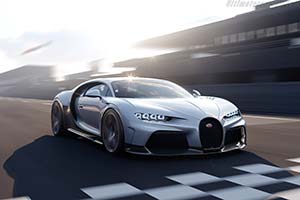
<< Prev Page 2 of 2  Bugatti thoroughly overhauled the 8.0-liter W16 engine for the Chiron Super Sport, boosting its performance b 100 PS to 1,176 kW/1,600 PS. At the same time, the vehicle weight was reduced by a further 23 kilograms. The engineers made modifications to the turbochargers, oil pump, and cylinder head with valve train, as well as to the transmission and clutch. “We increased the revolutions per minute (RPM) for even greater longitudinal acceleration and an even more emotive driving experience,” says Michael Kodra, Head of Drive Development at Bugatti. The engine’s rpm was increased by 300 to up to 7,100 rpm, for noticeably increased agility. 1,600 newton meters of torque is now accessible from between 2,000 and 7,000 rpm, rather than up to 6,000 rpm. Bugatti thoroughly overhauled the 8.0-liter W16 engine for the Chiron Super Sport, boosting its performance b 100 PS to 1,176 kW/1,600 PS. At the same time, the vehicle weight was reduced by a further 23 kilograms. The engineers made modifications to the turbochargers, oil pump, and cylinder head with valve train, as well as to the transmission and clutch. “We increased the revolutions per minute (RPM) for even greater longitudinal acceleration and an even more emotive driving experience,” says Michael Kodra, Head of Drive Development at Bugatti. The engine’s rpm was increased by 300 to up to 7,100 rpm, for noticeably increased agility. 1,600 newton meters of torque is now accessible from between 2,000 and 7,000 rpm, rather than up to 6,000 rpm.With the improved performance created by larger turbochargers with more efficient compressor wheels, the seven-gear dual-clutch transmission at full load and full speed transitions from sixth to seventh gear at 403 km/h. The Chiron Super Sport accelerates from 0 to 200 km/h in 5.8 seconds and to 300 km/h in 12.1 seconds. The Chiron Super Sport accelerates from 0 to 400 km/h seven percent quicker than a Chiron. Seventh gear boasts 3.6 percent longer transmission. In order to achieve seamless acceleration at full throttle, boost pressure must remain close to maximum while the hyper sports car rapidly builds momentum and reaches its optimal speed. When changing gear, the pressure dips only very briefly for a mere 0.3 seconds, to then return to full boost pressure of 2.8 bar to fill the Chiron Super Sport’s W16 engine. “In spite of the immense power and the enormous longitudinal acceleration, the Chiron Super Sport offers a comfortable, quiet, and balanced drive,” explains Michael Kodra. Even above 6,000 rpm, acceleration doesn’t diminish, giving the Chiron Super Sport a mighty thrust up to 7,100 rpm. “The attributes of this engine are a perfect fit for the fastest Chiron.” says Michael Kodra. Bugatti developed a new chassis specifically for the Chiron Super Sport’s high speeds and new aerodynamics. The steering systems and dampers create a firmer and more rigid connection to the vehicle from the driving fee resulting in tighter steering for smoother steering movements. Harder springs stabilize the entire vehicle at top speed, and the engineers additionally also retuned the electronically controlled chassis. It regulates the settings in real-time in a matter of six milliseconds and adapts to the driving behavior. There is a choice of four driving modes – EB, Handling, Autobahn, and Top Speed. With the extended rear and modified front, the Chiron Super Sport achieves balanced aerodynamics at top speed. “Even on long bends taken at high speeds, the rear remains calm and neutral, resulting in a very composed drive in the Chiron Super Sport. Our focus at top speed is on absolute driving stability coupled with comfort,” explains Jachin Schwalbe, Head of Chassis Development at Bugatti. This unwavering directional stability together with the quietness and rigidity of the steering and noticeably increased performance make the Chiron Super Sport unique. Newly developed Michelin Pilot Sport Cup 2 tires which have been optimized for top speed offer greater rigidity and smoothness than grip-optimized tires fitted to the Chiron Pur Sport. What’s more, these are the only tires that can consistently drive at up to 500 km/h. This is made possible by reinforced belts that can cope with immense forces – verified on the test bench originally built for the Space Shuttle. Every tire is x-rayed following production in order to rule out even the most minuscule of irregularities. “We tweaked all possible parameters when developing the chassis in order to achieve the best possible setup for immense acceleration as well as the unique Bugatti luxury and comfort experience,” explains Jachin Schwalbe. “In comparison to the Chiron Pur Sport, which, as a free-revving vehicle with transverse dynamics offers a great deal of downforce up to 350 km/h, the Chiron Super Sport remains very neutral and quiet even above this in the uppermost speed ranges. This vastly increases the feeling of safety,” he explains. The result: extremely precise handling that the driver can predict together with confident steering and a quiet bodywork. The new Chiron Super Sport joins the ranks of some famous Bugatti predecessors. Bugatti first unveiled the Type 55 Super Sport at the Paris Motor Show in 1931. The grand tourer combined thoroughbred race car technology with the comfort of a sophisticated two-seater. With the help of a compressor, the 2.3-liter eight- cylinder engine delivered up to 160 PS and accelerated the Type 55 Super Sport to over 180 km/h. A number of the bodywork versions were designed by the young and talented Jean Bugatti, and only 38 vehicles were produced up to 1935. Bugatti didn’t construct the next version of the Super Sport until 1993 to 1995. 39 of the EB 110 Super Sport were produced. The EB 110 was once again all about lightweight construction, performance, luxury, and exclusivity, and became the best super sports car of its age. It was the first super sports car with a carbon fiber bodywork, all-wheel drive, and four turbochargers. The V12 turbocharged engine delivered more than 610 PS and set multiple records in the EB 110 Super Sport, including a record speed of 351 km/h. Two decades later, Bugatti brought the Super Sport back to life again. The Veyron 16.4 Super Sport boasting 1,200 PS broke the speed record in 2010 with a speed of 431.2 km/h, thereby securing a spot in the Guinness Book of Records as the world’s fastest road-legal series sports car – a record which it held for many years. This i the only Veyron model to feature NACA ducts rather than the typical large air intakes and the only model on which the engine is largely covered. Bugatti developed the horizontal color split specifically for the Veyron 16.4 Super Sport. History then repeated itself in summer 2019 when Bugatti exceeded the threshold of 300 mph with the Chiron Super Sport 300+, with the record-breaking vehicle hitting an incredible speed of 304.773 mph (490.484 km/h). This served as the basis for a few-off model of just 30 units featuring a similar design and color elements. Bugatti will soon begin with the manufacture of the Chiron Super Sport in Molsheim, France. Delivery of the hyper sports cars with a price tag of 3.2 million euros (net) is scheduled to start early 2022. << Prev Page 2 of 2 |
| Article | Image gallery (74) | Chassis (2) | Specifications |
| All Cars - Contact us - Privacy Statement - Top | © 1998 - 2026 Ultimatecarpage.com |