
 Ultimatecarpage.com
> Cars by brand
> Germany
> Audi
Ultimatecarpage.com
> Cars by brand
> Germany
> Audi
 A6 Avant e-tron Concept A6 Avant e-tron Concept
|
| Audi A6 Avant e-tron Concept |
| Article | Image gallery (18) | Specifications |
|
|
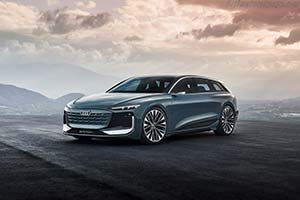
<< Prev Page 2 of 2  The flat headlights and taillights are slim and flush with the overall composition of the lines. Digital Matrix LED and digital OLED technology makes it possible to achieve maximum brightness and a wide range of features even with a minimal surface area, while at the same time offering customizable light signatures. The team of Audi lighting designers and developers has once again done an amazing job – this concept car packs a host of new features and personalization options into its lighting units. The flat headlights and taillights are slim and flush with the overall composition of the lines. Digital Matrix LED and digital OLED technology makes it possible to achieve maximum brightness and a wide range of features even with a minimal surface area, while at the same time offering customizable light signatures. The team of Audi lighting designers and developers has once again done an amazing job – this concept car packs a host of new features and personalization options into its lighting units.Three small, high-resolution LED projectors are built into each side of the body, transforming the ground beneath them into a stage when the doors are opened – small, extended, dynamic lighting effects greet the occupants with messages in their own language. The combination of safety features and aesthetic design is particularly important to Audi. That’s why the small, high-resolution projectors also display warning symbols on the ground – to warn a bike rider that the car door is about to open, for example. Another four high-resolution LED projectors – inconspicuously integrated into the corners of the vehicle – generate turn signal projections. The design of these projections can be modified to address different markets and approval regions as required. The Digital Matrix LED front headlights achieve almost cinematic quality. If, for example, the Audi A6 Avant e-tron concept is parked in front of a wall during a break to recharge the battery, the driver and passengers can pass the time playing a video game projected onto it. Instead of on a small screen in the cockpit, they’ll see their current game’s virtual landscapes projected onto the wall in XXL format – and all this via the Digital Matrix LED headlights. The rear end of the concept car features a new generation of digital OLED elements that, as a continuous strip of lights, act like a display. They can also be used to create almost unlimited customizable variations of digital light signatures and dynamic lighting displays that can be adapted to the customer’s personal taste. One new feature in the taillights is the three-dimensional architecture of the digital OLED elements, that – adapted to the shape of the body – makes it possible to perfectly integrate the night design into the overall look. This makes it possible to experience the dynamic light show not only in two dimensions – as was previously the case – but with an impressive, 3D spatial effect. And it goes without saying that the combination taillights, like the headlights, meet their developers’ requirements when it comes to the traditional functions of vehicle lighting, namely seeing and being seen – in the front, a clearly and brightly illuminated road with headlights that intelligently adapt to the traffic situation, weather, and surroundings, as well as communicate with other road users. In the rear, the ultrabright, homogeneous, and high-contrast digital OLED combination taillights can particularly and significantly increase the level of safety on the roads of the future. In addition, the projections around the vehicle allow its communication range to be extended beyond the vehicle for the first time. With the help of intelligent connectivity in the vehicle, the A6 e-tron concept provides information to other road users with visual signals. The PPE is designed exclusively for battery-electric drive systems and can therefore take full advantage of all the benefits of this technology. The key element of the future PPE fleet is a battery module between the axles that holds around 100 kWh of energy in the Avant version of the A6 e-tron concept. Using the entire vehicle base makes it possible to achieve a relatively flat layout for the battery. This means that it will be possible to use this single platform both for vehicles with high body styles and vehicles with a decidedly dynamic, flat architecture – such as the Audi A6 Avant – without any changes to the basic architecture. The battery size and wheelbase of PPE vehicles are scalable, making them suitable for use in different market segments. However, the proportions of a fairly long wheelbase and very short overhangs are something they will all have in common and this, together with the large wheels, results in basic proportions that are simply perfect – and not just in terms of design. This is because the occupants of the future PPE models will also benefit from the long wheelbase, which translates into a longer interior and more legroom in both rows of seats – a key benefit across all segments. In addition, electric vehicles are also generally more spacious thanks to the absence of a transmission tunnel, which is simply not needed due to the technology. But even without the transmission tunnel, Audi customers will not have to give up the brand’s trademark quattro drive system. The future range of PPE models will include versions with one electric motor each mounted to the front and rear axles that use electronic coordination to deliver all-wheel drive on demand and achieve a perfect balance between driving dynamics and energy efficiency. In addition, the e-tron family will also include basic versions optimized for minimum consumption and maximum range – in this case, propulsion will come from a single electric motor mounted to the rear axle. The Audi A6 Avant e-tron concept’s two electric motors are capable of delivering 350 kW of total output and 800 Newton meters of torque. The front wheels of the Audi A6 e-tron concept are connected via a five-link axle specially optimized for electric vehicles with a multi-link axle in the rear. The concept car features Audi air suspension with adaptive dampers. The heart of the Audi A6 Avant e-tron concept’s drive technology – and that of all future PPE models – will be the 800-volt charging technology. Like the Audi e-tron GT quattro1 before it, this ensures that the battery can be charged with up to 270 kW in a very short time at fast-charging stations. This revolutionary technology will enter the high-volume mid-range and luxury segments with the PPE for the very first time. Thus, the A6 Avant will become the storage champ in a double sense – not only because of its spacious back end. The PPE technology enables charging times that come close to a conventional stop to refuel a car powered by a combustion engine. Just 10 minutes is enough time to charge the battery to a level sufficient to power the car for more than 300 kilometers (186 miles). And in less than 25 minutes, you can charge the Audi A6 Avant e-tron concept’s 100 kWh battery from 5 to 80 percent. Together with a range of up to 700 kilometers (435 miles) – depending on the selected drive system and power output – the models in the Audi A6 e-tron family are uncompromisingly suitable for long trips. Furthermore, their range and charging speed keep pace with those of combustion engines, making them perfect universal cars for everyday needs, from short trips to the store to longer road trips when going on vacation. In terms of dynamic qualities, the Audi A6 e-tron concept – as is typical for an electric car – truly outshines its rivals with combustion engines. Thanks to its high torque right from the first revolution, even entry-level models designed for efficiency will accelerate to 100 km/h (62 mph) in less than seven seconds. And in the top-of-the-line, high-performance models, this sprint can even be reduced to well under four seconds. 2018 saw the debut of the Audi’s first fully electric production vehicle – the Audi e-tron. Since then the brand has systematically and rapidly pushed ahead with the widespread introduction of electric mobility across its entire product range. Following the Audi e-tron SUV and e-tron Sportback, the highly dynamic e-tron GT quattro1 – based on a new technology platform developed jointly with Porsche AG – made its debut in February 2021. And just two months later, the Audi Q4 e-tron and Q4 Sportback e-tron premiered – two extremely unique SUVs in the compact segment with a common technological platform, the Volkswagen Group’s MEB. The Audi A6 e-tron Sportback and Avant concept cars are now the first members of a family of vehicles – initially in the C-segment and later also in the B- and D-segments – to be based on another innovative technology platform: the Premium Platform Electric, or PPE for short. This modular system is being developed under Audi’s leadership together with Porsche AG. The first Audi production vehicles built on the PPE platform will be successively unveiled starting in 2023. The PPE is the first platform designed to accommodate an unprecedented range of high-volume automobiles – including SUVs and CUVs with high ground clearance as well as cars with low ride height that are part of Audi’s core product range, such as the Audi A6 series. But there are also plans to expand the PPE range into the B-segment, which has been the highest-volume market segment for Audi for decades. And even when it comes to the top-of-the-line D-segment, the PPE is an excellent technological platform to build on. With the PPE, electric vehicles will now also be attractive to customers who prefer automobile concepts beyond the SUV segment – like an Avant, for example, which is characteristic of the brand. As a result, Audi can effectively expand the range of electric vehicles in its portfolio – via the high-volume B- and C-segments. In addition, economies of scale will allow luxury-class technology and various different model versions to be incorporated into a wide-ranging lineup of models that is unrivaled in the premium market. << Prev Page 2 of 2 |
| Article | Image gallery (18) | Specifications |
| All Cars - Contact us - Privacy Statement - Top | © 1998 - 2026 Ultimatecarpage.com |