
 Ultimatecarpage.com
> Cars by brand
> Italy
> Pagani
Ultimatecarpage.com
> Cars by brand
> Italy
> Pagani
 Huayra Codalunga Huayra Codalunga
|
| Pagani Huayra Codalunga |
| Article | Image gallery (14) | Specifications |
|
|
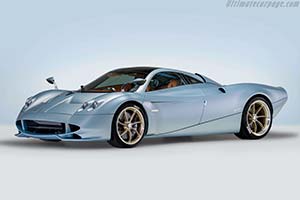
<< Prev Page 2 of 2  “We decided to use the simple linear style of the Huayra Coupé as the starting point. We made the Huayra Codalunga longer and smoother, as if it had been caressed and molded by the wind, to design lines that were even more elegant than the coupe. We drew inspiration from the long tails of the 1960s that raced at Le Mans, which had very clean lines. The Huayra Codalunga comprises very few essential elements; we have taken away rather than added. Simplifying is not at all straightforward, and this vehicle is, above all, the result of a complex pursuit of simple ideas.” – Horacio Pagani. “We decided to use the simple linear style of the Huayra Coupé as the starting point. We made the Huayra Codalunga longer and smoother, as if it had been caressed and molded by the wind, to design lines that were even more elegant than the coupe. We drew inspiration from the long tails of the 1960s that raced at Le Mans, which had very clean lines. The Huayra Codalunga comprises very few essential elements; we have taken away rather than added. Simplifying is not at all straightforward, and this vehicle is, above all, the result of a complex pursuit of simple ideas.” – Horacio Pagani.The coachbuilders of the ‘60s were inspired by aircraft designs and, in a relentless quest for speed and low drag, created some of the most iconic shapes in the automotive history. At the time, large body panels created by hand in aluminum alloy were the result. Today, Pagani uses its know-how in advanced composite materials to create a bodywork that follows this inspiration. The rear engine cover, which has a footprint of more than 3.7 m2, and is 360 mm longer than the one of the Huayra Coupé, conceals a mechanical prodigy: the Pagani V12, which, on this series, is capable of developing 840 HP with 1,100 Nm of torque. The lack of rear grilles makes space for an unobstructed view of the Codalunga’s exhaust system, which is made from titanium and weighs only 4.4 kg (9.7 lb). The special ceramic coating completes the homage to the racing cars of Le Mans and the symphony that emanates from the signature four tailpipes is a tribute to automotive passion. The work “to take away rather than add” resulted in a record weight of just 1,280 kg (2,822 lb) and extremely high aerodynamic efficiency, helped by the car’s shape and extra length. The four flaps with variable profiles represent the very latest in active aerodynamics, a feature which had its world preview in 2011 and which has been subsequently refined with each model. “The colors and materials also recall the cars of the 1960s. The paint on the outside blends into elements of the cockpit while structural parts retain their exposed carbon fiber finish. The artisan touch can also be seen on the internal finishes with woven aged suede leathers.” – Alberto Piccolo, Concept and Interior Designer, Pagani Automobili. On this special model, the choice was made to use neutral colors and semi-matte or fully matte paints, to evoke the shades of the past and to bring out the simplicity of the car’s design. This concept also plays a fundamental role on the inside, where the seats are finished with a woven leather/nubuck upholstery and aluminum components are machined from a single block. This recalls the manual techniques of the past, when the artisan would polish each element by hand. Work which is still performed today, a tradition kept alive by the experts in the center of the world sports car industry, Italy’s Motor Valley. << Prev Page 2 of 2 |
| Article | Image gallery (14) | Specifications |
| All Cars - Contact us - Privacy Statement - Top | © 1998 - 2026 Ultimatecarpage.com |