
 Ultimatecarpage.com
> Cars by brand
> Italy
> Pagani
Ultimatecarpage.com
> Cars by brand
> Italy
> Pagani
 Utopia Utopia
|
| Pagani Utopia |
| Article | Image gallery (28) | Specifications |
|
|
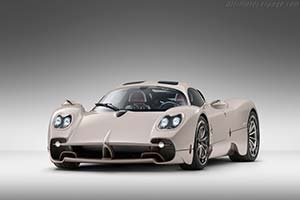
<< Prev Page 2 of 2  A car may be compared to a sculpture, but opening the door changes everything; a sculpture, yes, but one you can sit in. The interior of Utopia is even more original, if that is possible, than its exterior shape. A car may be compared to a sculpture, but opening the door changes everything; a sculpture, yes, but one you can sit in. The interior of Utopia is even more original, if that is possible, than its exterior shape.Neither modern nor retro, it is timeless. There are no screens apart from the minimal display in front of the driver; big screens would have been easier to fit and would have saved a lot of effort in the design, but it would have taken away much of the beauty. All the instruments are purely analog and each of the easy-to-read dials subtly reveals part of its mechanism as if it were revealing the skeleton movement. For Pagani, every component needed for the car to function is an opportunity to be creative. Even the steering wheel has been reinvented: it is fashioned from a solid aluminum block, from the spokes and hollow rim to the steering column boss, which contains the airbag. The pedals are also made from a single block of metal, while the gear lever mechanism is still exposed but more sophisticated than ever. All this with proper obsession paid to ergonomics, efficiency and ease of access. To reach this very simple final shape, the process has never been as complex. For six years, from the first sketches and computer calculations until the definitive shape was frozen for the carbon fiber molds, its internal airflows were perfected through endless hours of research in the wind tunnel and countless changes, one touch at a time. Utopia takes advantage of the mysteries of aerodynamics to maximize sure-footed handling and stability at any speed, however high. Its active aerodynamics, combined with the electronically controlled shock absorbers, ensure the optimum dynamic behavior in all driving conditions. The double-wishbone suspension, made from aerospace aluminum alloy, benefits from the lengthy development work carried out on the R, the track-only version of the Huayra. But Utopia, a car designed for road use, can cope with surfaces for daily use. The carbon monocoque used on previous Pagani models sets the standard in terms of its strength, lightness and build quality. Pagani has chosen to consolidate its existing strengths, to improve how its fibers are woven and to constantly invent new composite materials such as Carbo-Titanium and Carbo-Triax. On top of that, a new type of A-class carbon fiber has been developed specifically for aesthetic applications such as the bodywork, providing 38% of additional stiffness with the same density. A high-performance car must not only please its buyer, but support them and provide all the safety they require, without their need to ask or worry about it. Many exemptions are granted to very low-volume manufacturers, but Pagani made it a point of honor – once again – to build its cars and meet the most stringent regulations in the world, in every respect, starting with safety. Utopia passed more than 50 severe crash tests, from development to pre-tests and homologation approval, to reach its global certification. The Pagani V12 engine, a 6-liter biturbo specially built by Mercedes-AMG for Pagani, is the result of an enormous development work: it delivers 864 bhp and, above all, a prodigious 1100 Nm of torque. It revs higher and is both more flexible and more powerful while meeting the most stringent emissions regulations, including those in force in California. For the transmission the choice was a philosophical one. It would not be a dual-clutch transmission which is efficient, but heavy and robs the driver of the ability to set the pace of the car’s acceleration. Instead, Pagani turned to the most prestigious motorsport and high performance automotive transmission manufacturer, Xtrac, to develop the quickest shifting gearbox with helical gears possible. It is compact, light and transversely mounted for an optimized center of gravity. Moreover, in order to best match the wishes expressed by Pagani enthusiasts, its aficionados, a virtual manual would not be acceptable so a real seven-speed manual transmission has been developed. It was not an easy task to design such a gearbox with synchronizer rings and a mechanism able to handle 1100 Nm of torque adequate for a pure manual application, but it was an essential requirement for Utopia. However intelligent automatic transmissions may have become, nothing can replace the driver’s own mastery of the gearchanges: the prevailing logic is his alone, each change up or down is totally unique and depends solely on his decision and good judgment, the exact combination of circumstances, the nature of the road and the mood of the moment. As we discover his latest work, it is the path taken by its creator that fascinates us. Horacio Pagani builds the cars he has dreamt of. And it is to fulfill his highest aspirations, those closest to the impossible, that, as a very conscientious engineer, he seeks to serve the dreamer. In the land of dreams, you need a guide: the great Leonardo da Vinci has always been a crucial figure for Pagani. It is under Leonardo’s aegis that he has always believed that it is possible to combine art and technology. Can you think of any more demanding mentor? An artist and an inventor, Leonardo, one of the greatest portrait painters of all time, was also interested in anatomy. It is not the case for Horacio to compare himself to the Florentine genius but of following his path: Leonardo constantly combined technical inspiration with his love of beautiful shapes. Horacio Pagani is an artist, the car is his preferred way of expressing himself. When he draws something, however beautiful it is, the shape he creates is the result of the function it will perform. For him, a shape cannot be elegant if it is technically incorrect. And when the technical difficulty has been overcome, its beauty can be found in its solution. Horacio has always gone about things in the same way, that is just how he is: the creativity and the act of solving real problems, take the shape in him of an expression of painting or poetic harmony. He has always been a composer, and for a long time as a designer he was a soloist, but now he has become a conductor and has learned to see his ideas carried out by his team – young men and women who will then contribute with their own ideas to the common masterpiece, and on which he can put his signature with pride. From its origin, the situation has changed considerably; the firm was self-sufficient in 1999, with just 25 employees in total and so much to be done; but this is no longer appropriate. Pagani, a function-focused company, remains essentially a family-sized business but today employs 180 staff. Engineers specializing in all fields, designers and highly qualified technicians occupy the Art & Science Research Center, where the Zondas originally came into being, whereas the new facility is home to the production process. Turning out 50 cars a year, it is closer to a sartorial atelier than an assembly line. Nearly 25 years ago, the Zonda was designed and built by a very small team with few resources. Imagine what an intuition can grow into, nurtured and developed by the new strengths Pagani Automobili now possesses. Whatever the decision, whatever the direction its creative ideas may take, this little company is capable of realizing them, quickly and well, with an unrivaled standard of quality. Its design, prototyping, development << Prev Page 2 of 2 |
| Article | Image gallery (28) | Specifications |
| All Cars - Contact us - Privacy Statement - Top | © 1998 - 2026 Ultimatecarpage.com |