
 Ultimatecarpage.com
> Cars by brand
> Italy
> Ferrari
Ultimatecarpage.com
> Cars by brand
> Italy
> Ferrari
 Roma Spider Roma Spider
|
| Ferrari Roma Spider |
| Article | Image gallery (13) | Specifications |
|
|
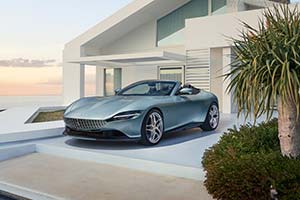
<< Prev Page 2 of 2  The adoption of a fabric soft top and its indirect impact on the car’s bodywork geometries provided the starting point for the aero development. To retain the Ferrari Roma’s low drag, combined with the possibility of generating efficient downforce, the line of the roof and its curvature over the frontal section were subjected to in-depth numerical analysis and guided by the work of the Aerodynamic Department to ensure the project target was reached. The adoption of a fabric soft top and its indirect impact on the car’s bodywork geometries provided the starting point for the aero development. To retain the Ferrari Roma’s low drag, combined with the possibility of generating efficient downforce, the line of the roof and its curvature over the frontal section were subjected to in-depth numerical analysis and guided by the work of the Aerodynamic Department to ensure the project target was reached.The modifications to the Ferrari Roma Spider’s bodywork also required new mobile spoiler geometry. In fact, the design of the latter has been meticulously honed to reflect the car’s styling and new roof line. Similar to the Ferrari Roma, this element is designed to extend and retract in a calibrated way specific to the spider as a function of the car’s speed, and the longitudinal and transverse acceleration acting on the body. This guarantees three different spoiler positions, specifically calibrated for top-down driving. The result is that the Ferrari Roma Spider has downforce in handling situations and at high speeds comparable with the Ferrari Roma, ensuring the car is always aerodynamically balanced and able to deliver the same driving exhilaration. Huge attention was lavished on aerodynamic comfort on board with the top down, with particular focus on minimising both turbulence and wind noise in the cabin. The solutions selected were driven by the need to simplify the transition from top-up to top-down driving, by introducing automatic movements for the surfaces tasked with creating an aerodynamic ‘bubble’ effect over the cockpit for comfort. The first was the addition of a 5mm nolder on the new windscreen header rail in the area of the flow separation. The second was the development of an automatic patented wind deflector that can be deployed by the driver without any need to stop the car. If the client wants to deploy the wind deflector, they simply press a button on the tunnel and the backrest of the rear seats (in the absence of rear passengers) will rotate into position behind the front occupants’ heads. In this configuration, the air flow that would normally be drawn into the cabin from the rear of the car is deflected, creating an area of relatively still air around the occupants and reducing still further the turbulence around the heads of taller drivers by around 30% compared to previous 2+ spider applications. The deployable wind stop’s permeability was optimised by a transverse aperture at its centre which, thanks to its calibrated angle, acts as a real aerodynamic duct, while its shape in the plan view is tapered at the sides. These two geometric characteristics combine to deflect the most highly energised flow entering the cabin well away from the occupants. The duct at the centre of the wind stop ensures that part of the flow entering the cabin is deflected downwards towards the rear seat, forcing it to mix with a slower flow. This means it loses most of its energy, effectively reducing turbulence in the cabin. The result is an extension of the bubble around the occupants and particularly their heads, guaranteeing unparalleled en plein air comfort. The shape, angle and permeability of the deployable wind stop are all crucial to achieving this objective, and were developed thanks to a combination of CFD simulation and many wind tunnel sessions. There is no doubt that the most visually striking downforce generation feature is the active spoiler at the rear of the car’s upper body. A mobile spoiler is cleverly concealed in the rear lid, not interfering in the least the car’s line. However, thanks to a special mechanism, it can deploy into three different positions (Low drag – LD, Medium Downforce – MD, High Downforce – HD). In low speed situations, when downforce has only a modest impact on the car’s performance, the spoiler goes into low drag position. This configuration is maintained until the car hits a speed of 100 km/h. At speeds of over 300 km/h, the spoiler is in MD mode. This choice was made because in these conditions, the preference is for a better balanced car, in part because of the minimal impact on drag. In speed ranges in which downforce plays a pivotal role in performance, the spoiler is in MD position and its movement to the HD position depends on the car’s longitudinal and lateral acceleration. The threshold value is variable and linked to the Manettino position. In medium downforce mode (MD), the mobile element is at a 150-degree angle to the rear screen. In this configuration, it can generate around 30% of maximum downforce with an increase in drag of under 1%. In high-performance handling or braking situations, the mobile element automatically moves to HD configuration, generating maximum downforce and readying the car to provide the driving thrills that all Ferraris deliver. When deployed to its maximum height (HD), the mobile element creates a 135 degree angle with the surface of the rear screen, thus generating around 95 kg of downforce at 250 km/h, yet increasing drag by a mere 4%. The increase in front downforce is due for the most part to a pair of vortex generators, which have been optimised for this particular model. They create a ground effect by introducing concentrated and coherent vortices into the area whilst simultaneously managing the wake from the front wheels with the ultimate aim of guaranteeing very efficient downforce generation. The goal of the Ferrari Roma Spider’s vehicle dynamics development was to deliver superior driving thrills and handling precision on a par with the Ferrari Roma, thanks to the Side Slip Control concept which uses an algorithm developed by Ferrari that provides an instantaneous estimate of side slip to all the various on-board control systems. This data is then used to coordinate and implement interventions in a rapid, timely and accurate manner. The Side Slip Control System (SSC), version 6.0 of which is used here, integrates all the car’s vehicle dynamics systems, most notably the Ferrari Dynamic Enhancer, active solely in the Manettino’s ‘Race’ position. The FDE is a lateral dynamics control system that rapidly adjusts the hydraulic brake pressure at the callipers on all four wheels consistent with the dynamic situation requiring control. It is designed to make the evolution of the car’s lateral dynamics more predictable through and exiting corners, ensuring the driver’s control of the steering wheel and throttle are simpler and more intuitive. The system flanks the traditional Electronic Stability Control system. Like the Ferrari Roma, the Ferrari Roma Spider’s Manettino has five positions to make its handling and traction performance even more accessible with the introduction of the Race position. Supported by the introduction of the Ferrari Dynamic Enhancer, this position is designed to boost fun behind the wheel. The Ferrari Roma Spider’s chassis is derived from the Ferrari Roma, but features new components, with the rear section inspired by the solution used on the Ferrari Portofino M. The sill, a fundamentally important structural element, was developed specifically for the Ferrari Roma Spider, as were some elements required to install the soft top, and the A-pillar/windscreen surround. The bodyshell retains the fundamental elements of the Ferrari Roma’s design: the modifications made focused mainly on the rear and on harmonising the Ferrari Roma Spider’s lines so that they retain their elegance with the top down. Exceptional torsional rigidity and beam stiffness figures for the bodyshell and chassis have been achieved despite an increase in weight of just 84 kg for a weight/power ratio of 2.5 kg/cv, which remains at the very top of the high-performance 2+ spider category. This impressive result also ensures that the Ferrari Roma Spider benefits from the same excellent handling and performance as the Ferrari Roma. This increase was due in part to two factors. Firstly, the addition of the unique integrated wind deflector, which significantly improves occupant comfort. Secondly, the addition of headrests for the rear seats that visually integrate into the tonneau cover design. The automatic fabric soft top guarantees occupant comfort on a par with the retractable hard top system equipping the other spider models in the range. The large rear glass screen is fully integrated into the soft-top geometry. The five-layer fabric dampens wind and road noise, making it quiet even at high speeds. During development, special attention was also paid to reducing the ballooning effect typical of soft tops. The technical solutions adopted by Ferrari’s engineers have thus guaranteed class-leading performance in these areas. The soft-top mechanism was designed to be light yet resilient: it pushes technical performance limits to new heights thanks to a Z-shaped movement that folds the soft top away in a mere 13.5 seconds and up to a maximum speed of 60 km/h. When stowed, the roof occupies a height of just 220mm, which is the lowest in the category, and that, in turn, ensures a roomy boot (a class-leading 255 litres with the top up). The gas springs used to extend the wind deflector were meticulously designed and developed to deliver controlled, smooth action at all stages of movement and in all conditions. The wind deflector can be opened at up to 170 km/h. The chance of opening the mechanism is automatically speed-limited to ensure that it can be deployed in safety. Once in place, the wind deflector can be used at any speed in open configuration. The wind deflector retains all the features unique to a real backrest: the surface the rear occupants rest on is padded for comfort, while it is shaped to open even when the front seats are pushed back. The central duct compensates for the air pressure acting either side, improving the efficiency of its movement. The system’s kinematic points are the result of an in-depth study of the entire back seat and boot area, optimising their position in relation to movement and weight. << Prev Page 2 of 2 |
| Article | Image gallery (13) | Specifications |
| All Cars - Contact us - Privacy Statement - Top | © 1998 - 2026 Ultimatecarpage.com |