
 Ultimatecarpage.com
> Cars by brand
> France
> Alpine
Ultimatecarpage.com
> Cars by brand
> France
> Alpine
 A290_β A290_β
|
| Alpine A290_β |
| Article | Image gallery (16) | Specifications |
|
|
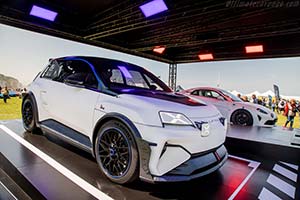
<< Prev Page 2 of 2  While the production A290 will look a lot like the Alpine A290_β show car from the outside, the interior is much more conceptual and based on a pioneering architecture that puts the driver in the middle of the action. Two magenta and blue light beams also underline the fact that the driver’s seat is on the centreline. While the production A290 will look a lot like the Alpine A290_β show car from the outside, the interior is much more conceptual and based on a pioneering architecture that puts the driver in the middle of the action. Two magenta and blue light beams also underline the fact that the driver’s seat is on the centreline.There is a close link between the inside and outside, emphasised by the windscreen overflowing onto the bonnet – which also shines a light on the central driving seat. It provides a singular perspective of the arrow-shaped dashboard inspired by Formula 1 cars’ nose cones. The dashboard stretches across cockpit and outwards onto the wing mirrors. Then it stretches horizontally, to the base of the bonnet and to the back where the spoiler emerges from the chassis’ backbone. All the driving functions are lined up on this axis. This underscores the fusion and harmony between the inside and outside, and the central role that the driving position has played in the rest of the A290_β’s design. The cockpit is inspired by racing cars: it is minimalistic and all about performance and efficiency. The steering wheel packed with an assortment of motorsport-inspired features is a great example and the bucket seats and safety harnesses round out the effect. A city-friendly hot-rod inspired by racing cars and the Alpenglow concept car: that, in a nutshell, is what the A290_β is all about. Its three-seat architecture and central driving position illustrate this perfectly. The whole point is that the driver is at one with the car and the passengers enjoy an unparalleled experience. The driver connects with the road and focuses on the driving experience. The passengers – co-pilots, here – watch the driver in action and savour the sensations. The bucket seat structures are 100% raw carbon, and lightweight as befits every Alpine car’s build. They come with Sabelt safety harnesses made for racers. The seat insert pads were meticulously designed to add to the sporty shape and provide flawless support. The driver’s seat is covered in ultralumen, a high-tech retro-reflective material and discretely adorned with triangles hinting at the car’s three-seater configuration, mountains and the Alpine brand’s emblem. The handle next to the driver’s feet was designed specifically for this show car with an Alpine driver, and opens the doors in less than 7 seconds. This all-new design feature also provides a high level of safety. The Alpine A290_β’s dashboard is deliberately shaped like an arrow, to highlight the centreline driving position and convey a sense of speed, performance and complete control. This style adds to the vibrant feel in the show car’s cockpit, where every detail is at its most extreme. The sense of oneness was crucial in completing the interior design. The dashboard, for example, has a blue line running across it and linking it with the doors. The indicator light strips beneath the wing mirrors are also blue. As the driver can see the indicators blinking from the cockpit, there is no need for matching flashing lights inside. The blue line travels around the passenger area to enhance the connection between the driver, passengers and machinery. All the car’s functionalities are on the centreline where the driver sits. A console built into the roof provides instant access to several features (kill switch, indicators, light settings, etc.). One thing that sets this show car apart is that it has no screens inside. That way, the driver can focus 100% on driving and racing. It does, however, have a slender head-up display, over the steering wheel, showing the essentials (for instance speed and battery charge). The driver also has a headset with a display feeding all the race-related information live: any flags the officials are waving, the track’s condition, information about the other cars, etc. The link with motorsports is palpable and entices the driver and passengers to enjoy this one-of-a-kind, sense-arousing experience. The production car will be built around the same driving experience: the cockpit will revolve around the driver – the physical layout as well as the multimedia system and virtual interfaces associated with it, such as the onboard telemetry system and Alpine animations. The A290_β’s steering wheel is directly inspired by Alpine’s LMP2, A470 and Formula 1 A523 single-seaters. Its geometric gamepad-like design has a series of specific functions, including a red OV (Overtake) button to deliver a 10-second power boost. This button is also designed to optimise safety: it can only be used when the track is dry and can only be pressed again after a 10 second wait. This Overtake button derived directly from Formula 1 and the rest of the motorsport universe will come on all models in Alpine’s full-electric line-up. Other features such as the radio, driving mode selector, ABS settings and the pit-lane speed-limiting button are also ergonomically built into the steering wheel to provide advanced control. The steering wheel in the compact production sports car will include several of the features, including the Overtake button, charge and driving mode selection. The A290_β’s interior architecture is unique in itself – but also comes with sophisticated, noble, up-to-the-minute and long-lasting materials. The dashboard is clad in environmentally-friendly certified vegetable-tanned leather that has a very distinctive and pleasurable feel. On the door panels, this leather is laser-machined to create a variety of contrasts and underline the high-tech upholstery. There are also tastefully embroidered leather touches ennobling some of the vehicle’s structural components, such as the chassis. The hallmark Alpine triangle, on the side window under a matte varnish, gives the show car a techy, modern feel. At night, it becomes a showpiece: the glow inside lights up the blue and magenta patterns. This motif is sprinkled all around the vehicle, its look changes and it combines into a consistent and elegant visual effect befitting the brand. The steering wheel also has a small crystal triangle – like the one in the Alpenglow concept car – at the centre. The aluminium inside and outside points to an Alpine’s lightness but is also a statement about this show car’s sporty demeanour and bold aims. The parking brake, for instance, is sand-blasted aluminium covered in leather. Other parts, including the footrests, decorative inlays on the doors and dashboard winglets are also sand-blasted aluminium. The ultralumen reflective material covering the top of the dashboard and steering wheel, and the driver’s seat, intensifies the effect that you get from the driving seat on the centreline and the cockpit’s original architecture. When you flash a light on it, this technical material lights up all the driving-pleasure essentials – and again highlights the driver’s central role and the car’s sporty feel. The name Alpine is written in metallic letters across the sides and front. Blue, white and magenta flags replicate the show car’s colour scheme and underline its identity. The expertise that the development teams poured into the electrical design – which was a big hit in the A110 E-ternité prototype – shines through the A290_β. It captures much of the engineers’ development work on the future electric models in the line-up and the way they are changing the game for sports driving. To boost the show car’s efficiency, Alpine’s development teams fine-tuned its torque vectoring technology,which controls the torque reaching each wheel separately. This balancing act pushes performance as high as it can possibly go, when driving in a straight line or turning, and the feeling is unforgettable. The production car will also have a torque management mechanism suited to its design. Another surprise in Alpine’s new B-segment sports car is an all-new multi-link rear axle. It strikes the best possible balance between vigour and comfort, and is a rare privilege for a car in this category. The Alpine A290_β’s chassis was built for purpose. The show car, as a result, is pleasantly playful at low and mediums speeds – again, to add to the driving sensations. Then, at high speeds, the car becomes extremely stable, treating the driver to an intense and at the same time reassuring experience. The shock absorbers, suspension springs and front and rear anti-roll bars were optimised so that the vehicle is pleasurable to drive on every type of road. The braking and cooling systems were also tuned time and again for maximum efficiency and effectiveness. The little Alpine electric sports car will come with a high-performance Brembo braking system, 4-piston calipers, identical to that of the A110. To keep the driver and passengers comfortable in all circumstances, and at the same time improve grip, the car will come with hydraulic compression stops to cushion shocks more efficiently. This technology will allow the suspension system’s settings to be specifically tuned to provide superior agility and comfort. Several settings are available directly via the buttons on the steering wheel, to optimise the show car’s behaviour in real time. The ABS has 11 positions, and responds according to road holding. There are also three driving modes for tracks: Wet, Dry and Full. These three strategies are fine-tuned and the underlying settings adjust according to the road’s condition. On a wet track, the car responds much more gently, has more traction and is stabler. In Dry mode, its behaviour is completely different: it glides more, and the wheels respond more aggressively. And Full mode, like the Overtake button, unleashes the electric motors’ full might. << Prev Page 2 of 2 |
| Article | Image gallery (16) | Specifications |
| All Cars - Contact us - Privacy Statement - Top | © 1998 - 2026 Ultimatecarpage.com |