
 Ultimatecarpage.com
> Cars by brand
> Great Britain
> Lotus
Ultimatecarpage.com
> Cars by brand
> Great Britain
> Lotus
 Theory 1 Theory 1
|
| Lotus Theory 1 |
| Article | Image gallery (12) | Specifications |
|
|
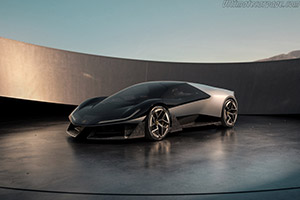
<< Prev Page 2 of 2  Theory 1 seamlessly integrates projections, screens, and haptics, with Lotus’ new design manifesto to create a borderless user experience and provide the driver with information quickly and easily through: Theory 1 seamlessly integrates projections, screens, and haptics, with Lotus’ new design manifesto to create a borderless user experience and provide the driver with information quickly and easily through:
With current cars made of an average of 100 A-surface materials, as a concrete action to a more sustainable future and circular economy, Lotus started from scratch to build a car with as few materials as possible. As a result, the ‘Challenge of 10’ was created, and it is Lotus’ intention and ambition to push the automotive industry forward, demonstrating the company’s north star for future material innovation. Theory 1 has been designed with only ten main A-surface materials with performance, durability, lightweight, recycled, and recyclable properties. This includes the use of cellulose based glass fibre, recycled chopped carbon fibre, titanium, recycled glazing, recycled polyester, recycled rubber, elastomeric Polyurethane, transparent polycarbonate, thermoplastic polyurethane, and recycled aluminum. The Challenge of 10 demonstrates Lotus’ commitment to pure minimalism, which is a nod back to Lotus’ simplicity of construction and lightweight principles of the company’s heritage vehicles. This philosophy is also demonstrated in the LOTUSWEAR™ driver system with the soft robotic fabrics in collaboration with MotorSkins, as well as 3D printed lattice structure headrests in partnership with Carbon. In addition, Lotus has tapped into global electronics manufacturer Kyocera SLD Laser, Inc., a Kyocera group company, to deliver industry-leading laser lights in both the interior and exterior, in order to deliver a safe, powerful, and advanced lighting system, whilst drastically reducing component size and weight. This includes ‘Next Generation’ laser wire DRL functions, which are less than a millimeter in diameter, and main and dipped-beam functions which are delivered through lenses of 7x35mm. With these principles as the foundation of Lotus design DNA, the company’s intent is to enhance the performance of its cars in line with racing principles, which Lotus was renowned for. Its aim is also to make performance cars more accessible by simplifying the design and technology, making it as easy as possible for anyone to use. Theory 1 extends Lotus’ expertise in engineering to bring drivers an electric car that performs exceptionally and unlocks driver confidence by making the experience as fun and engaging as possible. This includes advanced active and passive aerodynamic techniques including cooling, active rear spoiler, and passive rear underbody. All of this, along with the low centre of gravity, enhances stability and increases the lightness of the vehicle. Theory 1 seamlessly integrates advanced aero and cooling systems, which are designed to work in harmony and increase efficiency. This includes:
The rear wing has also been mounted directly to the motor and suspension assembly to ensure the downforce acts directly on the suspension mounts, all the way through to the tyres - reducing losses and frontal lift. The rear suspension system also features a pull rod design, which delivers a more compact package and lower centre of gravity. The ultimate advanced dynamic architecture, delivering a state-of-the-art and seamless experience. Lotus has developed a proprietary sports car door system that enables all occupants with easy ‘step-in’ access to the car with its reverse opening and wrap-over design. With this, Lotus has been able to achieve the smallest footprint it can with the doors opened, allowing for practical use of doors even in narrow spaces. For instance, if a car is parked in a tight car park with a 2.4-meter space, the driver will still be able to get in and out of the vehicle with ease. This has previously been a challenge with similar high-performance sports cars. Furthermore, Theory 1 is a three-seater sports car which has a central driving position, with a passenger on each side, nestled behind the driver. Inspired by motorsports, the driver’s seat in the middle of the car provides the driver with the best possible visibility of the road ahead, as well as easy access to all controls. The inside of the vehicle structure has also been shaped around the human body, with the seating integrated into the structure. Lotus has designed the car, to respond to the occupant’s body. For instance, the steering wheel and pedals all move towards the driver. The car also features steer-by-wire, which enables precision and control at every turn and the ability to adjust steering ratios, speed and feel. This is designed to deliver precision and the smoothest ride, further enhancing driver confidence, and connecting them to the road. Theory 1 features bespoke Pirelli tyres belonging to the P Zero family, Pirelli’s Ultra High-Performance (UHP) range. These have been developed specifically to enhance the vehicle’s performance, with particular attention to limit the environmental impact, and include Elect - Pirelli’s most advanced set of technologies developed to emphasize the characteristics of electric cars. Pirelli Elect tyres have a structure and materials that support the weight and the high torque typical of vehicles with electric powertrains, providing longer durability, less tyre wear, and optimising battery range. These tyres are present today in the company’s electric vehicles including its hyper-SUV, Eletre; hyper-GT, Emeya; and hypercar Evija. The car also details the latest advanced performance braking systems from AP Racing, who Lotus has had a long-standing relationship with. It goes all the way back to the 1967 Lotus 49 and AP Racing today provides the brake systems in Lotus’ current product lineup including Evija, Eletre and Emeya. Theory 1 features a super lightweight, high performance carbon ceramic braking system, with near-net Monoblock aluminum forged body with asymmetric design – reducing material where not needed. << Prev Page 2 of 2 |
| Article | Image gallery (12) | Specifications |
| All Cars - Contact us - Privacy Statement - Top | © 1998 - 2026 Ultimatecarpage.com |