
 Ultimatecarpage.com
> Cars by brand
> Germany
> Volkswagen
Ultimatecarpage.com
> Cars by brand
> Germany
> Volkswagen
 1 Litre 1 Litre
|
| Volkswagen 1 Litre |
| Article | Image gallery (10) | Specifications | User Comments (13) |
|
|
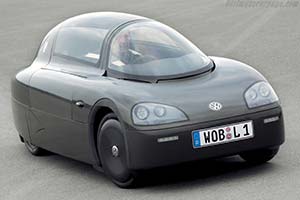
Page 1 of 1  At the 42nd Annual Meeting of Stockholders of Volkswagen AG in Hamburg, the most economical car in the world was presented: the 1-litre car. The prototype, which until now has been kept closely under wraps, and which may people never believed could be built, was driven under its own power from Wolfsburg to the Annual Meeting in Hamburg. Before the Annual Meeting, the current Chairman of the Board of Management, Dr. Ferdinand Piëch, drove this research vehicle to Hamburg from the company's headquarters at an average fuel consumption of 0.89 litres per 100 kilometres. At the 42nd Annual Meeting of Stockholders of Volkswagen AG in Hamburg, the most economical car in the world was presented: the 1-litre car. The prototype, which until now has been kept closely under wraps, and which may people never believed could be built, was driven under its own power from Wolfsburg to the Annual Meeting in Hamburg. Before the Annual Meeting, the current Chairman of the Board of Management, Dr. Ferdinand Piëch, drove this research vehicle to Hamburg from the company's headquarters at an average fuel consumption of 0.89 litres per 100 kilometres.The objective of developing a roadworthy vehicle that consumes just 1.0 litre of fuel per 100 kilometres could not be achieved through compromise. All existing technical solutions were examined, and in close cooperation with numerous suppliers, replaced by better, and principally lighter versions. The result is a vehicle that looks more like a sports car than a typical research vehicle. The conceptual necessity for a small frontal area led to an unusually narrow and very flat body form being chosen. The body was developed in a wind tunnel, is 3.47 metres long, but just 1.25 metres wide and just over a metre in height, and is made completely of carbon fibre composites. To save weight, it is of course not painted. The carbon-fibre-reinforced outer skin is tensioned over a spaceframe that is not made of aluminium, but rather of magnesium, which is even lighter. Fuel consumption is a mere 0.99 litre per 100 kilometres. With a 6.5-litre tank, this gives a range of some 650 kilometres without refuelling. Due to the restriction of space, it was not possible to adapt an existing gearbox. For this reason, a compact, automated 6-speed gearbox is employed, which is controlled from a turn switch in the cockpit. The interior is sportingly simple in design, yet offers enough space for two people, who can comfortably get in after folding back the turret-like gullwing door. An extremely lightweight construction has also been employed for the seats. The seat frames are made of magnesium, and firm, yet comfortable fabric covers are used instead of a classic upholstery. The sports-car-like design demonstrates that Volkswagen's 1-litre car is not a spartan research vehicle, but a high-tech special vehicle. It starts with the special seating arrangement. The driver and passenger sit centrally as if in a monoposto, but in tandem. The mid-engine is installed transversely in front of the rear axle. With its complex design (double wishbones at front, DeDion suspension at rear) and combined with the low centre of gravity and low overall vehicle weight, the lightweight running gear results in very agile handling. The 1-litre car also incorporates numerous details of a practical and convenient nature. For example, there is an easily accessible stowage compartment with a capacity of 80 litres under a separate flap in the rear, a reversing camera that helps when manoeuvring, automatic locking/unlocking of the gullwing door and a starter button in the cockpit that together allow keyless operation. The concept of the 1-litre car - four wheels, low height, with two seats in tandem - gives an idea for a possible new family of vehicles, which could cover new requirements ranging from the ultra-economical vehicle, through the low-lost everyday touring vehicle for young people to the high-performance sports supercar. Page 1 of 1 |
| Article | Image gallery (10) | Specifications | User Comments (13) |
| All Cars - Contact us - Privacy Statement - Top | © 1998 - 2026 Ultimatecarpage.com |