Go to Ultimatecarpage.com

Car search: Quick Advanced 
  Ultimatecarpage.com  > Cars by brand  > Italy  > Ferrari
Racing cars  > F1 1980-1989
     126 CK
Cars statistics: 3761 cars, 363 makes, 26312 images; Events statistics: 150 reports, 25899 images; Forum statistics: 73,932 members, 37,333 topics; more...


Ferrari 126 CK

Ferrari 126 CK Ferrari 126 CK Ferrari 126 CK Ferrari 126 CK Ferrari 126 CK Ferrari 126 CK
Click here to save all images    Image credits: Wouter Melissen 


Click here to download printer friendly version Ferrari never were very quick to respond to technical revolutions in motorsport as they preferred to rely on the gradual development of proven machines. For example, it is no coincidence that Ferrari scored the last front-engined Formula 1 and Le Mans wins. This strategy did at times backfire, with the best (worst?) example being the 1980 Formula 1 season; after Ferrari dominated 1979 season with a clean-sweep of both championships, the team scored just a handful of points and ended tenth in the constructor's cup. It could also be argued that Ferrari's 1979 performance was phenomenal, but either way, the Italian team had a considerable gap to bridge to regain competitiveness.

While it was instrumental in Ferrari's successes of the second half of the 1970s, the flat 12 engine by now formed the team's biggest handicap. Sure it was still powerful and reliable enough, but its width protruded too far into the venturi tunnels under the car. These were essential to produce the ground effect all Formula 1 racers relied on for cornering speeds. The V8 and V6 engines used by the competition were much more suited for this application. Another ongoing development concerned forced induction; pioneered in Formula 1 by Renault. In the first years, the French struggled to get the powerful engines reliable, but by the turn of the decade they had become serious contenders. So when developing a new engine seemed inevitable, it was no surprise that Ferrari took the Turbo path.

Following in Renault's footsteps, Ferrari opted for a V6 engine with a displacement of just under 1.5 litres. Like the 1960s Dino V6 used in the Sharknose F1 cars, the new V6 had a wide V-angle of 120 degrees. To ensure the block was strong enough, it was constructed from cast iron and the cylinder heads were constructed from an aluminium alloy. The necessary boost of 1.7 bar was provided by two KKK Turbochargers. To prevent the dreaded Turbo-lag, fuel was injected in the Turbos to keep them spinning during braking and cornering. The engine was mated to Ferrari's familiar transverse gearbox and bolted directly to a straightforward aluminium monocoque. Dubbed the 126 CK, the Turbocharged Ferrari made an early debut during the practice of the 1980 Monza GP, but technical problems prevented it from taking part in the race.

Throughout the winter, the 126 CK was further developed in preparation for the 1981 season. The services of Canadian Gilles Villeneuve were retained and Frenchman Didier Pironi replaced 1979 World Champion Jody Scheckter who had retired from Formula 1 after the dreadful season. Even though it was difficult to drive and rarely reliable, the new Turbocharged Ferrari was much closer to the top runners on pace, especially in Villeneuve's hands. At the first European race in San Marino, the quick Canadian put the 126 CK on pole and recorded the fastest lap, but changing conditions in the race saw him drop back to seventh, two places behind Pironi. There finally was success in Monaco where Villeneuve scored a somewhat first victory for the Turbocharged Ferrari. He would copy the result in the next race, but in the remainder of the season Ferrari rarely challenged for victory.

British chassis expert Harvey Postlethwaite was hired to construct a better chassis for 1982. He replaced the old-fashioned sheet aluminium with a honeycomb construction, which offered far more rigidity without a weight penalty. The 126 C2 was a great improvement, but the others had made progress as well. World Champions Brabham had switched to the very powerful BMW Turbo engines and McLaren used a new carbon composite monocoque. Ferrari started the season well, culminating in a one-two at San Marino. However Villeneuve felt that Pironi had stolen the victory from him and in the practice session for the next race, he tried to get even, with fatal consequences. Pironi and Villeneuve's replacement Patrick Tambay took a victory each in the remainder of the season. Sadly Pironi was involved in a heavy accident as well and could not race anymore. At the time he led the championship. A small consolidation for Ferrari was winning the constructor's trophy.

While Postlethwaite worked on a carbon fibre monocoque, the C2 served for several more races of the 1983 season. It was altered though to comply with the new flat-bottom regulations that were the result of the banning of ground effects. In this 'B' spec, the 126 C2 added another 2 wins to its tally. The carbon fibre C3 was ready in time for the British Grand Prix and its potential was underlined by drivers Tambay and Rene Arnoux placed first and second after qualifying. Arnoux scored two wins and the drivers scored sufficient points to add another constructor's trophy to Ferrari's tally. The C3 was slightly modified to become the C4 for 1984 and Michele Albareto joined the team to replace Tambay. He was the first Italian in almost a decade to drive for Ferrari in almost a decade. There was just one win this season, for Albareto in Belgium. Ferrari finished runner up in the championship behind the dominant McLaren team.

Ferrari's first four Turbo-seasons were a right mix of ups and downs and at the end of 1984 there was some drastic changes made in the personnel department. Engine man Mauro Forghieri was again set aside and was replaced by Ildo Renzetti who came from Fiat. He discarded the iron block and replaced it with one constructed from aluminium alloy. Postlethwaite again designed a new carbon fibre tub and the 156/85 was born. The new engine was fragile and the aerodynamics were poor, nevertheless Alboreto managed to score a win anf Ferrari was runner-up again. For 1986 the team returned to the iron block again and the KKK Turbos were replaced by Garretts. It did not help much and Alboreto and Stefan Johansson struggled throughout the season with the F186. Ferrari was fourth in the constructor's championship.

There were several drastic changes for 1987 and the F187 was pretty much a clean sheet design. The V6 layout was retained, but the engine now had a more conventional angle of 90 degrees. Producing a stunning 880 bhp, it was mated to a new six speed gearbox and bolted directly to a Gustav Brunner designed monocoque. The F187 finally lived up to its potential at the end of the season as Gerhard Berger drove it to two victories. The car was modified slightly for 1988 and renamed F187/88C. The slimmed down F187 was no match for the Honda engined McLarens, which won all but one race that season. That one race was the Italian Grand Prix at Monza where Berger drove the 'Ultimo Turbo' to a win after McLaren's Prost and Senna bumped each other out of the race.

Yes the F187/88C was the 'Ultimo Turbo' as for 1989 Turbocharged engines were banned in Formula 1. Ferrari returned to the more familiar V12 engine and debuted the paddle-shift gearbox. Eight years of racing the Turbo engine resulted in two constructor's championships and over a dozen victories. Considering the rapid progression made in the sport, this was not bad at all and there was no other team so consistent in these difficult times as Ferrari. Of course the biggest story of this era is the dramatic 1982 season with big accidents for both Villeneuve and Pironi. Looking at the team's performance, it would be inconceivable that either one of these drivers could have won the driver's championship in 1982 and possibly also in 1983.

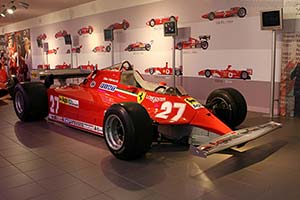
Featured is one of the first Turbo Ferraris; the 126 CK. The pictured machine is chassis 052, which was used by Villeneuve to score his back-to-back victories in Monaco and Spain in 1981. It is currently on display in the Galleria Ferrari; the company's fabulous new museum.

Article by Wouter Melissen, last updated on 05 / 21 / 2007

Add your comments on the Ferrari 126 CK


General specifications
Country of origin Italy
Chassis number 052
Numbers built 8
Produced in 1981
Body design Mauro Forghieri / Antonio Tomanini

Major wins
  • 1981 Monaco Grand Prix (Gilles Villeneuve in 052)
  • 1981 Spanish Grand Prix (Gilles Villeneuve in 052)

Engine
Configuration Type 021 120º V 6
Location Mid, longitudinally mounted
Weight 177 kilo / 390.2 lbs
Construction cast-iron block, light alloy head
Displacement 1.496 liter / 91.3 cu in
Bore / Stroke 81.0 mm (3.2 in) / 48.4 mm (1.9 in)
Compression 6.5:1
Valvetrain 4 valves / cylinder, DOHC
Fuel feed Lucas Fuel Injection
Aspiration Two KKK Turbos

Drivetrain
Chassis/body composite body on aluminium monocoque chassis
Front suspension double wishbones, upper rocker arms, lower wishbone, inboard spring/damper units
Rear suspension upper arm, lower wishbone, single central radius arm
Steering rack-and-pinion
Brakes Brembo ventilated discs, all-round
Gearbox Ferrari Type 021 5 speed Manual
Drive Rear wheel drive

Dimensions
Weight 619 kilo / 1364.7 lbs
Length / Width / Height 4468 mm (175.9 in) / 2110 mm (83.1 in) / 1025 mm (40.4 in)
Wheelbase / Track (fr/r) 2719 mm (107 in) / 1761 mm (69.3 in) / 1626 mm (64 in)

Performance figures
Power 540 bhp / 403 KW @ 11500 rpm
Torque 378 Nm / 279 ft lbs @ 9500 rpm
BHP/Liter 361 bhp / liter
Power to weight 0.87 bhp / kg

Resources
Useful links


Ultimatecarpage.com - All Cars - Contact us - Privacy Statement - Top © 1998 - 2009 Ultimatecarpage.com