Page 1 of 2 Next >> After the First World War, two novelties were introduced to motor racing that would change the outlook of the sport for many years to come. First off was the engine displacement limit, which was briefly enforced in 1914, but for the 1920 season the first global limit was set.Since that day displacement limits have been used to regulate the sport and they have directly resulted in the introduction of forced induction engines. The other long lasting novelty was the straight eight engine, many of which were based on Ettore Bugatti's pioneering airplane engine design.
One of the great advantages of the three-litre limit set in 1920 was that cars from both sides of the Atlantic could compete in all races held. Being so shortly after the War, not many competitive race cars were running and the French and British ban on racing did not help much either. In 1919 and 1920 only two major races were on the agenda; the Targa Florio road race and the 500 Mile Sweepstake at Indianapolis. The ban was lifted at the end of the 1920 season. The most prominent race added on the calender for 1921 was the French Grand Prix at Le Mans.
Only three or four European manufacturers took part in these races, of which the French Ballot was the most advanced with a double overhead camshaft, four valve per cylinder 'eight'. A Sunbeam with a double overhead camshaft 'six' made a brief appearance, but it was withdrawn before it ever raced. Peugeot started racing again with the four cylinder Grand Prix cars of 1914, before they set out to design an 'eight' of their own. It arrived in 1920 and was the most complex of them all, featuring three camshafts and five valves per cylinder. Poor reliability let it down at its debut on the 1920 Indy 500 Mile race, after which Peugeot withdrew from motor racing.
In the United States, the Duesenberg brothers designed and constructed a straight-eight racer of their own. They had already experience with building successful race car engines, with a second place finish in the 1916 Indy 500 as the best result. In the War years the brothers constructed various marine and aero engines, including various straight-eights and a V16. Much like the Bugatti engine, the Duesenberg 'eight' was made up of two blocks of four cylinders. Each cylinder featured two exhaust and one inlet valves, operated by a single overhead camshaft. The camshaft was driven by a shaft connected to the crank.
The 114 bhp engine was installed in a ladder frame. Mated to the engine was a three speed gearbox, which was one gear down on the competition, but the engine offered plenty of low end torque to compensate for that. The chassis was fitted with live axles front and rear. Each corner was equipped with a semi-elliptic leaf spring and a Monroe friction damper. The first cars, introduced in 1920, were fitted with rear brakes only, which let the Duesenbergs down on road races in the 1920 season. Page 1 of 2 Next >>

 Ultimatecarpage.com
> Cars by brand
> United States
> Duesenberg
Ultimatecarpage.com
> Cars by brand
> United States
> Duesenberg
 Racing cars
> Pre 1950 GP
Racing cars
> Pre 1950 GP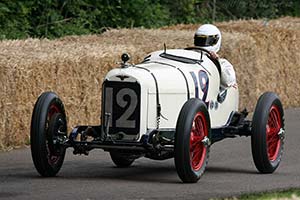
 After the First World War, two novelties were introduced to motor racing that would change the outlook of the sport for many years to come. First off was the engine displacement limit, which was briefly enforced in 1914, but for the 1920 season the first global limit was set.Since that day displacement limits have been used to regulate the sport and they have directly resulted in the introduction of forced induction engines. The other long lasting novelty was the straight eight engine, many of which were based on Ettore Bugatti's pioneering airplane engine design.