Page 1 of 2 Next >> By the early 1960s the Ford Motor Company decided to adopt a more youthful image. They felt one of the best ways to do so was to go out and win races in general and the 24 Hours of Le Mans in particular. Due to the gentleman's agreement between the three big American companies to stay out of racing, Ford desperately lacked the experience or know-how to take on the specialized, European manufacturers. Fortunately, the third ingredient required, money, was available in abundance. In an attempt to get into racing quickly and easily, Ford tried to buy the entire Ferrari operation. When the negotiations turned sour, Henry Ford II and his men did not give up, but instead decided to learn the Europeans a lesson with a completely new Ford racer.
Ford already gave backdoor support to Carroll Shelby for his Cobra racing cars, but in the end having to the share the credits with Shelby and AC Cars was not to the company's liking. In 1963 the decision was made to build a prototype sports racer that, unlike the Cobra, was built to score overall victories. They were realistic enough to realise that outside help was needed and after closely looking at companies like Lotus and Cooper, Ford eventually teamed up with Lola. This Eric Broadley run company had just completed a Ford-powered, mid-engined sports racer that would form the ideal basis for the new project. A new company called Ford Advanced Vehicles (FAV) was founded, which would be responsible for the engineering and assembly of the cars. The chassis and body panels were made by specialists Abbey Panels. Broadley was responsible for the overall design, fellow Englishman Len Bailey took care of the chassis design and John Wyer was hired as team manager.
Bailey's chassis design closely followed that of the Lola Mk VI GT with the initially used aluminium replaced by steel for additional durability. Broadley was not very happy with the added weight, but Ford felt it was necessary to cope with the heavy and powerful engines proposed for the new car. The all aluminium, dry-sump Ford Fairlane engine was also carried over from the Lola. In good American tradition, this V8 featured a central camshaft with push-rod operated overhead valves. It was intended to be used as a stop-gap until a four-cam version would become available. In later years one of these Indy-racing derived engines was indeed fitted, but the racing and production cars all featured OHV engines. The Fairlane engine displaced just under 4.2 litres and produced a decent 350 bhp. It was mated to a Colotti four speed gearbox. For the design of the all-round independent suspension highly advanced computers were used. The neatly packaged car was tightly clothed in a fibreglass body. For easy access, the doors were well cut into the roof.
The first two Ford GTs were completed in time to take part in the Le Mans test day in April of 1964. It was a disastrous day as the first car was destroyed on the Mulsanne Straight and the other damaged. The bodywork generated considerable lift at high speeds to the extent that the car would try to go airborne. Severe overheating was another problem discovered in the test. Back in the UK the nose of the car was considerably modified to improve the high speed handling and cooling characteristics. These improvements helped, but the new cars still proved very fragile and in 1964 not one car managed to reach the finish. Many of the retirements were attributed to the Colotti gearbox, which was eventually replaced by a ZF five speed gearbox. There was also a shortage of Fairlane engines, which led to the implementation of the larger cast-iron engines used by Shelby in his Cobras. It produced considerably more power and torque, despite being only slightly heavier. Eventually the Fairlane engine was discarded altogether in favour of the Cobra V8. Page 1 of 2 Next >>

 Ultimatecarpage.com
> Cars by brand
> United States
> Ford
Ultimatecarpage.com
> Cars by brand
> United States
> Ford
 Racing cars
> Other Sportscars
Racing cars
> Other Sportscars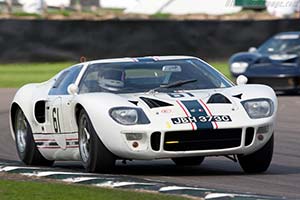
 By the early 1960s the Ford Motor Company decided to adopt a more youthful image. They felt one of the best ways to do so was to go out and win races in general and the 24 Hours of Le Mans in particular. Due to the gentleman's agreement between the three big American companies to stay out of racing, Ford desperately lacked the experience or know-how to take on the specialized, European manufacturers. Fortunately, the third ingredient required, money, was available in abundance. In an attempt to get into racing quickly and easily, Ford tried to buy the entire Ferrari operation. When the negotiations turned sour, Henry Ford II and his men did not give up, but instead decided to learn the Europeans a lesson with a completely new Ford racer.